Freedom of choice ease of use and the formation of interface preferences

Author(s) : Kyle B. Murray; Gerald Häubl

Assumptions and base statements


Incumbent: user’ used interface (either it have been chosen or assigned)


Human skills evolves with practices and habits. By repeating a pattern or using an interface they can get use to the skill level raise.


Cognitive-styles are a main way of thinking while reading this article. The authors take as an example the fact that freedom of choice affects interface preferences, the power law of practice has important implications. Choice and freedom matter in term of skill acquisition.


H1: Task completion time is lower for individuals who were initially constrained to using on interface, as compared to individuals who were always free to choose which interface they used.


Every little thing or detail is important:

– It take less than 50 milliseconds (Lindgaard et al. 2006) for a visitor to form an evaluation of a website

– Saving consumers as little as 15 to 20 seconds in a website can lead to a gain of market share as large as 100%


High skill, from higher practical, for an user imply an equal time-saving in his browsing experience, and so costs gets reduced.


H2: Preference for a particular interface is higher among individuals who were initially constrained to using interface than among those who were free to choose which interface they used.

H3: The effect of freedom of choice on interface preference is mediated by (incumbent interface) task completion times.


While it seems that it is preferable to constrain users’ choices, we have to take care of the psychological reactance. This phenomenon is well known and describe that when users are restrained they create a psychological reactance.

It also infer the perceived ease of use of a particular interface :

H5: The perceived ease of use of a particular interface is lower for individuals who were initially constrained to using that interface than for those who were always free to choose which interface they used.

H6: The effect of initial freedom of choice on interface preference is mediated by the incumbent’s perceived ease of use.

H7: (edited to make increase the understanding)Assuming a new interface is up and choice is given to visitors: previous visitors who were constrained and have created a psychological reactance are mostly expected to change for the new interface, and should perceived the incumbent to be much more difficult to use. No such difference will be noticed among individuals who prefer the incumbent or where free of choice before.


To test these hypothesis they introduce and test a model that links the impact of being able to ether choose or not among different interfaces on the perceived ease of use and users’ interface preference.


The tests lead to a simple ascertainment which is that the psychological reactance is a strong part in the users’ browsing experience. 


It is quite paradoxical because if users are constrained they will be more likely to move on an alternative interface if this choice come up. But they will have more skills and find information quickly compared to users which can choose the interface they want. Moreover it is noticeable that unconstrained users can develop more general skills, allowing them to switch with use between interfaces.


There is many counterparts to the constrained interface, mostly this is about ease of use perception and lack of loyalty for the customers. But even if the psychological reactance is important, we can read that people could also stay even if they have the opportunity to move on because it would be too much of a burden to do so.


Restrictions and constrained applications or interface can lead to some market opportunities for the competitors. The authors smartly pick the Apple’s example with the emphasis of the well known sentence: "Think Different". They used idea of being free to choose an alternative solution to a product which can be overwhelming for the user in a long-term use.


The word of the end is that when users feel that their freedom of choice has been constrained, they tend to react negatively and become more likely to choose a competitor.

KM UK Syllabus

Author(s) : Jean-Eric PELET

Students are encouraged to register on each of these social networks: Facebook, Twitter and LinkedIn in order to understand the course with more accuracy.

Objectives

  • Students will understand why the economy increasingly moves towards a knowledge based economy, and get the ability to manage knowledge becomes a matter of competitive survival.

Description

  • This course examines the impact of Knowledge Management and the continuously growing use of the Internet on traditional methods of collaboration and knowledge sharing. It aims at presenting the related business functions which enable and support them. It explores the existing and potential future uses of the Internet for the management of knowledge across a range of product categories.
  • It also investigates the use and utility of the Internet on both sides:
    • as a strategy for business,
    • as a medium to increase effectiveness, efficiency, and competitiveness,
    • as a technique across a range of different kinds of missions which influence how businesses operate today.

    Objectives

  • The aim of this lecture is to enable students to investigate, contextualize, and critically evaluate the application of Internet technologies in CRM and strategy.
  • The lecture will draw from theory and current practice across a wide range of e-marketing contexts to enhance awareness of the theory and practice of KM.
  • The course will prepare students for the opportunities and challenges of CRM by introducing them to a variety of areas covering the CRM landscape.
  • The course also aims to develop understanding of the processes of value creation and the performance metrics used to evaluate the effectiveness of digital strategies.

    Intended Learning Outcomes:

  • Demonstrate knowledge and understanding of key features around the CRM landscape and issues in CRM contexts.
  • Demonstrate knowledge and understanding of CRM strategies including research, consumer behaviour, and market segmentation issues.
  • Demonstrate knowledge and understanding of the CRM planning process including frameworks, implementation, and evaluation
  • Demonstrate comprehensive understanding of all aspects of CRM management through the construction of a CRM plan appropriate to a business scenario.
  • Critically apply theories by evaluating marketing plan in the context of implementation and performance metrics.

    Question for marketers

  • How can the Internet be used to support the different stages of the customer lifecycle?
  • How do I implement permission marketing?
  • What do personalization and mass customization mean and how should I apply them in my marketing?

    Keywords

    Knowledge management, Intellectual Capital management, User Generated Content, managerial needs, intangible assets, case study.

  • Programming

    1. Introduction to knowledge management
    2. The nature of knowing
    3. Intellectual capital
    4. Strategic management perspectives
    5. Organisational learning
    6. The learning organisation
    7. Knowledge management tools: component technologies
    8. Knowledge management systems
    9. Enabling knowledge contexts and networks
    10. Implementing knowledge management

    Evaluation: theoretical and practical

    The weighting of each assessment activity is indicated in the table below:

    Theory: Synthesis of an academic paper Practice – Creation of the CMS Practice – Participation to the main platform Total
    33% 33% 33% 100%

    In practice

    • Web2.0 tools are discussed and implemented on each website created by groups of students. A description of the knowledge management platforms will help students to build their knowledge management strategy efficiently;
    • Readings of up to date research papers dedicated to knowledge management will provide a deep understandings of the materials covered during the lectures.

    Objective

    • You are warmly encouraged to read this chapter in order to understand the whole lecture:
      • Pelet J.-É. (2010), Using Web 2.0 Social Computing Technologies to Enhance the Use of Information Systems in Organizations, IGI Global, pp.101-132, DOI: 10.4018/978-1-61692-904-6.ch007, http://bit.ly/fJVhWI
    • Following the example of this chapter, you are required to build a Content Management System platform related to the following topic: Knowledge Management and to one of the themes of your choice.
    • Number of students for one platform: 4

    Method

      1. A Knowledge Management platform about Knowledge Management is under construction on this website: http://knowledgemanagementforall.wordpress.com/
      2. Students make groups related to one theme of their choice to make it growing by addition of content
      3. Each student is asked to chose a topic among the following to make the website growing

    Themes:

      1. Enterprise 2.0,
      2. Collaboration,
      3. KM conversations,
      4. Knowledge Management,
      5. Knowledge,
      6. Knowledge sharing,
      7. Innovation,
      8. Design,
      9. Research,
      10. Social media,
      11. Business,
      12. Mobility,
      13. Strategy,
      14. Social,
      15. Technology,
      16. Mobile phones,
      17. Mobile,
      18. Emerging markets,
      19. Design thinking,
      20. Digital activism,
      21. Disruptive innovation,
      22. Management,
      23. Education,
      24. Entrepreneurship,
      25. Social network

    Topics:

      1. Setting the Tone,
      2. Technology and innovation,
      3. KM Networking,
      4. Human Resources,
      5. Education and Financial Perspectives in KM,
      6. KM Standards, Regulations and Tools/Techniques,
      7. KM Applications in Organizations

     These topics reveal to be useful in order to create CMS related to them

      1. The CMS of each group must be connected to websites related to the same topic, using RSS links or widgets, linking their content to student’s posts
      2. Groups choose a responsible of their platform and manage to prepare it according to the chosen topics.
      3. Groups of students must provide RSS links of their own group platform to the responsible once their synthesis is done
      4. This drawing summarizes what is expected:


  •  

    work project explanation
    Figure 1 : presentation of the projectEach group has to create its pages on the platform related to the chosen topicsstudents group
    Figure 2 : presentation of each group


  • Each theme must provide:
    • Explanation and definition of the topic
    • Presentation of the topic described among the pages on the platform
  • Students are required to prepare for each theme:
      1. Identification / presentation of themes
      2. Importance of the subject in relation to knowledge management
      3. Presentation of the Text / Sites listed / RSS found
      4. Insertion sites within a del.icio.us account
      5. Write short summaries of the sites / texts / rss

        Multimedia content is VERY welcome (pictures, videos, sounds, presentations, etc

      In theory

    • In order to gain an in-depth understanding of a topic of interest, the student committed to Knowledge Management, will choose an article to synthesize it.
    • This article can be chosen:
    • Among recent publications from top ranked journals (A* and A only) issued from Marketing databases
    • From articles delivered by the lecturer.
    • This synthesis of 2-pages (A4 format) is a summary of this article, mentioning what looks most important to you. It necessarily contains:

        • A literature review,
        • hypothesis,
        • results,
        • bibliographical references used in the synthesis.
    • This work will appear on the Content management System of the group the student takes part of, in order for the other students to read the works of their colleagues and eventually grade it. Students will also print this synthesis to get graded by the lecturer.
      1. Choose an article among the following one (go to the page)
      2. Write the title in front of your name on this page (clic here)
      3. Write a synthesis following this model and copy paste it from Word to the platform of the classroom by creating a post: one post for one synthesis of article
      4. All the necessary guidelines to write this synthesis are summarized on this page: Writing the synthesis of an academic article

    Course methodology

    1. Class lecture and discussions
    2. In and outside of class team/individual participation to the course knowledge management
    3. Team projects and presentation
    4. Individual research paper
    5. Outside of class reading/participation to the platform of the lecture
    6. Popular Website visits (in and outside of class)

    Individual research paper

    • The paper should be an independent piece of research work based on a critical analysis of secondary research written in the form of a publishable journal article outline, accompanied by at least five references of key source material contributing to the article.
    • The paper should be on one of the chosen topics from the theme of E-Marketing Environment and should clearly outline a research context, define a specific research problem, outline challenges and opportunities presented by the issue to marketers, provide a comprehensive theoretical background and rationale, and outline some marketing implications and recommendations.
    • (Examples would be the implications of the internet landscape in certain emerging economies; issues around country and market attractiveness for e-marketing; issues and challenges around converge of certain types of technologies; issues around the digital divide; issues around certain ethical and legal challenges; issues around ownership of internet and content etc.)

    Team Projects

    • Student teams comprised of approximately 3 students will be assigned several tasks such as developing a knowledge management plan for an organization that does not yet use the online environment, such as the traditional brick and mortar companies;
    • Each team will be required to turn in a detailed paper and complete individual and peer evaluations;
    • All these projects must be created on websites so your colleagues are able to watch it;
    • Each group will be required to develop an individual website.
    • Guidelines for these websites will be posted on the platform class website.
    • A number of online providers offer free websites and offer detailed instructions on how to complete this website.
    • This assignment can also be completed in any number of HTML editors (Microsoft FrontPage, Dreamweaver, etc.).
    • However, these programs will not be covered in class so students will have to learn one of these programs on their own.
    • A link to your Web Site must be submitted electronically via email.

    Classroom Courtesy

    • Since every student is entitled to full participation in class without interruption, all students are expected to be in class and prepared to begin on time. Please be considerate of fellow classmates and turn off all beepers, pagers, cell phones, etc. Students involved in discourteous behavior, rude/unnecessary comments, talking during class, sleeping, and other disruptions will not be tolerated (you will be required to leave).
    • Laptops will only be permitted if used for in-class note taking. Cell phones should also be out of sight while in class (and absolutely no text messaging).

    Learning and Teaching Activities:

    • Lecture style presentations will introduce students to theoretical underpinnings in course content. Seminar sessions will include case study interrogation, in-class presentations, class discussions, and audio-visual material (where appropriate) and will reinforce theoretical learning, foster application and analysis skills in enabling students to choose and discuss appropriate international marketing strategies and tactics. Online support will be available for disseminating teaching, learning, and assessment materials and for facilitating student discussion and feedback.
    • In line with the KMCMS’s Equal Opportunities Service policy, all appropriate support will be provided to meet the needs of differently-abled students including adaptation of learning materials where appropriate.
    • Students will be required to keep up with all the learning and teaching activities in order to successfully achieve all the mandated learning outcomes. The module will require considerable student input of independent reading and preparation daily to keep up with prescribed reading.

    Course Materials

    Textbook

    Jashapara, Knowledge Management: An Integrated Approach, 2nd Edition, © Pearson Education Limited 2011

    Bibliography

    • Alavi, M., & Leidner, D. E. (2001). Review: Knowledge management and knowledge management systems: Conceptual foundations and research issues. MIS Quarterly, 25(1), 107-136.
    • Aldridge, A., Forcht, K., & Pierson, J. (1997). Get linked or get lost: Marketing strategy for the internet. Internet Research: Electronic Networking Applications and Policy, 7(3), 161-169
    • Argyris, C. (1990). Overcoming organizational defenses: Facilitating organizational learning. Boston: Allyn and Bacon.
    • Bacharach, M., & Gambetti, D. (2001). Trust in signs. In K. Cook (Ed.), Trust in society (pp. 148-184). New York: Russell Sage Foundation.
    • Bergin, J. (2002). Teaching on the Wiki Web, ACM SIGCSE Bulletin, 34(3), 195.
    • Bernoff, J., Pflaum, C. N., & Bowen, E. (2008, October 20). The growth of social technology adoption: 2/3 of the global Internet population visit social networks. Cambridge, MA: Forrester Research. Retrieved from  http://www.forrester.com/Research/Document/Excerpt/0,7211,44907,00.html
    • Bhatt, G. (2000). Information dynamics, learning, and knowledge creation in organizations. The Learning Organization: An International Journal, 7(2), 89-98.
    • Choo, C. W., & Bontis, N. (Eds.). (2002). The strategic management of intellectual capital and organizational knowledge. New York: Oxford University Press.
    • Cotter, S. (2002). Taking the measure of e-marketing success. Journal of Business Strategy, 23(2), 30 – 37.
    • Coviello, N. E., Milley, R., & Marcolin, B. (2001). Understanding IT-enabled interactivity in contemporary marketing. Journal of Interactive Marketing, 15(4), 18-33.
    • Damanpour, F. (1992). Organizational size and innovation. Organization Studies, 13(3), 375–402.
    • Davenport, T. H., & Prusak, L. (1998). How organizations manage what they know. Boston: Harvard Business School Press.
    • Donath, J. (2007). Signals in social supernets. Journal of Computer-Mediated Communication, 13(1). Retrieved from http://jcmc.indiana.edu/vol13/issue1/donath.html
    • Drucker, P. F. (1988). The coming of the new organization. Harvard Business Review, 66(1).
    • Dunbar, R. I. M. (1996). Grooming, gossip, and the evolution of language. Cambridge, MA: Harvard University Press.
    • Dunbar, R. I. M. (2004). Gossip in evolutionary perspective. Review of General Psychology, 8(2), 100-110.
    • Eisenhardt, K. M., & Brown, S. L. (1999). Patching: Re-stitching business portfolios in dynamic markets. Harvard Business Review, 78(1), 91-101.
    • EMarketer. (2007, June). User Generated Content: Will Web 2.0 Pay its Way?
    • Fahey, L., & Prusak, L. (1998). The eleven deadliest sins of knowledge management. California Management Review, 40(3).
    • Foremski, T. (2005). If Internet 1.0 was a disruptive technology…where is the train wreck? SiliconValleyWatcher. Retrieved February 21, 2005, from http://www.siliconvalleywatcher.com/mt/archives/2005/02/if_Internet_10_1.php
    • Garrison, D., & Anderson, T. (2003). E-learning in the 21st century: A framework for research and practice. London: Routledge.
    • Godin, S. (2009). Seth Goodin’s blog. Retrieved from http://www.sethgodin.com/
    • Goffee, R., & Jones, G. (2001). Followership: It’s personal, too. Harvard Business Review, 79(11), 148-149.
    • Good, D. (2000). Individuals, interpersonal relations, and trust. In D. Gambetta (Ed.), Trust: Making and breaking cooperative relations (pp. 31-48). Oxford, UK: University of Oxford Press.
    • Grant, R. M. (1996). Toward a knowledge-based theory of the firm [in Special issue: Knowledge and the Firm]. Strategic Management Journal, 17(2), 109-122.
    • Granovetter, M. S. (1983). The strength of weak ties: A network theory revisited. Sociological Theory, 1, 201-233.
    • Gupta, K. S. (2008). A comparative analysis of knowledge sharing climate. Knowledge and Process Management, 15(3), 186 – 195.
    • Gupta, K. S. (2001, July-September). Knowledge management and empowerment: A conceptual relationship. Udyog Pragati, 25(3), 28-35. Bombay: NITIE.
    • Herbig, P., & Hale, B. (1997). Internet: The marketing challenge of the twentieth century. Internet Research: Electronic Networking Application and Policy, 7(2), 95-100.
    • Hall, R. H., & Hanna, P. (2004). The impact of Web page text: Background color combinations on readability, retention, aesthetics, and behavioral intention. Behavior and Information Technology, 23(3), 183-195.
    • Hill, A., & Scharff, L. V. (1997). Readability of websites with various foreground/background color combinations, font types and word styles. Proceedings of 11th National Conference in Undergraduate Research, 2, 742-746.
    • Ho S. Y. (2006). The attraction of Internet personalization to web users. Electronic e-commerce markets, 16(1) 41-50.
    • Hong J., Kianto A., & Kyläheiko, K. (2008). Moving culture and the creation of new knowledge and dynamic capabilities in emerging markets. Knowledge and Process Management, 15(3), 196-202.
    • Horrigan, J., Boase, J., Rainie, L., & Wellman, B. (2006). The strength of Internet ties. Pew Internet & American Life Project report. Retrieved August 10, 2007, from http://www.pewInternet.org/PPF/r/172/report_display.asp
    • IAB. (2008). Platform status report: User Generated Content, Social Media, and Advertising — An Overview. New York: Interactive Advertising Bureau. Retrieved April 2008, from http://www.iab.net/media/file/2008_ugc_platform.pdf
    • Kogut, B., & Zander U. (1992). Knowledge of the firm, combinative capabilities, and the replication of technology. Organization Science, 3, 383-397.
    • Kraemer K. L., Dedrick J., Melville N. P., & Zhu K. (2006). Global e-commerce, impacts of national environment and policy. Cambridge, UK: Cambridge University Press.
    • Kujansivu, P., & Lönnqvist, A. (2008). Business process management as a tool for Intellectual Capital management. Knowledge and Process Management, 15(3), 159-169.
    • Ladd, A., & Ward, M. A. (2002). An investigation of environmental factors influencing knowledge transfer. Journal of Knowledge Management Practice.
    • Lamb, B. (2004). The standard wiki overview. EDUCASEUSE Review, 39(5), 36-48.
    • Lee C. S. (2001). An analytical framework for evaluating e-commerce business models and strategies. Internet Research, 11(4), 349-359.
    • Leuf, B., & Cunningham, W. (2001). The WIKI WAY: Quick Collaboration of the Web. Reading, MA: Addison-Wesley.
    • Lev, B. (2001). Intangibles: Management, measurement and reporting. Washington DC: Brookings Institution Press.
    • Levenburg, N. (2005). Delivering customer value online: An analysis of practices, applications and performance. Journal of Retailing and Consumer Services, 12(5), 319-331.
    • Levitt, T. (1983). The globalization of markets. Harvard Business Review, 61(3), 92–102.
    • Lindgren, R., & Henfridsson, O. (2002). Using competence systems: Adoption barriers and design suggestions. Journal of Information & Knowledge management, 5(2).
    • Lönnqvist, A., Kujansivu, P., & Antola, J. (2006). Are management accountants equipped to deal with intellectual capital? The Finnish Journal of Business Economics, 3, 355-368.
    • Lukka, K., & Kasanen, E. (1995). The problem of generalizability: Anecdotes and evidence in accounting research. Accounting, Auditing and Accountability, 8, 71-90.
    • Mattelart, A. (1996). The invention of communication. Minneapolis: University Minnesota Press.
    • McDermott, C., & O’Connor, G. (2002). Managing radical innovation: An overview of emergent strategy issues. The Journal of Product Innovation Management, 19, 424-438.
    • Milgram, S. (1967). The small world problem. Psychology Today, 1, 61–67.
    • Murali, R. (2009). Designing knowledge management systems for teaching and learning with Wiki technology. Journal of Information Systems Education.
    • Retrieved August 27, 2009 from http://findarticles.com/p/articles/mi_qa4041/is_200510/ai_n15715725/
    • Murdoch, R. (2009). Global Media Entrepreneur.
    • Nardi, B. A., Whittaker, S., Isaacs, E., Creech, M., Johnson, J., & Hainsworth, J. (2002). Integrating communication and information through ContactMap. Communications of the ACM, 45(4), 89-95.
    • Newell, S., Scarbrough, H., Swan, J., & Hislop, D. (1999). Intranets and knowledge management: Complex processes and ironic outcomes. Proceedings of the 32nd Hawaii International Conference on Systems Sciences. New York: IEEE.
    • Nielsen. (2009, March). Global faces and networked places: A Nielsen report on social networking’s new global footprint. Retrieved from http://blog.nielsen.com/nielsenwire/wp-content/uploads/2009/03/nielsen_globalfaces_mar09.pdf
    • Nielsen. (2007, October). Online global consumer study. Retrieved October 1, 2007, from http://en-us.nielsen.com/main/news/news_releases/2007/october/Word-of-Mouth_the_Most_Powerful_Selling_Tool__Nielsen_Global_Survey
    • Nonaka, I., & Takeuchi, H. (1995). The knowledge-creating company. How Japanese companies create the dynamics of innovation. New York: Oxford University Press.
    • OECD. (1996). The knowledge-based economy. Paris: OECD.
    • OECD. (1999). S&T indicators: Benchmarking the knowledge based economy. Paris: OECD.
    • OECD. (2001). Science, technology and industry scoreboard 2001: Towards a knowledge based economy. Paris: OECD.
    • OECD. (2007). OECD science, technology and industry scoreboard 2007. Retrieved from
    • http://www.oecd.org/document/21/0,2340,en_2649_33703_16683413_1_1_1_1,00.html
    • O’Reilly, T. (2005). What is web 2.0? Retrieved from http://oreilly.com/web2/archive/what-is-web-20.html
    • Pelet J.-É. (2010), Using Web 2.0 Social Computing Technologies to Enhance the Use of Information Systems in Organizations, IGI Global, pp.101-132, DOI: 10.4018/978-1-61692-904-6.ch007, http://bit.ly/fJVhWI
    • Pelet, J. É., & Papadopoulou P. (2009). Consumer responses to colors of e-commerce websites: An empirical investigation. In K. Kang (Ed.), E-Commerce. Vienna, Austria: InTech. Retrieved from http://intechweb.org
    • Pelet, J. É. (2008, June). Effects of the color of e-commerce websites on the memorization and on the intention of purchase of the Net surfer. Unpublished thesis. Nantes University, France.
    • Pillania, R. K. (2008). Innovations and knowledge management in emerging markets. Knowledge and Process Management, 15(3), 184-185. Hoboken, NJ: Wiley Publishers.
    • Pillania, R. K. (2007). Leveraging which knowledge in the globalization era? Indian facet. The Learning Organisation, 14(4), 313-320. Bingley, UK: Emerald Group Publishing Limited.
    • Poon, S. P. H., & Swatman, P. M. C. (1999). A longitudinal study of small business internet commerce experiences. International Journal of Electronic Commerce, 3(3), 21-34.
    • Powell, T. C., & Dent-Micallef, A. (1997). Information technology as competitive advantage: The role of human, business and technology resources. Strategic Management Journal, 18(5), 375-405.
    • Raub, W., & Weesie, J. (1990). Reputation and efficiency in social interactions: An example of network effects. The American Journal of Sociology, 96(3), 626-654.
    • Rapp, A., Schwillewaert, N., & Hao, A. W. (2008). The influence of market orientation on e-business innovation and performance: The role of the top management team. The Journal of Marketing Theory and Practice, 16(1), 7-25.
    • Reisman, S. (2003). Electronic learning communities. Charlotte, NC: Information Age Publishing.
    • Seetharaman, A., Lock, T., Low, K., & Saravanan, A. S. (2004). Comparative justification on intellectual capital. Journal of Intellectual Capital, 5(4), 522-539.
    • Simeon, R. (1999). Evaluating domestic and international Web-site strategies. Internet Research: Electronic Networking Applications and Policy, 9(4), 297 – 308.
    • Storey, J., & Barnett, E. (2000). Knowledge management initiatives: Learning from failure. Journal of Knowledge Management, 4(2).
    • Sveiby, K. (1997). The new organizational wealth. San Francisco, CA: Berrett Koehler.
    • Von Krogh, G. (2000). Enabling knowledge creation. London: Oxford University Press.
    • Voola, R. (2005). An Examination of the Effects of Firm Capabilities on E-Business Adoption and Competitive Advantage: A Resource Based Perspective. Unpublished doctoral thesis. Newcastle University, UK.
    • W3C. (2008). Publication version 1.1 of the AccessiWeb repository. Cambridge, MA: W3C. Retrieved June 9, 2008, from http://www.w3c.org/
    • Wagner, C. (2004). Wiki: A technology for conversational knowledge management and group collaboration. Communications of the Association for Information Systems, 13, 265-289.
    • Warne, L., Ali, I. M., & Pascoe, C. (2003). Team building as a foundation for knowledge management: Findings from research into social learning in the Australian Defence Organization. Journal of Information & Knowledge Management, 2(2), 93-106.
    • Welling, R., & White, L. (2006). Measuring the value of Internet Web sites. Journal of Internet Commerce, 5(3), 127-145.
    • Wellman, B., Garton, L., & Haythornthwaite, C. (1997). Studying online social networks. Journal of Computer Mediated Communication, 3(1). Retrieved August 10, 2007, from http://jcmc.indiana.edu/vol3/issue1/garton.html
    • Wellman, B., & Gulia, M. (1999). The network basis of social support: A network is more than the sum of its ties. In Networks in the Global Village (pp. 83-118). Boulder, CO: Westview Press.
    • Whittaker, S., Jones, Q., & Terveen, L. (2002). Contact management: Identifying contacts to support long-term communication. In Proceedings of the 2002 ACM conference on Computer Supported Cooperative Work (pp. 216-225). New York: ACM Press.
    • Wiig, K. M. (2000). Knowledge management: An Emerging discipline rooted in a long history. In Knowledge Horizons (pp. 3-26). Boston: Butterworth-Heinemann.
    • Wikipedia. (2009a). Facebook. Retrieved from http://en.wikipedia.org/wiki/Facebook
    • Wikipedia. (2009b). Twitter. Retrieved from http://en.wikipedia.org/wiki/Twitter
    • Wikipedia. (2009c). Linkedin. Retrieved from http://en.wikipedia.org/wiki/Linkedin
    • Wikipedia. (2009d). Friendster. Retrieved from http://en.wikipedia.org/wiki/Friendster
    • Wikipedia. (2009e). Myspace. Retrieved from http://en.wikipedia.org/wiki/Myspace
    • Wikipedia. (2009f). Content management system. Retrieved from http://en.wikipedia.org/wiki/Content_management_system
    • Wikipedia. (2009g). Blog. Retrieved from http://en.wikipedia.org/wiki/Blog
    • Wikipedia. (2009h). Web syndication. Retrieved from http://en.wikipedia.org/wiki/Web_syndication
    • Wikipedia. (2009i). Atom standard. Retrieved from http://en.wikipedia.org/wiki/Atom_%28standard%29
    • Wikipedia. (2009j). WYSIWYG. Retrieved from http://en.wikipedia.org/wiki/WYSIWYG
    • Wikipedia. (2009k). Api. Retrieved from http://en.wikipedia.org/wiki/Api
    • Young, R. (2008). Back to basics: Strategies for identifying, creating, storing, sharing and using knowledge. In From Productivity to Innovation: Proceedings from the Second International Conference on Technology and Innovation for Knowledge management. Tokyo: Asian Productivity Organization. Retrieved August 2009, from http://www.apo-tokyo.org/00e-books/IS-34_FromProdToInnovation/IS-34_FromProdToInnovation.pdf
    • Zhou, A. Z., & Fink, D. (2003). The intellectual capital web: A systematic linking of intellectual capital and knowledge management. Journal of Intellectual Capital, 4(1), 34-48.
  • UK CRM – Syllabus

    Author(s) : Jean-Eric PELET


    Students are encouraged to register on each of these social networks: Facebook, Twitter and LinkedIn in order to understand the course with more accuracy.

    Objectives

    Description

    • This course develops critical student perspectives into Customer Relationship Management (CRM) and technologies enabling the Internet and their uses in marketing and business management.
    • It enables students to understand the theory and practice of marketing and business strategy in the context of the dynamic electronic and digital landscape. It is now essential for businesses to engage with the complexities of Internet technologies in order to achieve competitive success. This fast changing environment throws up both opportunities and challenges to businesses.
    • The course will enable students to gain a deeper understanding of the CRM and strategic aspects of business conducted within the electronic context.

      Objectives

    • The aim of this lecture is to enable students to investigate, contextualize, and critically evaluate the application of Internet technologies in CRM and strategy.
    • The lecture will draw from theory and current practice across a wide range of e-marketing contexts to enhance awareness of the theory and practice of CRM.
    • The course will prepare students for the opportunities and challenges of CRM by introducing them to a variety of areas covering the CRM landscape.
    • The course also aims to develop understanding of the processes of value creation and the performance metrics used to evaluate the effectiveness of digital strategies.The course will also:
    • Assess the relevance of the concepts of relationship, direct and database marketing on the internet
    • Evaluate the potential of the internet to support one-to-one marketing, and the range of techniques and systems available to support dialogue with the customer over the Internet
    • Assess the characteristics required of tools to implement one-to-one marketing

      Intended Learning Outcomes:

    • Demonstrate knowledge and understanding of key features around the CRM landscape and issues in CRM contexts.
    • Demonstrate knowledge and understanding of CRM strategies including research, consumer behaviour, and market segmentation issues.
    • Demonstrate knowledge and understanding of the CRM planning process including frameworks, implementation, and evaluation
    • Demonstrate comprehensive understanding of all aspects of CRM management through the construction of a CRM plan appropriate to a business scenario.
    • Critically apply theories by evaluating marketing plan in the context of implementation and performance metrics.

      Question for marketers

    • How can the Internet be used to support the different stages of the customer lifecycle?
    • How do I implement permission marketing?
    • What do personalization and mass customization mean and how should I apply them in my marketing?

      Keywords

    • Customer Relationship Management, relationship marketing, e-marketing, digital marketing, Customer Analytics
    • This course also examines the impact of the Internet on traditional methods of marketing, and more generally, the related business functions which enable and support it. It explores the existing and potential future uses of the Internet for the marketing(s) of goods and services across a range of product categories.
    • It also investigates the use and utility of the Internet on both sides:
      • as a strategy for business,
      • as a medium to increase effectiveness, efficiency, and competitiveness,
      • as a technique across a range of different kinds of missions which influence how businesses operate today.

      Programming

      1. Introduction to CRM and e-marketing
      2. The buzz marketing: developing the company’s profile and communicate quickly
      3. The search engine marketing: developing the company’s visibility on search engines and increase traffic to its site
      4. The co-creation and participation: improving creativity and credibility by the participation of users
      5. The company blogs: create the company’s community of online users
      6. The presence marketing: adopt a new channel of communication, promote immediacy in customer relations
      7. Social networks: building networks to develop business opportunities and career
      8. The ubiquitous marketing: leverage the company’s commercial presence to increase its business

      Evaluation: theoretical and practical

      The weighting of each assessment activity is indicated in the table below:


      Theory: Synthesis of an academic paper Practice – Creation of the CMS Practice – Participation to the main platform Total
      33% 33% 33% 100%

      Objective

      • You are warmly encouraged to read this chapter in order to understand the whole lecture:
        • Pelet J.-É. (2010), Using Web 2.0 Social Computing Technologies to Enhance the Use of Information Systems in Organizations, IGI Global, pp.101-132, DOI: 10.4018/978-1-61692-904-6.ch007, http://bit.ly/fJVhWI
      • Following the example of this chapter, you are required to build a Content Management System platform related to the following topic: Knowledge Management and to one of the themes of your choice.
      • Number of students for one platform: 6

      Method

      Multimedia content is VERY welcome (pictures, videos, sounds, presentations, etc.)

      In theory

        • In order to gain an in-depth understanding of a topic of interest, the student committed to Knowledge Management, will choose an article to synthesize it.
        • This article can be chosen:
        • Among recent publications from top ranked journals (A* and A only) issued from Marketing databases
        • From articles delivered by the lecturer.

      This synthesis of 2-pages (A4 format) is a summary of this article, mentioning what looks most important to you. It necessarily contains:

          • A literature review,
          • hypothesis,
          • results,
          • bibliographical references used in the synthesis.
      • This work will appear on the Content management System of the group the student takes part of, in order for the other students to read the works of their colleagues and eventually grade it. Students will also print this synthesis to get graded by the lecturer.
          1. Choose an article among the following one (see below)
          2. Write the title in front of your name on this page (clic here)
          3. Write a synthesis following this model and copy paste it from Word to the platform of the classroom by creating a post: one post for one synthesis of article

      Course methodology

      1. Class lecture and discussions
      2. In and outside of class team/individual participation to the course knowledge management
      3. Team projects and presentation
      4. Individual research paper
      5. Outside of class reading/participation to the platform of the lecture
      6. Popular Website visits (in and outside of class)

      Individual research paper

      • The paper should be an independent piece of research work based on a critical analysis of secondary research written in the form of a publishable journal article outline, accompanied by at least five references of key source material contributing to the article.
      • The paper should be on one of the chosen topics from the theme of E-Marketing Environment and should clearly outline a research context, define a specific research problem, outline challenges and opportunities presented by the issue to marketers, provide a comprehensive theoretical background and rationale, and outline some marketing implications and recommendations.
      • (Examples would be the implications of the internet landscape in certain emerging economies; issues around country and market attractiveness for e-marketing; issues and challenges around converge of certain types of technologies; issues around the digital divide; issues around certain ethical and legal challenges; issues around ownership of internet and content etc.)

      Team Projects

      • Student teams comprised of approximately 3 students will be assigned several tasks such as developing a knowledge management plan for an organization that does not yet use the online environment, such as the traditional brick and mortar companies;
      • Each team will be required to turn in a detailed paper and complete individual and peer evaluations;
      • All these projects must be created on websites so your colleagues are able to watch it;
      • Each group will be required to develop an individual website.
      • Guidelines for these websites will be posted on the platform class website.
      • A number of online providers offer free websites and offer detailed instructions on how to complete this website.
      • This assignment can also be completed in any number of HTML editors (Microsoft FrontPage, Dreamweaver, etc.).
      • However, these programs will not be covered in class so students will have to learn one of these programs on their own.
      • A link to your Web Site must be submitted electronically via email.

      Classroom Courtesy

      • Since every student is entitled to full participation in class without interruption, all students are expected to be in class and prepared to begin on time. Please be considerate of fellow classmates and turn off all beepers, pagers, cell phones, etc. Students involved in discourteous behavior, rude/unnecessary comments, talking during class, sleeping, and other disruptions will not be tolerated (you will be required to leave).
      • Laptops will only be permitted if used for in-class note taking. Cell phones should also be out of sight while in class (and absolutely no text messaging).

      Learning and Teaching Activities:

      • Lecture style presentations will introduce students to theoretical underpinnings in course content. Seminar sessions will include case study interrogation, in-class presentations, class discussions, and audio-visual material (where appropriate) and will reinforce theoretical learning, foster application and analysis skills in enabling students to choose and discuss appropriate international marketing strategies and tactics. Online support will be available for disseminating teaching, learning, and assessment materials and for facilitating student discussion and feedback.
      • In line with the KMCMS’s Equal Opportunities Service policy, all appropriate support will be provided to meet the needs of differently-abled students including adaptation of learning materials where appropriate.
      • Students will be required to keep up with all the learning and teaching activities in order to successfully achieve all the mandated learning outcomes. The module will require considerable student input of independent reading and preparation daily to keep up with prescribed reading.

      Course Materials

      Textbook

      • Strauss, J., El-Ansary, A., & Frost, R. (2006). e-marketing (4th ed.). Upper Saddle River, NJ: Pearson Education Inc. ISBN 0-13-148519-9.
      • E-commerce : De la stratégie à la mise en œuvre opérationnelle de Henri Isaac, Pierre Volle, et Yann Bréban (Broché – 23 mai 2008)
      • Culture Web : Création, contenus, économie numérique de Xavier Greffe et Nathalie Sonnac (Broché – 14 mars 2008)

      Further readings

      Documents are pdf files

      Download the reader if necessary:


      Get Adobe Acrobat Reader

      Consulting papers

      • Best Practices in Email Marketing > The Ultimate Email Marketing Guidebook: Increasing Subscriber Engagement > Breakthrough Examples of How Brands are Raising the Email Marketing Bar, read
      • Social currency: why brands need to build and nurture social currency by Vivaldi Partners, read
      • Rise of Social commerce: A trail guide for the social commerce pioneer by Lora Cecere et al., read
      • Seven guidelines for achieving ROI from Social Media by eMarketer, read
      • Four ways to get more value from digital marketing by David C. Edelman, read
      • The best of both worlds by Tom Bunzel, read
      • Buzz building: 7 steps to Social Media Marketing Success by Silverpop, read
      • Vital checklist for website redesign by Khrysti Nazzaro, read
      • How to use social media to improve customer service and cut costs by Bob Thompson, read
      • Generate leads with social media strategy: 6 steps to fill up sales funnel by Meclabs, read

      Video

      Go to the post.

      Podcast

      Go to the post.

      Links

      Cloud Marketing

      Digital Social Networks

      Books

      1. Flores L., Volle P., « Potentiel relationnel et impact du site de marque sur la performance marketing », Décision Marketing, n°40, octobre-décembre 2005.
      2. Jayachandran S., Sharma S., Kaufman P. et Raman P., « The Role of Relational Information Processes and Technology Use in customer Relationship Management », Journal of Markeging, vol.69, octobre 2005.
      3. Luo X. et Seyedian M., « Contextual Marketing and Customer-Orientation Strategy for E-Commerce : An Empirical Analysis », International Journal of Electronic Commerce, vol. 8, n°2, hiver 2003, 95-118.
      4. Montoya-Weiss M., Voss G.B., Grewal D., “Determinants of on line channel use an doverall satisfaction with relational multichannnel service provider”, Journal of the Academy of Markegting Sciences, vol. 31, n°4, 2003.
      5. Parasuraman A., Grewdal D., “The impact of technology on the quality-value-loyalty chain : a research agenda”, Journal of Marketing Science, n°28, 1, 2000, 168-174.
      6. Parasuraman A., Zeithaml V.A., Malhotra A., “ES QUAL, A multiple item scale for assessing Electronic Service Quality”, Journal of Service Research, vol. 7, n°3, février 2005.
      7. Senecal S., Nantel J., “The influence of online product recommendations on consumer’s online choices”, Journal of Retailing, 80, 2004.
      8. Thomas J. S., Sullivan U. Y., “Managing Marketing Communications with Multichannel Customers”, Journal of Marketing, vol. 69, october 2005.
      9. Van der Laan J.W., The future of on line food retailing, Food Personnality, janvier 2000.

      Going further

      1. Andrieu O., Créer du trafic sur son site Web, Eyrolles, 2004, Paris.
      2. Cheskin Research, E-Commerce trust study, janvier 1999.
      3. Flores L., Muller B., Egrebi M., Chandon J. L., « Impact des sites de marque : effet de la visite et apport des outils relationnels », Revue Française du Marketing, n°217, 2/5, mai 2008.
      4. March V., L’affiliation, Pourquoi ? Comment ?, Editions d’Organisation, 2004, Paris.
      5. McAlexander J. A., Schouten J. W., Koening H. F., “Building brand community”, Journal of Marketing, vol. 66, Iss. 1, janvier 2002, Chicago.
      6. Moe W., Fader P. S., “Which visits lead to purchases ? Dynamic conversion behaviour at E Commerce Sites, in Mitch Betts, Turning browsers into buyers”, MIT Sloan Management Review, 42, 2, hiver 2000, 8-9.
      7. Niks, Wouter, Plasmeijer P. Et Peelen E., E-commerce, transactiemodel voor internet, Samson, 2000, Alphen a/d Rijn.
      8. Peppers D., Rogers M., One to One manager : Real World lessons in customer relationship management, Capstone Publishing, 2000, Oxford.
      9. Saporta S., Référencement sur le Net : les nouvelles méthodes gagnantes, Editions d’Organisation, 2005, Paris.
      10. Swinkels H., Web Usability bij de Nederlandse e-tailers, een onderzoek naar, 2001.
      11. Turban E., King D., Lee J., Viehland D., Electronic commerce, a managerial perspective, Prentice Hall, 2004. Wiklund M. E., Usability in Practice : How companies develop user friendly products,AP Professionnal, 1994, Massachussets.

    Writing the synthesis of an academic article

    Author(s) : Jean-Eric PELET

    Agenda

    1. Content of the synthesis
    2. Format of the synthesis
    3. Sources of interest
      • Other interesting sources
    4. Journal’s categorization
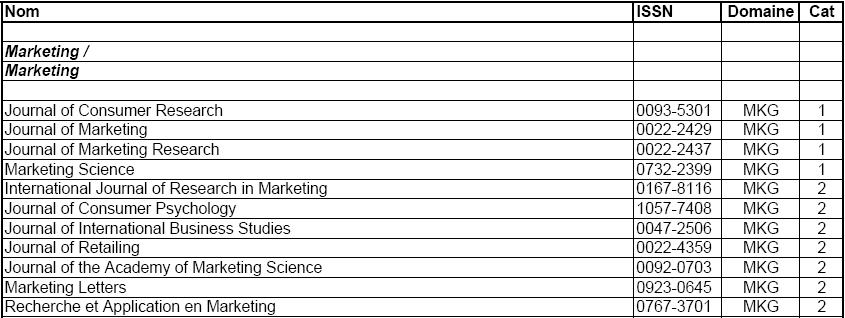
      • Marketing
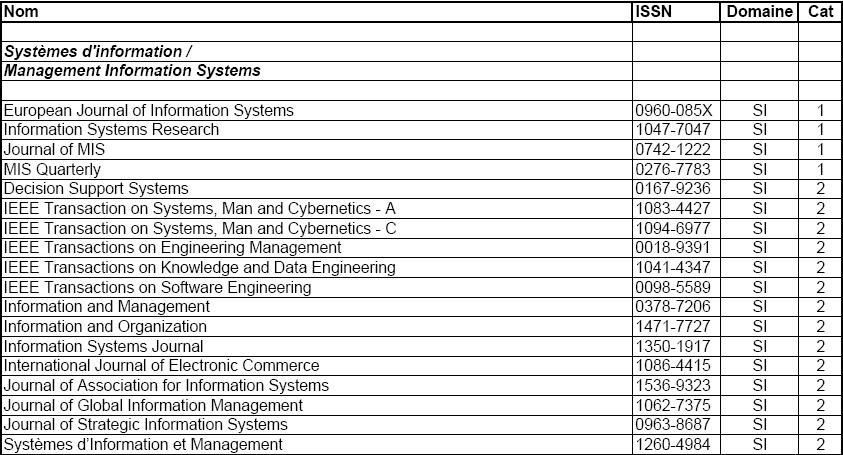
      • Information System
    5. Student information

    The 2-3 pages maximum synthesis will be uploaded on kmcms.net Abstract:

    • (Times 12, italics, justified left and right): copy paste the abstract of the article you have read if it already exists
    • Authors must supply a structured abstract set out under the following sub-headings (maximum is 250 words in total):
      • Purpose (mandatory)
      • Design/methodology/approach (mandatory)
      • Findings (mandatory)
      • Practical implications (if applicable)

    Keywords: Cicero, Catiline, Orations , Distribueudos (3-5) copy paste the key words of the article you have read if it already exists

    Content of the synthesis

    1. Topic
    2. Reference
    3. Literature review
    4. Hypothesis
    5. Conceptual Model
    6. Experiment
      • Scales
      • Independent Variable
      • Dependent Variable
    7. Results
    8. Conclusion
    9. Limits
    10. Future ways of research
    11. Critic

    Format of the synthesis

    • Body of the text: leave it as it is on kmcms.net
    • Read it carefully please 🙂 (clic below)


    • Best thing to do:
      1. write your synthesis in word, delete the mistakes – language of the article, either french or english -, make a very good work
      2. copy it from word in a notepad/blocnote file to delete the style (css) from word
      3. paste it from this notepad to kmcms.NET by creating a new post (and follow the advices provided in the syllabus – or below -)
      4. use Header 3 for titles Header 4 for sub titles (very important, to make your work readable)
      5. send me the url of your work (even those who already told me that have done their synthesis, I need this link, to watch your beautiful work to mark it at its best
      • That’s it !

      1. Headings

      Use the < H3> < /H3> tags (Header 3)

      1.1. Sub-heading

      Use the < H4> < /H4> tags (Header 4)

      Tables and figures should have a title, and should be annonced in the body of the text. They should be located at the right place in the paper. Table should not be submitted as graphic elements.

      References to other publications must be in RAM (http://www.afm-marketing.org/afmnetfichiers/Instrcutions_aux_auteurs_RAM.pdf) style and carefully checked for completeness, accuracy and consistency. You should cite publications in the text: (Adams, 2006) using the first author’s name or (Adams and Brown, 2006) citing both names of two, or (Adams et al., 2006), when there are three or more authors. At the end of the paper a reference list in alphabetical order should be supplied:

    • For books: Surname, Initials (year), Title of Book, Publisher, Place of publication. e.g. Harrow, R. (2005), No Place to Hide, Simon & Schuster, New York, NY.
    • For book chapters: Surname, Initials (year), "Chapter title", Editor’s Surname, Initials (Ed.), Title of Book, Publisher, Place of publication, pages. e.g. Calabrese, F.A. (2005), "The early pathways: theory to practice – a continuum", in Stankosky, M. (Ed.), Creating the Discipline of Knowledge Management, Elsevier, New York, NY, pp. 15-20.
    • For journals: Surname, Initials (year), "Title of article", Journal Name, volume, number, pages. e.g. Capizzi, M.T. and Ferguson, R. (2005), "Loyalty trends for the twenty-first century", Journal of Consumer Marketing, Vol. 22 No. 2, pp. 72-80.
    • For published conference proceedings: Surname, Initials (year of publication), "Title of paper", in Surname, Initials (Ed.), Title of published proceeding which may include place and date(s) held, Publisher, Place of publication, Page numbers. eg Jakkilinki, R., Georgievski, M. and Sharda, N. (2007), "Connecting destinations with an ontology-based e-tourism planner", in Information and communication technologies in tourism 2007 proceedings of the international conference in Ljubljana, Slovenia, 2007, Springer-Verlag, Vienna, pp. 12-32.
    • For unpublished conference proceedings: Surname, Initials (year), "Title of paper", paper presented at Name of Conference, date of conference, place of conference, available at: URL if freely available on the internet (accessed date). eg Aumueller, D. (2005), "Semantic authoring and retrieval within a wiki", paper presented at the European Semantic Web Conference (ESWC), 29 May-1 June, Heraklion, Crete, available at: http://dbs.uni-leipzig.de/file/aumueller05wiksar.pdf (accessed 20 February 2007).
    • For working papers: Surname, Initials (year), "Title of article", working paper [number if available], Institution or organization, Place of organization, date. e.g. Moizer, P. (2003), "How published academic research can inform policy decisions: the case of mandatory rotation of audit appointments", working paper, Leeds University Business School, University of Leeds, Leeds, 28 March.
    • For newspaper articles (authored): Surname, Initials (year), "Article title", Newspaper, date, pages. e.g. Smith, A. (2008), "Money for old rope", Daily News, 21 January, pp. 1, 3-4.
    • For newspaper articles (non-authored): Newspaper (year), "Article title", date, pages. e.g. Daily News (2008), "Small change", 2 February, p. 7.
    • For electronic sources: if available online the full URL should be supplied at the end of the reference, as well as a date that the resource was accessed. e.g. Castle, B. (2005), "Introduction to web services for remote portlets", available at: http://www-128.ibm.com/developerworks/library/ws-wsrp/ (accessed 12 November 2007).

      Sources of interest

    • Marketing: EBSCO / EMERALD INSIGHT / SCIENCE DIRECT / JSTOR etc.
    • Information Systems: SCOPUS

      Other interesting sources

      Journal’s categorization

      Marketing

      More details : See this page for the whole categorization of journals in management

      Revues classées en marketing

      Information System

      More details on Information Reviews: http://lamp.infosys.deakin.edu.au/journals/index.php

      Revues classées en SI

    Gestion de la cohérence des récits des marques de luxe sur internet : étude sémiotique et analyse comparée des secteurs de la maroquinerie et de la joaillerie, Revue Française du Marketing, 233.

    Author(s) : Nathalie Veg-Sala, Angy Geerts


     Etudes et résultats : On remarque tout d’abord que la manière de communiquer diffère en fonction des marques de consommation de masse ou de luxe. Pour communiquer, les marques de luxe choisissent le plus souvent des codes et symboles qui racontent une histoire et créent des mythes autour des marques afin de faire rêver le consommateur. L’histoire est stable sur du long terme pour être crédible.  L’enjeu pour ses marques sur internet est d’être présente tout en conservant leur rareté qui fait leur prestige. Il n’y a pas que le produit qui compte mais aussi le service, la communication, l’image qu’il reflète donc l’expérience d’achat. Toute la difficulté pour les marques et de retranscrire cet univers sur leur site internet. 

    D’après les études antérieures, les opportunités pour les marques de luxe à réaliser un site internet sont l’interactivité, la possibilité de toucher une population ou encore la créaton d clubs privilèges afin de recréer le côté élitiste. Par ailleurs, les menaces résident dans la difficulté de garder une relation de prestige avec le client, de retranscrire des émotions à travers l’écran (Okonkwo, 2005) et le risque de banalisation de la marque.

    L’étude effectuée compare des boutiques physiques  et leurs sites internet sur le message visuel, textuel et le support de communication utilisé. Les marques étudiés sont Hermès et Louis Vuitton pour la maroquinerie, Van Cleef & Arpels et Boucheron pour la haute joaillerie. Tout d’abord, l’univers d’Hermès est traditionnel, rattaché à la noblesse française, avec des matériaux emblématiques comme le cuir tandis que le site internet est enfantin, très centré sur le e-commerce et plutôt incohérent avec l’image de marque.

    La marque Louis Vuitton joue sur l’héritage, lesavoir-faire est voyage. Ces éléments  sont retranscrits sur le site avec possibilité d’acheter en ligne mais ce n’est pas ce qui saute aux yeux. Concernant Van Cleef & Arpels, la féérie et le rêve des boutiques et du site internet, poétique et épuré est  en adéquation avec l’univers de la marque et le renforce. Toutefois on ne peut pas acheter de bijoux en ligne. En dernier, Boucheron joue la carte de la marque historique ancrée dans le temps, légitime et innovante. Le site internet est cohérent et se rapproche au plus de boutiques physiques. La partie e-commerce est par ailleurs très présente.

    En résumé, il existe différents moyens pour les marques de luxes d’utiliser internet : outil de communication et/ou outil de vente en ligne. Les produits vendables en ligne ne sont généralement pas les plus chers de la gamme.

    Conclusion : Internet est devenu un outil incontournable des marques de luxe afin de développer leur notoriété et la communication autour de leur image. Garder une certaine cohérence avec les boutiques physiques (codes, couleurs) et l’histoire de la marque semble primordiale pour leur image et l’arrivée de l’interactivité renforce cette idée de relation et de service du client. Même s’il est possible d’utiliser ce média comme un simple outil de communication, les boutiques en ligne deviennent de plus en plus nombreuses.

    Limites et ouvertures : Les marques de luxe ont trouvé une nouvelle façon de donner un côté exclusif à leur produits et à leurs clients en créant des clubs privilèges spéciaux à l’aide de mots de passes spécifiques. D’autre part, seuls deux secteurs ont été explorés. Il serait intéressant d’analyser d’autres prestigieux  environnement comme ceux de la cosmétiques ou de la mode.

    Marketing the unfamiliar : the role of context and item specific information in Electronic agents recommendations

    Author(s) : Cooke Alan D J, Sujan Harish, Sujan Mita, Weitz Barton A

    L’auteur examine les techniques fréquemment employées par les e-marchands pour vendre de nouveaux produits aux clients via les systèmes de recommandations.

    Les consommateurs évaluent différemment le nouveau produit en fonction de son contexte. La solution idéale selon l’étude est de recommander le produit non familier au sein d’un lot de produits familiers. Grace à l’effet de halo, le produit non familier parait plus similaire aux autres recommandations et est donc plus attractif. Par contre, les deux études menées par l’auteur montrent que donner des informations distinctives sur le nouveau produit au sein d’un lot de recommandations familières a pour effet de renforcer le contraste entre les produits familiers et le nouveau produit et ainsi de diminuer son attractivité.

    Par conséquent, placer le nouveau produit au sein d’un lot de recommandations contextuels est bénéfique lorsque ces recommandations sont attractives aux yeux du consommateur, paraissent similaires aux yeux du consommateur et sont agencés sur la page de manière à ce que le consommateur les perçoivent comme une seule unité, lorsque peu d’information, particulièrement des informations distinctives sont fournies sur le produit cible (nouveau produit).

    A l’inverse il vaut mieux présenter les nouvelles recommandations ( nouveaux produits)  de manière isolée lorsque l’on a peu d’informations à propos du consommateur, les recommandations familières risquent d’être perçues comme trop différentes du produit cible, lorsque des informations discriminantes à propos du produit cible sont fournies et lorsque des informations très positives peuvent être fournies à propos du produit cible.

    The cost of thinking

    Author(s) : Shugan Steven M.

    L’auteur propose un modèle pour quantifier le coût de traitement de l’information (thinking costs) lorsque le consommateur doit faire un choix parmi plusieurs produits. Puis il compare les couts de traitement de l’information induits par le fait d’utiliser des règles pour simplifier le processus de décision. Ces règles sont supposés permettre de limiter les coûts de traitement de l’information en permettant au consommateur non pas de faire le meilleur choix mais de faire le choix le plus satisfaisant compte tenu des couts de traitement de l’information.

    On distingue 4 règles de simplifications du processus de décision :

    ·         Conjonctif : le premier produit qui vérifie un niveau minimum sur toutes les caractéristiques

    ·         Disjonctif / maximax : le produit qui a le plus haut niveau sur ses meilleures caractéristiques

    ·         Minimax : le produit qui a le plus haut niveau sur ses plus mauvaises caractéristiques

    ·         Lexicographique : le produit qui a le plus haut niveau sur la caractéristique jugée la plus importante.


    Selon le modèle de Shugan :

    ·         Plus il y a de paires de produits à comparer, plus le coût de traitement de l’information est important

    ·         Plus la complexité perçue de la comparaison est importante  (les produits sont très similaires) plus le coût de traitement de l’information est important, car il faudra alors comparer plus de caractéristiques produits

    ·         Plus la différence de préférence entre les produits est importante, moins le coût de traitement de l’information est important

    ·         Plus le niveau de confiance requis (risque de la catégorie de produit) est important, plus le coût de traitement de l’information est important car il faudra alors comparer plus de caractéristiques produit


    Le coût de traitement de l’information  peut être réduit par :

    ·         La mémoire

    ·         Des statistiques de synthèse comme les certifications ou les marques

    ·         Le niveau de connaissance des attributs clés par le consommateur