
Reference :
Li, G., Cao, Y., Lu, B., Yu, Y., & Liu, H. (2023). Luxury brands’ live streaming sales: the roles of streamer identity and level strategy. International Journal of Advertising, 42(7), 1178–1200. https://doi-org.devinci.idm.oclc.org/10.1080/02650487.2023.2215075
Keywords: Influencer marketing,Live streaming , Internet celebrity, Luxury brands
Summary :
Through a lens of influencer marketing and source credibility theory, this study investigates the role of streamer identity (i.e. internet celebrities and e-shop sellers) and
streamer level (macro vs. micro) on luxury brands’ live streaming
sales. Using fixed-effect models, the data from 7,164 live streaming campaigns between 1 August 2020 and 31 December 2020 are analyzed covering 17 international luxury brands on Taobao Live.
Development :
The main research goals that the authors adress in this article are:
1-To investigate wether the scale of streamers’ identity (celebrities / e-shop sellers) has a direct impact on live streaming sales of luxury brands.
2- to understand whether streamer level (macro vs. micro) moderates these impacts; and
3- to further explore the association between internet celebrities’ live streaming sales and e-shop sellers’ live streaming sales.
Theoritical background :
Luxury brands’ influencer marketing :
Influencer marketing is seen as a form of native advertising (Breves et al. 2021) that
identifies appropriate influencers with the purpose of fostering a higher level of
engagement and promoting sales (Arora et al. 2019).
Influencers can not only shape public opinions
(Janssen, Schouten, and Croes 2022)
In addition, influencers also influence
luxury consumers’ purchasing decisions by demonstrating social value and highlighting
expressions of social identity (Pangarkar and Rathee 2022)
Live streaming selling :
Live streaming selling acts as an extension of influencer marketing.
Unlike traditional influencer
marketing, live streaming commerce is an emerging marketing approach by
which influencers and brands can promote sales and bolster a high level of engagement
in real time (Arora et al. 2019; Lin, Yao, and Chen, 2021).
Live streamers are an emerging group of Influencers .
they act as a key factor influencing brands and consumers in live streaming marketing (Guo, Zhang, and Wang 2022;
Zhao et al. 2021).
Unlike typical social media influencers, live streamers interact with
their audience in real time, which allows them to gain traffic and followers at increasing
speed (Guo, Zhang, and Wang 2022).
Source credibility theory:
source is perceived as possessing expertise relevant to
the communication topic and can be trusted to give an objective opinion on the
subject’ (Hovland and Weiss 1951; Goldsmith et al. 2000).
Source credibility theory is generally used to test the effectiveness of influencer
advertising.
This theory argues that communications from
high-credibility influencers are more persuasive than communications from
low-credibility influencers (Weismueller et al. 2020)
Streamer identity and luxury brands’ live streaming sales:
The theory captures the three most impactful source effects on
buying intent, brand attitude, and attitude toward advertising (S. W. Wang and
Scheinbaum 2018; Halder et al. 2021).
Hypothesis :
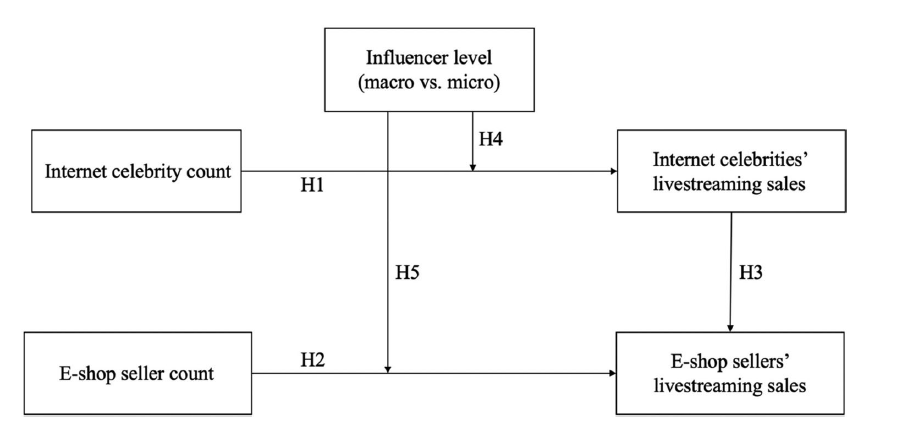
H1: Internet celebrity count is positively associated with internet celebrities’ live streaming sales of a luxury brand.
H2: E-shop seller count is positively associated with e-shops’ live streaming sales of a luxury brand.
H3: Internet celebrities’ live streaming sales are positively associated with e-shop sellers’ live streaming sales of a luxury brand.
H4: The positive association between internet celebrity count and luxury brand live streaming sales is stronger when internet celebrities are at the micro level.
H5: The positive association between e-shop seller count and luxury brands’ live streaming sales is stronger when e-shop sellers are at the macro level.
Conceptual model :
Method : data was collected through live streaming service data collector Zhigua to collect live streaming data of TAOBAO
the data was brands’live streaming campaigns for 152 days.
The 17 luxury brand names are treated as a fixed-effect variable to control for the brand effect
they categorizedstreamers with more than 1 million followers as macro streamers and those with 1 thousand to 1 million followers as micro streamers.
Key findings :
-the number of internet celebrities has a positive impact on the internet celebrities’ live
streaming sales (H1 supported).
-the number of e-shop sellers has a positive impact on e-shop sales (H2 supported)
-Influencer live streaming sales positively boost e-shop sellers’ live streaming sales (H3 supported)
-the number of influencers with macro and micro levels has a significant positive impact on live streaming sales (H4 supported)
-the number of macro e-shop sellers has a more positive impact than the number of micro influencers (H5 supported)
the interaction between the same identity type of influencers on both the micro and macro levels has a negative impact on live
streaming sales.