Mots clés : Fidélité à la marque Relations consommateurs / marque Engagement de marque
Fidélité du consommateur Amour de marque
Résumé : L’objectif de cette recherche est de développer et valider une mesure à l’échelle multidimensionnelle de la fidélité à la marque. Cet article rend compte du processus rigoureux de développement de l’échelle, à travers deux études distinctes impliquant 592 consommateurs américains. L’étude 1 implique la génération d’éléments à l’échelle, la validation du contenu et la purification de l’échelle, tandis que l’étude 2 implique une méthode de collecte de données à deux vagues, évaluant l’échelle de fidélité à la marque raffinée au sein d’un réseau nomologique de relations. Les résultats démontrent que l’échelle de fidélité de la marque à 20 éléments a une forte validité de construction comme échelle formative réfléchissante de premier ordre et de second ordre. Les résultats suggèrent que si les consommateurs adoptent des comportements / cognitions (tels que définis dans l’échelle de fidélité à la marque), alors les relations consommateur / marque sont susceptibles d’être stables et prévisibles; sont susceptibles de subir les ravages du temps; et, ce qui est important, sont susceptibles de rester monogames. Pour les praticiens, le score global de fidélité à la marque peut être utilisé pour suivre les performances de la marque au fil du temps et à des fins d’analyse comparative de l’industrie. De plus, les dimensions mesurées de la fidélité à la marque fournissent une direction spécifique sur laquelle des actions de marketing correctives peuvent être mises en œuvre.
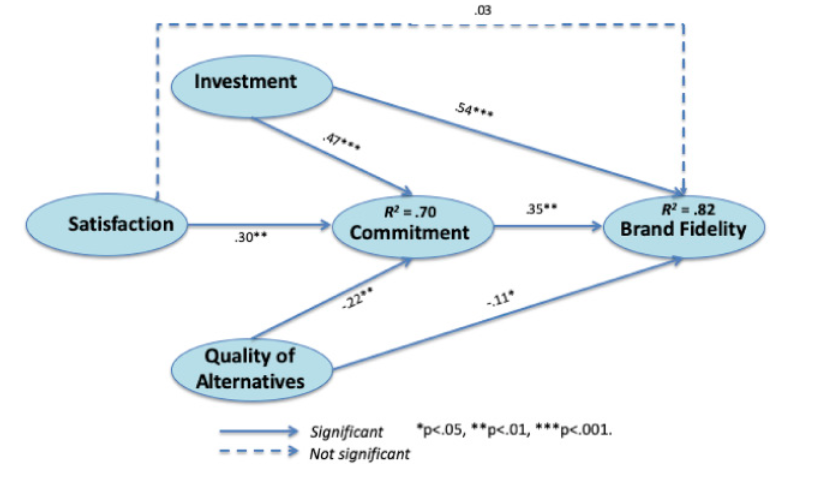
Schéma conceptuel des dimensions explorées
Discussion : La mesure de fidélité à la marque, avec ses multiples composantes, permet une compréhension approfondie des mécanismes qui soutiennent la durabilité, la stabilité et l’exclusivité des relations consommateur / marque. Premièrement, il est important de reconnaître que la mesure finale de fidélité à la marque ne reflétait pas exactement les dimensions de fidélité à la marque conceptuellement proposées par Grace et al. (2018). Les dimensions telles que les illusions positives et la volonté de sacrifier n’étaient pas bien différenciées dans les données. Cependant, Grace et al. (2018) ont fait allusion au potentiel de certains chevauchements dans les dimensions de fidélité à la marque, lorsqu’ils sont appliqués dans le contexte des relations consommateur / marque, par opposition aux relations amoureuses (par exemple, Rusbult et al., 2012). Par exemple, les individus ont très souvent des illusions irréalistes (ou trop positives) à propos de leur partenaire, soit parce que (1) ils ne voient que ce qu’ils veulent voir, c’est-à-dire qu’ils voient leur partenaire à travers des lunettes roses, ou (2) ils ne voient que ce que leur les partenaires (peuvent tromper) se présentent comme tels. Bien que ce dernier comportement soit courant chez l’homme, les marques qui prétendent être quelque chose qu’elles ne sont pas (ou qui promettent trop) perdent très vite des clients qui s’associent rapidement à leurs concurrents. Par conséquent, la création d’illusions de marque de consommation positives est plus susceptible de représenter une détérioration des relations plutôt qu’une force. En outre, étant donné que l’effet dérogatoire implique non seulement la minimisation d’alternatives attractives, mais également la surestimation ou la clémence par rapport à la relation partenaire (Rusbult et al., 2012), il n’est donc pas surprenant que trois des cinq les éléments développés pour mesurer les illusions positives se sont effondrés dans la dimension dérogation des alternatives.
Dans le même ordre d’idées, les résultats ont indiqué un lien entre la volonté de sacrifier et l’accommodement / le pardon, la volonté de sacrifier des articles ne formant pas une «dimension autonome», mais plutôt croisée ou fortement corrélée avec les dimensions de l’accommodement / pardon. Cette connexion a également été anticipée par Grace et al. (2018), en ce sens qu’ils ont fait valoir que si un consommateur était disposé à accommoder ou à pardonner à la marque, en période de performance ou de variation de prix, alors, ce faisant, il est probable qu’il ferait un sacrifice quelconque (par exemple, financier , commodité, social ou autre). En outre, la concurrence importante des marques signifie également que les consommateurs sont moins disposés à faire des sacrifices lorsqu’il existe des alternatives intéressantes. Sur cette base, la volonté de sacrifier est beaucoup plus pertinente pour les relations humaines qui sont essentiellement basées sur des échanges sociaux réciproques plutôt que négociés (Lawler et Yoon, 1996).
Cette recherche a également identifié que, dans le contexte des relations consommateur / marque, l’accommodement / le pardon est multiforme. Cela est dû à l’effet souvent différentiel des variations de prix et de performances sur l’allégeance relationnelle dans les situations d’échange négociées (c’est-à-dire les relations consommateur / marque), plutôt que dans les situations d’échange réciproques (relations interpersonnelles). Sur cette base, il n’est pas surprenant que les éléments d’échelle mesurant l’hébergement (pardon) par rapport aux variations de performance soient chargés séparément à ceux mesurant l’hébergement (pardon) par rapport aux variations de prix.
Questions de l’enquête :
FACTOR ONE
Accommodation/Forgiveness (Performance): The degree to which a consumer is forgiving of and provides support to a brand partner in times of performance variations.
ACCPERF1 If XXXX experienced some problems and the brand was temporarily not up to scratch, how likely is it that you would continue to use this brand?
ACCPERF2 If XXXX experienced some problems and the brand was temporarily not up to scratch, how likely is it that you would recommend this brand to others?
ACCPERF3 If XXXX experienced some problems and the brand was temporarily not up to scratch, how likely is it that you would support the brand when others were complaining about it?
ACCPERF4 If XXXX experienced some problems and the brand was temporarily not up to scratch, how likely is it that you would make excuses for the brand?
FACTOR TWO:
Accommodation/Forgiveness (Price): The degree to which a consumer is forgiving of and provides support to a brand partner in times of price variations.
ACCPRIC1 It doesn’t bother me when XXXX increases its prices, as I will always use this brand anyway.
ACCPRIC2 Regardless of what price XXXX is, I will always strongly recommend this brand to others.
ACCPRIC3 When XXXX has had a price increase, it has been well justified.
ACCPRIC4 XXXX is still well worth the money even when its prices goes up.
FACTOR THREE:
Cognitive Interdependence: The degree to which a consumer feels “at one” with the brand partner and takes personal ownership of the brand
COGINT1 I refer to XXXX as “my” brand.
COGINT2 I feel I have a strong bond with XXXX.
COGINT3 I would be lost without XXXX.
COGINT4 XXXX says something about me.
COGINT5 XXXX is an important part of my life.
COGINT6 I would feel offended if someone said something bad about XXXX.
FACTOR FOUR:
Derogation of Alternatives: The degree to which a consumer focuses on the strengths of the brand partner and the weaknesses of its competitors.
DERALT1 There is really no other brand like XXXX.
DERALT2 If asked, I would be quick to point out how superior XXXX is to its competitors.
DERALT3 XXXX is one of a kind and, in my opinion, there is no competition.
DERALT4 It is impossible for another other brand to compete with XXXX.
DERALT5 XXXX is faultless.
DERALT6 I would be devastated if I could not buy XXXX anymore as nothing else will ever come near it.
Mots clés : Achats compulsifs Achat compulsif Fantasme, anxiété Dépendance
Résumé : L’article met en évidence les principales conclusions de la recherche concernant le comportement d’achat compulsif et vise à décrire et à tester la relation entre l’achat compulsif et un phénomène d’achat alternatif, c’est-à-dire l’achat impulsif. Deux vues communes de la relation entre l’achat compulsif et l’impulsion sont discutées et combinées pour former une conceptualisation hybride. Les résultats suggèrent que les achats impulsifs augmentent l’anxiété des consommateurs, elle-même liée à l’achat compulsif. L’évasion des consommateurs semble notamment dissuader la conversion de l’anxiété en achats compulsifs. Les résultats et les implications managériales sont discutés.
H1: Les achats impulsifs sont liés positivement à l’anxiété des consommateurs.
H2: L’anxiété des consommateurs est liée positivement à l’achat compulsif.
H3: L’anxiété des consommateurs est liée positivement à l’évasion des consommateurs.
H4: L’évasion est liée positivement à l’achat compulsif
Conclusion :
Dans notre société, les gens sont aux prises quotidiennement avec une multitude de dépendances physiques et comportementales, notamment l’alcoolisme, la toxicomanie, le jeu et d’autres troubles compulsifs. La recherche marketing devrait mettre davantage l’accent sur les maux de la surconsommation et des achats compulsifs, offrant des remèdes potentiels aux consommateurs. Jusqu’à présent, les progrès de la recherche sur les achats compulsifs ont permis d’identifier de nombreux antécédents et résultats de l’achat compulsif. Cependant, les remèdes comportementaux pour les achats compulsifs font défaut de manière significative. La recherche devrait se concentrer sur les moyens pratiques d’améliorer la résistance des consommateurs aux achats d’impulsions. Par exemple, cette recherche indique que les consommateurs qui sont enclins à acheter compulsivement devraient s’abstenir de tenter des situations d’achat (c’est-à-dire visiter des sites de commerce électronique ou des magasins sans besoin clair), surtout lorsqu’ils se sentent déprimés ou stressés. Les comportements d’achat compulsif peuvent générer de graves difficultés émotionnelles, financières et interpersonnelles pour les consommateurs. Les dépendances des consommateurs peuvent être profitables aux organisations à court terme; cependant, ces comportements ont tendance à être irréguliers et difficiles à maintenir. En offrant des alternatives saines et des stratégies spécifiques pour aider à remédier à la dépendance au shopping, la recherche peut améliorer la qualité de vie des acheteurs compulsifs et de leurs familles.
Mots clés : Engagement de marque, Comportements compulsifs, Matérialisme, Narcissisme , Des médias sociaux, Vanité
Résumé : La double théorie de la passion indique que la passion harmonieuse mène à la passion obsessionnelle. Cette étude envisage que l’engagement de la marque (passion harmonieuse) conduit à un comportement compulsif (passion obsessionnelle) de deux manières : l’utilisation compulsive des médias sociaux et l’achat compulsif. Faisant écho à des recherches antérieures sur la passion, nous postulons que trois traits de personnalité associés aux comportements compulsifs – la vanité, le narcissisme et le matérialisme – modèrent ces relations, tandis que la technostress médiatise l’effet de l’utilisation compulsive des médias sociaux sur les achats compulsifs. Nous menons une enquête en ligne au Royaume-Uni auprès de 527 consommateurs, en utilisant la modélisation d’équations structurelles pour l’analyse des données. Les résultats indiquent que la vanité modère la relation entre l’engagement de la marque et l’utilisation compulsive des médias sociaux: à mesure que la vanité s’intensifie, l’effet de l’engagement de la marque sur l’utilisation compulsive des médias sociaux augmente. De même, le narcissisme modère l’utilisation compulsive des médias sociaux → relation d’achat compulsif. En revanche, le matérialisme ne modère ni l’engagement de la marque → l’utilisation compulsive des médias sociaux, ni l’utilisation compulsive des médias sociaux → la relation d’achat compulsif.
H1: L’engagement de la marque affecte positivement l’utilisation compulsive des médias sociaux.
H2: L’utilisation compulsive des médias sociaux affecte positivement l’achat compulsif.
H3: La vanité influence tout le processus par lequel les gens adoptent des comportements compulsifs, y compris la force des effets de (a) l’engagement de la marque sur l’utilisation compulsive des médias sociaux et (b) de l’utilisation compulsive des médias sociaux sur les achats compulsifs.
H4: Le narcissisme influence le processus par lequel les gens adoptent des comportements compulsifs, y compris la force des effets de (a) l’engagement de la marque sur l’utilisation compulsive des médias sociaux et (b) de l’utilisation compulsive des médias sociaux sur les achats compulsifs.
H5: Le matérialisme influence l’ensemble du processus par lequel les gens adoptent des comportements compulsifs, y compris la force des effets de (a) l’engagement de la marque sur l’utilisation compulsive des médias sociaux et (b) de l’utilisation compulsive des médias sociaux sur les achats compulsifs.
H6: L’effet de l’utilisation compulsive des médias sociaux sur les achats compulsifs est médié par la technostress, de sorte qu’une plus grande utilisation compulsive des médias sociaux augmente le niveau de la technostress, et une plus grande technostress augmente les achats compulsifs.
Analyse des données à avoir directement dans l’article
Conclusion :
Théoriquement, cette étude ouvre un nouveau flux de recherche sur l’engagement de la marque sous l’angle de la passion – la double théorie de la passion avait un certain pouvoir explicatif pour l’association entre l’engagement de la marque et les comportements compulsifs. Les comportements compulsifs en tant que côté obscur de l’engagement de la marque ont un sens à la lumière de la passion obsessionnelle et de la passion harmonieuse. Ceci est important non seulement parce qu’une telle dyade a rarement été envisagée et examinée dans la littérature passée, mais aussi parce que nos résultats lient clairement la recherche sur la passion à la recherche sur l’engagement. C’est peut-être la contribution la plus importante de cet article.
L’examen de trois modérateurs est une autre contribution nouvelle. Premièrement, les chercheurs ont examiné la relation entre l’achat compulsif, la vanité, le narcissisme et le matérialisme (par exemple, Harnish et Bridges, 2015). Deuxièmement, une méta-analyse récente a révélé une forte corrélation entre le narcissisme et le comportement de réseautage social en termes d’auto-présentations (Gnambs et Appel, 2017). Cependant, peu de recherches tentent d’élaborer sur ces relations entrelacées entre trois traits de personnalité menant des comportements obsessionnels. En évitant une simplification excessive, cette étude a révélé que chacune de ces constructions pouvait jouer un rôle unique et donc différer les unes des autres en termes de modération sur les relations entre l’engagement de la marque, l’utilisation compulsive des médias sociaux et l’achat compulsif.
Cela dit, l’interprétation des résultats n’est pas simple. Le lien direct entre l’engagement de la marque et l’utilisation compulsive des médias sociaux était statistiquement non significatif. L’effet de l’engagement de la marque sur l’utilisation compulsive des médias sociaux ne devient significatif que lorsque le niveau de vanité augmente. En d’autres termes, les individus très engagés ne deviendraient pas automatiquement des utilisateurs obsessionnels des médias sociaux, à moins que ces personnes possèdent le trait de personnalité clé, c’est-à-dire la vanité. Lorsque la vanité entre en jeu, les consommateurs très engagés peuvent commencer à montrer leurs réalisations et leurs apparences associées aux marques. Cela semble la conclusion la plus intéressante de cette étude.
Un schéma quelque peu similaire a été observé dans le rôle modérateur du narcissisme. Comparé au matérialisme, qui ne présente aucune modération, le narcissisme modère la relation entre l’utilisation compulsive des médias sociaux et l’achat compulsif, tandis que cette relation directe était également statistiquement significative. Cependant, bien que le narcissisme soit le moteur qui pousse les utilisateurs de médias sociaux compulsifs vers des achats compulsifs, son rôle se limite à un catalyseur. Il existe une influence directe significative de l’utilisation compulsive des médias sociaux sur les achats compulsifs. Cela indique que la passion obsessionnelle de l’auto-amélioration (c’est-à-dire la présentation de soi, l’auto-exposition) en soi rend les gens plus obsédés par la consommation. Nous devons cependant noter que notre recherche a utilisé la construction générale du narcissisme sans faire de distinction entre le narcissisme vulnérable (sentiment d’insécurité) et grandiose (sentiment d’auto-importance). Les recherches futures devraient examiner les effets distincts possibles des composants du narcissisme.
Contrairement à la vanité et au narcissisme, le matérialisme ne joue aucun rôle dans nos modérations prévues. Autrement dit, ce n’est pas un désir de possession matérielle qui fait passer les gens d’Instagram à l’achat compulsif.
Nos résultats fournissent également des connaissances utiles aux praticiens. Bien que les entreprises soient sans aucun doute intéressées à étendre leurs efforts de marketing par le biais des médias sociaux, elles doivent accorder une plus grande attention à la «frontière» entre les comportements harmonieux et obsessionnels. Alors que «montrer» sa réussite personnelle et être fier peut être un résultat naturel de l’engagement de la marque en raison de la vanité, les appels marketing excessivement matérialistes ou narcissiques (en particulier la publicité) peuvent conduire à une obsession risquée. Dans cette optique, il est souhaitable que les entreprises se concentrent davantage sur les aspects expérientiels de la marque plutôt que sur la possession matérielle. Peut-être que les entreprises devraient poursuivre leur engagement envers la marque par le biais d’événements et d’expériences plutôt que par la promotion des ventes, car la première aide à établir une relation émotionnelle à plus long terme avec la marque.
Du point de vue des politiques publiques, les entreprises devraient envisager une stratégie préventive contre les achats narcissiques et matérialistes qui pourrait conduire les consommateurs à adopter des comportements malsains et obsessionnels. À la lumière de nos résultats de la littérature, le narcissisme peut motiver les utilisateurs compulsifs des médias sociaux à afficher de graves lacunes d’autorégulation en s’engageant dans des achats compulsifs. En tant que tels, les comportements compulsifs deviennent un grave problème social, et les spécialistes du marketing sur les réseaux sociaux devraient éviter de tels appels promotionnels.
De la même manière, les praticiens peuvent avoir besoin de réfléchir à la manière d’atténuer le stress technologique des utilisateurs des médias sociaux. Comme cette construction agit comme un catalyseur pour le saut de l’utilisation compulsive des médias sociaux à l’achat compulsif, il semble extrêmement important de fournir un remède pour réduire l’anxiété liée à l’utilisation dans les contextes des médias sociaux.
Les questions posées dans l’enquête :
Éléments du questionnaire utilisés dans cette étude
(1)
Questions sur l'utilisation d'Instagram

    Votre profil Instagram est:

        Public, veuillez fournir votre identifiant: ________________

        Privé

    Combien de photos (en moyenne) publiez-vous par mois? _____

    Publiez-vous des selfies?

        Oui

        Non

    Lorsque vous prenez une photo, pensez-vous comment en obtenir une bonne pour la publier et obtenir de bons retours (nombre élevé de «likes»)?

        Oui, je réfléchis toujours à la façon d'obtenir une bonne image qui me donnera beaucoup de «j'aime».

        Parfois. Je veux avoir une bonne image, même si je ne suis pas trop inquiet de ne pas avoir assez de «j'aime».

        Jamais. Je ne poste que des choses que je veux partager sans penser au nombre de «j'aime» que j'obtiendrai.

    À quelle fréquence pensez-vous ou vérifiez-vous votre compte pour voir combien de likes vous obtenez après avoir posté une photo? ____________

    Combien d'abonnés avez-vous (à peu près)? _______

    De combien de likes avez-vous besoin pour sentir que votre message a réussi? ________
(2)
Utilisation compulsive des médias sociaux (échelle de 7 points; 1 = jamais, 4 = parfois, 7 = toujours)

•

    À quelle fréquence trouvez-vous difficile d'arrêter d'utiliser Instagram lorsque vous êtes en ligne? *
•

    À quelle fréquence continuez-vous à utiliser Instagram malgré votre intention d'arrêter? *
•

    À quelle fréquence les autres (par exemple, partenaire, enfants, parents, amis) disent-ils que vous devriez moins utiliser Instagram? *
•

    À quelle fréquence manquez-vous de sommeil à cause d'Instagram?
•

    À quelle fréquence pensez-vous que vous devriez utiliser Instagram moins souvent? *
•

    Combien de fois avez-vous essayé en vain de passer moins de temps sur Instagram?
•

    À quelle fréquence vous précipitez-vous dans votre travail (à domicile) pour aller sur Instagram?
•

    À quelle fréquence négligez-vous vos obligations quotidiennes (travail, école ou vie de famille) parce que vous préférez aller sur Instagram?
•

    À quelle fréquence vous sentez-vous déprimé ou irrité lorsque vous ne pouvez pas utiliser Instagram? *
(3)
Technostress (Beyens et al., 2016)

•

    Je suis obligé par Instagram de vivre avec des horaires très serrés. *
•

    Je suis obligé de changer les habitudes pour m'adapter aux nouveaux développements sur Instagram.
•

    Je dois sacrifier mon temps personnel pour rester à jour sur Instagram. *
•

    Je sens que ma vie personnelle est envahie par Instagram.
•

    Je ne trouve pas assez de temps pour étudier et mettre à niveau mes compétences technologiques sur Instagram.
•

    Je suis menacé par des personnes possédant de nouvelles compétences Instagram.
(4)
Élicitation de la marque
Nous sommes intéressés par votre relation avec une marque à laquelle vous vous sentez très attaché et émotionnellement attaché. Cela peut être n’importe quelle marque tant que vous avez un lien très fort et spécial avec elle….… Veuillez penser à une marque à laquelle vous vous sentez émotionnellement attaché. Dans l’espace ci-dessous, veuillez décrire brièvement de quelle marque il s’agit, depuis combien de temps vous avez acheté cette marque et pourquoi vous vous y sentez émotionnellement attaché.
(5)
Engagement envers la marque (Sprott et al., 2009)

•

    J'ai un lien spécial avec cette marque. *
•

    Je considère que cette marque fait partie de moi-même. *
•

    Je ressens souvent un lien personnel entre cette marque et moi.
•

    Une partie de moi est définie par cette marque dans ma vie.
•

    J'ai l'impression d'avoir un lien personnel étroit avec cette marque que je préfère le plus.
•

    Je peux m'identifier à cette marque dans ma vie.
•

    Il existe des liens entre cette marque et la façon dont je me considère. *
•

    Cette marque est une indication importante de qui je suis. *
(6)
Achats forcés (Ridgway et al., 2008)

•

    Mon placard contient des sacs à provisions non ouverts.
•

    D'autres pourraient me considérer comme un «accro du shopping».
•

    Une grande partie de ma vie est centrée sur l'achat de choses.
•

    J'achète des choses dont je n'ai pas besoin. *
•

    J'achète des choses que je n'avais pas l'intention d'acheter. *
•

    Je me considère comme un acheteur impulsif. *
(7)
Vanity (Netemeyer et al., 1995)

Éléments de préoccupation physique

•

    La façon dont je regarde est extrêmement importante pour moi.
•

    Je suis très préoccupé par mon apparence. *
•

    Je me sentirais gêné si j'étais avec des gens et que je n'étais pas à mon meilleur. *
•

    Regarder de mon mieux vaut l'effort.
•

    Il est important que je regarde toujours bien.

Éléments de la vue physique

•

    Les gens remarquent à quel point je suis attirante.
•

    Mes regards sont très attrayants pour les autres.
•

    Les gens envient ma beauté.
•

    Je suis une très belle personne. *
•

    Mon corps est sexuellement attrayant. *
•

    J'ai le type de corps que les gens veulent regarder. *

Éléments relatifs à la réalisation

•

    Les réalisations professionnelles sont une obsession pour moi.
•

    Je veux que les autres me regardent à cause de mes réalisations. *
•

    Je suis plus préoccupé par la réussite professionnelle que la plupart des gens que je connais.
•
Atteindre un plus grand succès que mes pairs est important pour moi.
•
    Je veux que mes réalisations soient reconnues par les autres. *

Afficher les éléments

•

    Dans un sens professionnel, je suis une personne très réussie.
•

    Mes réalisations sont très appréciées des autres.
•

    Je suis une personne accomplie.
•

    Je suis un bon exemple de réussite professionnelle. *
•

    D'autres souhaitent avoir autant de succès que moi. *
(8)
Narcissisme (de Bellis et al., 2016)

•

    En ce moment, je sens que je mérite plus que les autres. *
•

    En ce moment, je sens que je ferais un bon leader.
•

    En ce moment, je sens que je suis plus capable que les autres.
•

    En ce moment, je sens que je suis une personne exceptionnelle.
•

    En ce moment, je sens que je peux lire les gens comme un livre. *
•

    En ce moment, j'ai envie de regarder mon corps. *
(9)
Matérialisme (Richins, 2004)

•

    J'aime beaucoup de luxe dans ma vie. *
•

    Acheter des choses me donne beaucoup de plaisir.
•

    Ma vie serait meilleure si je possédais certaines choses que je n’ai pas.
•

    J'admire les gens qui possèdent des maisons, des voitures et des vêtements chers. *
•

    Je serais plus heureux si je pouvais me permettre plus de choses.
•

    Cela me dérange parfois un peu que je ne puisse pas me permettre d'acheter tout ce que j'aime. *
•

    J'aime posséder des choses qui impressionnent les gens. *
Remarque: Nous avons mesuré toutes les échelles à plusieurs éléments sur la base de recherches antérieures avec une échelle à 7 points (1 = complètement en désaccord, 4 = je ne sais pas, 7 = complètement d’accord).
Mots clés : Comportement du consommateur, Échelle de mesure, Tendance d’achat impulsive, Traits de personnalité, Maîtrise de soi, Comportement d’achat impulsif
Résumé : Avec l’ouverture de l’économie et la prolifération de la culture des centres commerciaux, la pertinence économique d’un comportement d’achat impulsif a pris de l’importance. Le comportement d’achat impulsif est mieux compris en examinant la tendance d’achat impulsif qui façonne un tel comportement, et puisque le comportement des consommateurs diffère selon les cultures, en incorporant une perspective indigène dans la compréhension et la mesure de la tendance. Des études ont été menées pour développer une échelle indienne pour mesurer la tendance d’achat impulsif et pour la valider en examinant son association avec d’autres variables pertinentes. Une échelle à 8 facteurs à deux facteurs a été élaborée; une relation positive significative a été observée entre la tendance d’achat impulsif et le comportement d’achat impulsif, et la relation entre la tendance d’achat impulsif et la maîtrise de soi s’est révélée inversement significative. Les résultats ont également montré une relation significative entre la tendance d’achat impulsif et les deux constructions de la personnalité de la conscience et de l’extraversion.
H1 : Le concept de «maîtrise de soi» a un effet négatif significatif sur la tendance d’achat impulsif.
H2A: Le trait de personnalité «stabilité émotionnelle» a un effet négatif significatif sur la tendance d’achat impulsif.
H2B : Le trait de personnalité «agréabilité» a un effet négatif significatif sur la tendance d’achat impulsif.
H2C : Le trait de personnalité «extraversion» a un effet positif significatif sur la tendance d’achat impulsif.
H2D : Le trait de personnalité «conscience» a un effet négatif significatif sur la tendance d’achat impulsif.
H2E : Le trait de personnalité «ouverture» a un effet positif significatif sur la tendance d’achat impulsif.
H3: La tendance d’achat impulsif a un effet positif significatif sur le comportement d’achat impulsif.
Voir analyse dans directement dans l’article :
Conclusion : Nous soutenons que l’étude propose une nouvelle échelle, relativement moins lourde, pour mesurer la tendance d’achat impulsif, ce qui est une contribution importante. Le fait que l’échelle ait été validée par une étude différente confère également sa fiabilité. Si un soutien supplémentaire était fourni par la validation dans d’autres cultures et pays, la courte échelle de 8 éléments pourrait être bien accueillie par les chercheurs. Le fait que l’échelle ait été conçue avec les réponses de la population indienne lui confère une plus grande importance compte tenu du potentiel de marché associé à ce marché de détail en développement rapide.
Un autre fait marquant important de cette entreprise a été la découverte que l’extraversion et la conscience des traits étaient significativement liées à la tendance d’achat impulsif. Cela pourrait être utilisé pour la classification basée sur les traits et le profilage des consommateurs avec une large applicabilité potentielle.
De plus, l’étude dévoilant une relation positive entre la tendance d’achat impulsif et le comportement d’achat impulsif, et une relation négative entre la tendance d’achat impulsive et la maîtrise de soi, a validé les qualités de mesure de l’échelle de mesure de la tendance impulsive. En outre, il a confirmé à nouveau la croyance selon laquelle la tendance d’achat impulsif est plus élevée chez les individus ayant un niveau de maîtrise de soi relativement plus faible, et que les tendances d’achat impulsif affectent positivement le comportement d’achat impulsif.
Journal of Business Research, Martin Meinbner, Jella Pfeiffer, Thies Pfeiffer, Harmen Oppewal
Mots clés : eye tracking, attention visuelle, réalité virtuelle, réalité augmentée , système d’assistance, comportement de l’acheteur
Pour certains stimuli tels que des prototypes d’automobile , il est difficile et couteux de créer ou de produire des prototypes physiques. C’est pourquoi la réalité virtuelle est utilisée depuis longtemps dans le processus de développement de nouveaux produits (Purschke et al, 1998). Bien que le réalisme de l’interaction se soit beaucoup amélioré avec les récents développement technologique (amélioration de l’infographie et de la vitesse du processeur), la réalité virtuelle n’est toujours pas indiscernable de la réalité physique et n’est pas totalement équivalente à celle d’un environnement naturel. Aujourd’hui, le réalisme limité de l’interaction peut encore être considéré comme un inconvénient de l’environnement de RV. Plus la technologie s’améliore et la résolution des environnements 3D s’améliore, plus l’expérience des répondants dans l’ EV va devenir plus ou moins « indiscernable de la réalité normale » «(Loomis et al., 1999). Il n’est pas difficile de suivre les mouvements oculaires des répondants portant des lunettes. Certaines sociétés comme « Tobii » ont mis au point des lentilles de prescription pouvant être utilisées dans des systèmes de suivi des yeux mobiles. Néanmoins, l’intrusivité et la lourdeur du dispositif de suivi de l’œil pour le patient est une source de préoccupation . Le traçage des yeux mobile nécessite le port de lunettes spéciales. La précision des données de suivi de l’œil dépend du matériel utilisé, mais également de la qualité de la cartographie entre les regards et les objets fixés dans l’environnement (bureau, modèle 3D de RV ou réalité physique). L’eye tracking dans un HMD permet d’obtenir la plus grande précision, car l’éclairage externe et la position de la tête de l’utilisateur peuvent être entièrement contrôlés. Normalement, l’eye tracking dans un HMD permet d’obtenir la plus grande précision , car l’éclairage externe et la position de la tête de l’utilisateur peuvent être entièrement contrôlés. Obtenir la permission de partenaires externes pour enregistrer les mouvements des yeux sur le terrain peut être difficile. Par exemple, dans le commerce de détail, il faudrait obtenir un accord avec un supermarché pour pouvoir suivre les consommateurs. De plus , d’un point de vue éthique, il vaut mieux avoir l’accord des consommateurs pour faire du eye tracking envers eux-mêmes, de plus la présence autour d’eux d’autres consommateurs peuvent égalment influer sur le comportement des répondants et doit donc être contrôlés. Ces problèmes n’apparaissent pas lors d’expérience en laboratoire. Les environnements offrent beaucoup de modalité, plusieurs formes de communication et d’interaction sont possibles. Jin (2009) a étudié comment l’utilisation de plusieurs modalités (texte, animation audio et vidéo) modifie les évaluations des produits, ainsi que les intentions d’achat et le plaisir des consommateurs en ligne lors de la présentation d’informations commerciales dans des environnements 3D. Lors de son étude, Jin a constaté que la richesse en modalité est un facteur important qui influence positivement les attitudes envers les produits et augmente les intentions d’achat. De plus, plusieurs modalités décrivant le comportement du répondant peuvent être enregistrées. En plus du suivi de la position et de l’orientation de la tête et du regard, les systèmes de RV permettent d’enregistrer les mouvements des main et du corps, ainsi que des enregistrements vocaux. Les environnement de RV permettent donc d’enregistrer plus les comportements des consommateurs que les environnements non virtuels. De plus, le suivi oculaire dans les EV nécessitent moins d’efforts pour préparer l’ensemble des donnés que dans le suivi oculaire dans les environnements physiques. Les équipements de suivi des yeux mobiles sont plus couteux que ceux des suivis de yeux de bureau et étaient très laborieux au début de l’ère de la RV mais cela s’est amélioré avec l’avènement de la technologie de RV sur le marché grand public avec les casques Oculus Rift et HTC Vive par exemple. En tout, le matériel nécessaire au suivi de l’œil mobile en RV à un cout similaire à celui d’un équipement de suivi de l’œil mobile standard. Mais il ne faut pas oublié les efforts nécessaires à la réalisation d’un scénario de RV. Van der Lans, Pieters et Wedel (2008) ont défini la visibilité de la marque comme la mesure dans laquelle une marque se distingue visuellement de ses concurrents. Selon certaines études , plus un produit est au centre de la vision d’un consommateur, plus il aura de chance d’ être choisi par ce consommateur. Selon Chandon et al. (2009), la position horizontale de la marque sur l’étagère influence l’attention portée à la marque et la probabilité de choix. De plus, ces résultats ont été répliqués et étendus par Atalay et al. (2012) qui ont montré que les personnes interrogées examinaient plus souvent les produits au centre , surtout juste avant de prendre leur décision et étaient plus susceptibles de choisir ces produits. La position d’un produit dans le rayon d’un magasin et par rapport à la vision du consommateur a donc une influence sur le choix du consommateur envers ce produit : plus un produit est au centre , plus il a de chances d’être choisi selon certains auteurs. Cependant, certains auteurs nuancent cette hypothèse, par conséquent la question de savoir dans quelle mesure la centralité attire l’attention et le choix subséquent n’a pas encore suffisamment été prise en compte car les études empiriques précédents utilisaient toutes des écrans en 2D (Bigné t al. 2017). Il serait nécessaire d’étudier l’effet de centralité dans un environnement 3D plus réaliste. D’autres facteurs (ex : efforts requis pour la recherche d’information) ont été négligés dans les études empiriques précédentes. Afin de répondre aux exigences d’expérience des consommateurs, les magasins de vente au détail essaient de redessiner l’intérieur de leurs magasins, en les rendant plus divertissant par exemple (Kozinets et al. 2002). Dans le secteur de la vente au détail et des magasins de supermarchés par exemple, la question de comment aider les consommateurs à atteindre leurs objectifs d’achat se pose. Généralement, les moyens utiliser (mise en valeur de nouveaux produits par des panneaux…) ne sont pas très spécifiques ni ciblés sur les besoins du consommateur, il faut donc créer de nouveaux outils pour répondre aux besoins spécifiques des clients comme ceux des clients allergiques à certains aliments ou des diabétiques. Identifier les préférences des consommateurs dans les magasins de détail est difficile car les consommateurs ne fournissent pas forcément les informations de préférence aux détaillants ou prennent trop de temps à fournir ces informations (Lu, Xiao et Ding, 2016). Il est donc important de fournir un système d’assistance qui fournit les informations requises en peu de temps (quelques millisecondes) et sans impliquer des efforts de la part du consommateur. Jusqu’à présent plusieurs technologies ont été suggérées pour aider les consommateurs (ex :applications sur smartphone, charriots de magasinage augmentés, lunettes intelligentes) . Les applications sur smartphone nécessitent la numérisation d’un code barre avec le téléphone ce qui rend la technologie peu attrayante pour le consommateur. Les futures doivent donc se concentrer sur « la simplicité et la frugalité de l’information ». Selon cet article, dans un avenir peu lointain, les lunettes intelligentes comme les lunettes google qui intègrent la technologie de suivi des yeux pourront certainement fournir des informations personnelles dans de nombreux cas de la vie quotidienne. Avec ces lunettes , l’acquisition d’informations supplémentaires nécessitent que le mouvement des yeux et demande donc très peu d’efforts. Néanmoins il faudra traiter ces informations, ce qui sera une tache supplémentaire et qui entrainera une prolongation du processus de recherche. Une étude a été menée lors de laquelle des répondants ont été placés devant des étagères virtuelles de produits de gâteaux de supermarchés via un dispositif CAVE , on remarque qu’au cours des différentes étapes , la majorité des répondants ont changé leur choix initial et ont suivi les recommandations faites par les informations de réalité augmentée. Cette étude montre donc que les personnes interrogées ont utilisé les informations supplémentaires fournies dans la réalité augmentée et qu’elles ont influencé leurs décisions. Le questionnaire de la fin de l’exercice montre que la technologie de réalité virtuelle a été jugée utile, et la majorité des répondants pensent qu’il serait souhaitable de disposer d’informations complémentaires dans une réalité augmentée lors de leurs achats dans des supermarchés.
En résumé, l’étude montre que la décision d’achat a une grande valeur écologique car elle présente les produits de manière naturaliste, le consommateur peut interagir avec le rayon et expérimenter des produits similaires au monde réel. Les données supplémentaires peuvent être analysées pour étudier la manière dont les répondants interagissent avec les étagères . De plus, les données de suivi des yeux sont annotées automatiquement par le système donc leur analyse peut être lancé, on peut aussi analyser automatiquement les zones d’intérêt, l’annotation automatique permet de créer des systèmes d’assistance qui fournissent des informations complémentaires en temps réel sur la base du comportement du regard des consommateurs. (analyser et réagir en temps réel à l’attention et au comportement du répondant).
Conclusion :
Ce document parle donc des avantages et des inconvénients de l’utilisation des technologies de suivi de l’œil dans les environnements de bureau, naturels et virtuels. La recherche dans la vente au détail et la prise de décision peuvent tirer parti de l’utilisation du suivi de l’œil mobile en RV. Celle-ci conserve la plupart des modalités perceptuelles, comme la perception 3D et la sensation de mouvement, ce qui offre une expérience plus proche de la vie réelle. L’étude montre comment en affichant des informations supplémentaires sur le produit en réaction aux mouvements oculaires de l’utilisateur, l’environnement interagit avec l’utilisateur en temps réel. L’affichage automatique d’informations supplémentaires sur le produit lorsque l’utilisateur regarde un produit est une fonctionnalité qui n’est pas disponible dans les magasins réels mais qui deviendra sans doute disponible au fil du temps par exemple dans des lunettes intelligentes avec suivi oculaire intégré. On peut s’attendre à ce que la technologie de suivi des yeux intègre prochainement de nombreux appareils électroniques (ex : tablettes, ordinateurs portables) De nouveaux types de lunettes intelligents permettront de construire des systèmes d’assistance sensibles au contexte. De tels systèmes d’assistance basés sur le regard ont le potentiel de changer considérablement la recherche et la pratique dans le commerce de détail. La RV est une nouvelle technologie qui va révolutionner l’expérience d’achat des consommateurs. La mise au point de systèmes d’assistance est l’une des avancées majeures de la recherche sur la vente au détail et a de nombreuses conséquences sur les détaillants, les consommateurs et la société. Ce qui peut avoir un impact potentiel énorme sur la société et les consommateurs car ils peuvent être mieux informés.
A. Bhatnagar, P. De, A. Sen, A.P. SinhaGoal-directed and exploratory search under competing demands for attention: The influence of promotional tools on online search behavior, working paper
J. Blascovich, J. Loomis, A.C. Beall, K.R.Swinth, C.L. Hoyt, J.N. BailensonImmersive virtual environment technology as a methodological tool for social psychology
J. Brade, M. Lorenz, M. Busch, N. Hammer, M.Tscheligi, P. KlimantBeing there again–presence in real and virtual environments and its relation to usability and user experience using a mobile navigation task
International Journal of Human-Computer Studies, 101(2017), pp. 76-87
Jounal of Business Research, Krinsten Cowan , Seth Ketron
Mots clés : réalité virtuelle , co-création, retailing, implication e-commerce, experiences de marque
La réalité virtuelle attire de plus en plus l’attention des specialistes du marketing. D’ici 2020, le marché de la réalité virtuelle devrait atteindre 41,5 milliards de dollars. Les marques intègrent déjà la réalité virtuelle à leurs stratégies. Exemple : les agents immobiliers utilisent la réalité virtuelle pour inciter les clients à voir des propriétés. Même le New York times a utilisé la narration avec Google Cardboard dans le cadre d’une campagne visant à améliorer le lectorat. Peu de recherches ont été faites sur le marketing et la RV.
Pourquoi ya-t-il une récente focalisation sur la réalité virtuelle dans le marketing ? La RV est utile pour les marques car elle permet aux consommateurs de voir une autre dimension viertuelle, offrant ainsi un potentiel considérable pour la vente de produits et la création de relations entre la marque et le consommateur. La RV permet un contrôle supérieur à celui des environnements 2D. Il intègre des éléments sensoriels améliorés et dans les situations à forte implication, suscite la téléprésence , qui est un « sentiment d’être présent dans un autre monde » (BERG & Vance, 2016). Une réalité virtuelle efficace peut générer des attitudes de la marque et des intentions d’achat plus positives (Choi, Ko et Kim,2016). Il existe peu de recherche sur la RV.
Le but de cette article est d’examiner les opportunités de marketing de la RV en effectuant une analyse documentaire. Cet article dit que la RV peut améliorer l’attitude des consommateurs par deux voies : une forte implication qui repose sur l’imagination et la téléprésence et une faible implication qui met l’accent sur l’interactivité.
La réalité virtuelle simule un monde réaliste dans un monde numérique, offrant une immersion physique et psychologique pour isoler l’utilisateur dans un autre monde (Gutierrez, Vexo et Thalmann, 2008). Naturellement, plus les entrées sensorielles (haptiques, visuelles, olfactives, etc.) présentes dans un environnement virtuel (VE) sont nombreuses, plus il est facile pour l’utilisateur de visualiser et de se sentir intégré au monde (Loomis, Blascovich et Beall, 1999; Martins et al., 2017). Ainsi, l’industrie a été motivée à créer des VE qui stimulent les cinq sens (Price, Jewitt et Brown, 2013). Les applications de réalité virtuelle englobent trois domaines: les simulations de produits, les environnements virtuels automatisés (AVE) et les mondes virtuels (VW). Les simulations de produits permettent aux utilisateurs de visualiser des objets dans un monde 3D, notamment des fonctions de rotation, de zoom et, dans certains cas, d’utilisation virtuelle (Algharabat et Dennis, 2010). Les AVE permettent aux entreprises de tester les idées de produits et les modèles de vente au détail à l’aide d’espaces virtuels ou de casques. Les VW, telles que Second Life et World of Warcraft, constituent un réseau d’utilisateurs dans un espace virtuel qui intègre des éléments de jeu, de créativité et de rituel (Boellstorff, Nardi, Pearce et Taylor, 2012). L’intention de la marque est de susciter une forte participation des consommateurs, pouvant éventuellement conduire à l’achat d’un produit. Cependant, le consommateur peut n’être motivé que pour jouer et s’amuser.
AVE : environnements virtuels basés sur la réalité intégrale qui favorisent le contrôle de l’utilisateur et l’interaction avec un environnement virtuel dans lequel le consommateur est transporté seul, sans aucun visuel du monde réel. Les AVE utilisent les cinq -sens (Gutierrez et al. 2008) et se présentes sous deux formes : les environnements CAVE (cave automatic virtual environnements) et les écrans montés sur la tête (HMD). Ces deux éléments peuvent être utilisés dans les magasins de vente au détail pour encourager les achats de consommateurs à forte implication, ils peuvent aussi être utilisés dans un contexte de faible implication .
Les CAVE sont des surfaces d’affichage fixes activées par plusieurs projecteurs et haut-parleurs qui entourent le consommateur. Cette technologie utilise des lunettes qui fournissent une stimulation stéréoscopique de projections sur les surfaces de la salle. Grâce à cette technologie , l’utilisateur peut se déplacer dans la pièce et se sentir plus présent dans l’environnement qu’avec les autres types de réalité virtuelle. Un exemple de cette technologie est celui d’IKEA qui a lancé la RV dans les magasins ce qui permet aux clients de se déplacer dans les cuisines, de personnaliser les vues et même de cuisiner (Dalton, 2017). Les CAVE nécessitent des investissements importants en équipement et un dialogue direct avec les consommateurs c’est pourquoi elles conviennent mieux aux détaillants physiques.
Les HMD changent de position et d’orientation à mesure que l’utilisateur se déplace. Les HMD sont moins couteux que les CAVE , nécessitent moins d’espaces et peuvent être plus appropriés pour les détaillants. C’est pourquoi le commerce virtuel présente des opportunités pour les HMD. Plusieurs marques (supermarchés, Swarovski) explorent l’intégration des HMD car avec ces derniers, les consommateurs pourraient être plus enclin à acheter impulsivement dans le commerce virtuel.
Les mondes virtuels (VW) sont des environnements spatiaux simulés par ordinateur prenant en charge la communication entre utilisateurs et peuvent êtres divisés en deux catégories : en mondes virtuels sociaux (SVW) et en jeux de rôle en ligne massivement multijoueur (MMORPG). Les mondes virtuels ont tendance à attirer plus de consommateurs que des simulations et d’AVE (Vrechopoulos, Apostolou et Koutsiouris, 2009) pour les consommateurs qui cherchent à se socialiser et à s’échapper. Les sentiments de téléprésence peuvent stimuler l’immersion, ce qui renforce le caractère persuasif des messages de la marque (Burrows & Blanton, 2014) et les réactions des consommateurs liées à la marque. Dans les mondes virtuels sociaux , les utilisateurs peuvent dépenser de l’argent virtuel, visiter des centres commerciaux virtuels et acheter des marques possédant des magasins dans les SVW existants. Les recherches récentes démontrent que les préférences des produits virtuels et des marques reflètent les préférences du monde réel (Jung et Pawloski, 2014). Il y a 20 millions d’utilisateurs qui jouent aux jeux en ligne massivement multijoueurs (Mmodata , 2012). Les membres développent des liens . Dans les MMORPG et les SVW, les marques disposent de plusieurs options pour atteindre les consommareurs indirectement comme les contrats d’endossement, le placement de produit et le parrainage. Les spécialistes du marketing peuvent inviter des influenceurs sociaux à parler de produits ou à donner des informations (Barnes & Pressey, 2012). Les marques peuvent s’engager dans des placements de produits ou des parrainages de produits. es vêtements, les accessoires, l’animation et les biens immobiliers virtuels ou les meubles représentant un avatar représentent conjointement 85% des ventes de biens virtuels (Jung & Pawloski, 2014b). Mais le placement de produit nécessite beaucoup de soin car selon Homer( 2009) le placement de produits dans les véhicules de monde virtuel peut améliorer l’attitude de la marque et son importance , mais peut se retourner contre lui s’il n’est pas pertinent pour le jeu . exemple de placement de produit : Tiffany Cartier , détaillant de bijoux de luxe est présente dans le film Dalaran de World of warcraft. Un parrainage pareil offre des opportunités supplémentaires aux spécialistes du marketing (Meta Gamer, 2015).
Une implication : degré d’engagement de l’utilisateur avec les offres de la marque pour motiver l’achat dans un environnement et/ou la situation (Vorderer, 1992)
Une implication élevée (faible) renvoie donc à des situations dans lesquelles un utilisateur interagit avec les produits et l’environnement de vente au détail à des niveaux supérieurs (inférieurs) aux autres expériences d’engagement (Jin, 2009). Les marques peuvent utiliser la RV de deux manières différentes-implication forte et faible- pour améliorer les résultats des consommateurs tels que le comportement d’achat, la satisfaction et la fidélité à la marque. Une forte implication influence les réponses des consommateurs par l’imagination et la téléprésence. La voie à faible implication fonctionne par interactivité. Une implication élevée conduit à une attitude plus durable des consommateurs et à des réponses plus durables envers la marque (Coyle & Thorson, 2001).
La voie de l’implication élevée des produits
Hypothèse : la RV à forte implication affecte les réponses des consommateurs par l’imagination, de la cocréation et de la téléprésence en raison du traitement actif (Li et al. 2001). La capacité de RV à fournir des informations sensorielles de haute qualité s’est améliorée depuis l’émergence des technologies de la RV (Gutierrez et al. 2008). l’engagement sensoriel nécessite la stimulation de tous les sens et peut rendre les expériences virtuelles plus immersives et plus tangibles (Shih, 1998). Les spécialistes de marketing sensoriel se sont principalement concentrés sur la vision car elle renforce l’attrait de la marque (Krishna, 2012), l’amélioration des sens visuels augmente l’imagination et la téléprésence (Cowan, Spielmann, Horn et Griffart, 2017). Les odeurs en RV peuvent renforcer la focalisation sur le produit et accroitre la notoriété et la mémorabilité du produit avec une immersion accrue et à la téléprésence. (Tomono, Kanda et Otake, 2011) mettre au rappel de marque..
Les stimuli olfactifs et gustatifs ne sont qu’au début de leur développement. Le sens gustatif est le plus compliqué à stimuler et sera certainement le dernier sens à être intégré à la RV. Il ne faut pas donner trop d’informations sur un produit sinon cela conduit à une surcharge d’information ce qui a une incidence négative sur l’évaluation du produit.
Tangibilité et immersivité composants essentiels pour stimuler l’imagination d’expériences directes (Huang, 2006). la tangibilité est la facilité avec laquelle on peut comprendre, expérimenter physiquement ou décrire précisément les attributs d’un produit ou d’une expérience (Laroche, Yang, McDougall et Bergeron, 2005). En réalité virtuelle, la tangibilité découle de facteurs gustatifs et haptiques, car ces sens sont plus tactiles et nécessitent une plus grande proximité. L’imagination favorise une plus grande téléprésence, ce qui résulte à des évaluations de produits plus favorables.
Les consommateurs peuvent participer aux EV de par l’interactivité et la socialisation, les interactions consommateurs – marque dans les EV impliquent de la cocréation, ce qui peut influencer le sens de la marque.(ex miroirs virtuels) et peut susciter le sens de téléprésence.
L’immersivité fait référence à la capacité d’une technologie à créer un environnement convaincant et réaliste dans lequel l’utilisateur interagit (Li et al., 2002).. La téléprésence est le sentiment enrichissant d’être présent dans un environnement qui semble naturel . Elle résulte de la combinaison de la tangibilité et de l’immersivité dans l’imaginaire (Hyun et 0’Keefe). Dans la téléprésence , les consommateurs sont profondément attentifs et impliqués dans l’imagination d’une expérience directe (Huang, 2006). La cocréation améliore les attitudes de la marque et les intentions d’achat de par l’implication des clients vis-à-vis des produits. La cocréation peut être utilisée pour nouer des relations consommateur- marque. Le résultat ultime de la téléprésence est l’amélioration des évaluations des consommateurs (Suh et Chang, 2006) et même une hausse de la valeur du produit (Cheon, 2013). Lorsque les imaginations évoquent plus de vivacité , elles stimulent la téléprésence et entraine un changement d’attitude plus durable de la marque (Coyle & Thorson, 2001). Plus les consommateurs se sentent téléprésents plus ils y a des réactions positives des consommateurs vis-à-vis des marques (achat, satisfaction, fidélité). Attention à ce qu’il n’y est pas trop d’intrants, sinon il y a perturbation de la médiation. Téléprésence composante clé de la RV à forte implication.
La voie à faible participation fonctionne par interactivité. L’imagination peut compenser l’absence de contact et de manipulation dans l’environnement virtuel, par conséquent la fourniture d’entrées sensorielles appropriées augmentera la connaissance du produit ce qui améliorera les attitudes de la marque et la qualité de décision.
La réalité virtuelle devrait avoir plus de succès avec les produits hédoniques (par opposition aux produits utilitaires) le long du chemin de participation élevé (par opposition à faible).
Apport du document :
A l’heure actuelle, la réalité virtuelle est constituée de simulations, d’AVE et de VW. Chacune de ces catégories présente des opportunités pour les spécialistes du marketing en fonction du niveau d’implication du produit souhaité par la marque. une réalité virtuelle plus avancée (CAVE et HMD) nécessite un investissement financier plus important de la part des entreprises ou des consommateurs (ou des deux), et la participation à des VW peut constituer un investissement important en temps, en argent et en capital relationnel avec les éditeurs de logiciels. l’utilisation de la réalité virtuelle doit être soigneusement planifiée, exécutée et évaluée, comme pour toute autre stratégie marketing, en tant qu’élément du plan de communication marketing intégrant.
Il est souhaitable de renforcer la tangibilité et l’immersivité dans les situations où les produits sont très utilisés, ce qui peut renforcer l’imagination, ce qui accroît le sentiment de téléprésence. De même, les opportunités de co-création peuvent entraîner une augmentation des réponses des consommateurs, également via la téléprésence. si la connaissance du produit est déjà élevée, un degré d’immersion et de tangibilité accru peut conduire à une surcharge d’informations, ce qui nuit à l’efficacité de l’imagination et, par la suite, à la téléprésence. pour les consommateurs ayant une connaissance du produit avancée avant l’expérience, une stratégie sensorielle axée sur la tangibilité ou des expériences de co-création d’utilisateurs avec la marque sont souhaitables
R. Algharabat, A.A. Alalwan, N.P. Rana, Y.K.DwivediThree dimensional product presentation quality antecedents and their consequences for online retailers: The moderating role of virtual product experience
Journal of Retailing and Consumer Services, 36 (2017), pp. 203-217
A. Animesh, A. Pinsonneault, S.-B. Yang, W.OhAn odyssey into virtual worlds: Exploring the impacts of technological and spatial environments on intention to purchase virtual products
V.A. Badrinarayanan, J.J. Sierra, K.M.MartinA dual identification framework of online multiplayer video games: The case of massively multiplayer online role playing games (MMORPGs)
Réalité virtuelle, Hédonisme, Utilitarisme, Satisfaction des magasins, Taille de l’assortiment envisagé, Médiation modérée
Résumé
La réalité virtuelle (VR) est largement associée à un potentiel positif en termes d’efficacité et d’évasion plus élevées pour le consommateur. Alors que des recherches antérieures ont démontré l’importance des orientations d’achat hédoniques et utilitaires des consommateurs dans les canaux traditionnels, cette étude examine le potentiel d’un magasin de réalité virtuelle pour susciter l’hédonisme et l’utilitarisme. En combinant la littérature sur la réalité virtuelle, l’orientation commerciale et la vente au détail, nous développons un modèle de médiation modérée multiple. Ensuite, dans une conception quasi-expérimentale entre sujets, nous mesurons les niveaux d’hédonisme, d’utilitarisme, de satisfaction des magasins et de la taille perçue de l’assortiment. Les participants ont été exposés à la même étagère dans un magasin basé sur la réalité virtuelle et un magasin physique. Nous avons constaté que la RV a un impact négatif sur la satisfaction qui est modéré par la taille perçue de l’assortiment, et que la VR suscite à la fois l’utilitarisme et l’hédonisme, qui médient différemment mais également l’impact du canal sur la satisfaction des magasins. Dans l’ensemble, les consommateurs ont signalé des niveaux élevés de toutes les variables de résultats mesurés après avoir été exposés à l’expérience VR. De plus, les comportements dans les magasins VR et physiques se comparent assez bien.
Cette étude compare les réactions des consommateurs à la même étagère lorsqu’elle est mise en œuvre dans un magasin de détail virtuel et physique. Elle vérifie si les perceptions des consommateurs (satisfaction, taille perçue de la gamme), les orientations d’achat (utilitaire et hédonique) et les comportements (choix, temps passé devant l’étagère) convergent entre les magasins virtuels et non virtuels.
Selon Steuer en 1992 : « la réalité virtuelle est définie comme un environnement réel ou simulé dans lequel un percepteur fait l’expérience de la téléprésence » .
Les caractéristiques distinctives de la réalité virtuelle sont l’immersion et la présence. L’immersion fait référence à la mesure dans laquelle les individus sont stimulés par l’environnement virtuel tout en étant isolés du physique. Les systèmes VR immersifs permettent aux individus d’interagir avec un véhicule virtuel, affichant les modifications de ce dernier qui dépendent des mouvements individuels dans l’environnement physique.
Le niveau d’immersion influe sur le sentiment de présence. La RV est un outil de recherche marketing précieux car en activant les réactions des individus grâce aux environnements de RV, elle permet de collecter des données dans un environnement de magasin réaliste.
On remarque que même si la RV est en application depuis peu de temps , son histoire remonte à assez longtemps :le terme de RV a été créé vers 1980 ( ce serait intéressant de parler de l’histoire de la RV en introduction ou au début du mémoire).). La réalité virtuelle devient de plus en plus accessible aux marchés de consommation grâce à la disponibilité de casques audio abordables . L’immersion et la présence dépendent du développement technologique des systèmes de RV qui s’améliore beaucoup depuis quelques années.
Virtual reality based store in Lee and Chung (2008)
Virtual reality based store in Huang et al (2016)
Virtual reality in 2018
Selon beaucoup d’études, les magasins de RV peuvent générer de la satisfaction. Van Kerrebroeck et al en 2017 ont constaté un impact positif de la RV sur la satisfaction des magasins .
Selon Pantano et Servidio (2012), la satisfaction des consommateurs à l’égard des magasins basés sur la RV est influencée par la facilité d’utilisation et le plaisir ressenti de l’environnement virtuel, conformément à Ballantine (2005), qui a constaté que le niveau d’interactivité et les informations fournies via l’interface virtuelle peut conduire à la satisfaction.
Des études portant sur la RV ont montré que l’évaluation globale des consommateurs reflétait le côté hédonique et le côté utilitaire de l’expérience d’achat (Hassouneh & Brengman, 2015). L’utilitarisme était auparavant défini comme «ergique, rationnel et axé sur la tâche» (Scarpi, 2012) Selon la littérature , la RV favorise une plus grande efficacité de l’expérience d’achat grâce à :
-la définition d’itinéraire (Baumann, 2008)
-la facilité de localisation des produits grâce à la vision (Serrano et al. 2016).
-la comparaison entre les marques (Bigné et al. 2016)
-l’acquisition d’informations sur les produits (vision à 360)).
Ces différents facteurs permettent aux consommateurs d’anticiper les conséquences de choix et de l’utilisation du produit.
L’hédonisme est definit comme « la tendance des consommateurs à aimer faire du shopping » selon Holbrook et Hirschman en 1982). La RV offre une expérience immersive grâce au sens élevé de la présence (cf autre article). Malgré certains inconvénients potentiels (ex : nausée , fatigue des yeux), la RV a un potentiel hédonique.
Les orientations d’achat utilitaire et hédonique peuvent conduire à la satisfaction du magasin.
La satisfaction des achats utilitaires permise grâce à la capacité à trouver efficacement des produits recherchés et à la minimisation du temps d’achat. L’orientation shopping hédonique procure de la satisfaction lorsque les consommateurs ont le sentiment d’avoir vécu l’évasion, une atmosphère de magasinage agréable (Cottet et al. 2006) et du plaisir.
Taille échantillon plus petit= bien pour les consommateurs utilitaires (courte expérience d’achat, gain de temps) ; échantillon plus grand : bon pour les consommateurs hédoniques (liberté de choix…).
Les hypothèses associent magasin physique et virtuel, orientation shopping hédonique et utilitaire, satisfaction du magasin et taille de l’assortiment perçue.
Les participants de l’étude ont été placé devant la même étagère dans un environnement physique et un autre de réalité virtuelle. Les prix des produits étaient les mêmes. Les outils étaient un casque et deux contrôleurs agissant en tant que mains virtuels et un ordinateur avec le logiciel de simulation. Les répondants devaient évaluer sur une échelle de likirt de 7 points leur satisfaction globale à l’égard du magasin, la taille de l’échantillon perçue , leurs niveaux d’orientation des achats hédoniques et utilitaires et leur niveau d’excitation.
Analyses et résultats
Les participants de magasins de RV ont signalé des niveaux élevés de réalisme perçu, niveaux de présence perçus élevés, ils ne perçoivent l’expérience virtuelle comme ni gênante, ni difficile. Les participants passent plus de temps devant le plateau dans le magasin basé sur la RV que dans le magasin physique, ils ont perçu la même taille de gamme, et ordre d’assortiment. La manipulation du canal n’entraîne pas un changement de perception de gammes des consommateurs. La RV a la capacité de bien reproduire le comportement des consommateurs dans le point de vente physique. Aucune différence n’apparait dans la satisfaction des magasins entre les deux conditions expérimentales. Le canal virtuel affecte positivement l’orientation d’achat des consommateurs en termes d’utilitarisme et d’hédonisme, les orientations des achats utilitaires et hédoniques ont une incidence positive sur la satisfaction du magasin.
Discussion
L’hédonisme et l’utilitarisme conduisent tous deux à la satisfaction du magasin, même si la relation est plus forte pour l’utilitarisme. Les résultats montrent également que le canal de réalité virtuelle a un impact négatif sur la satisfaction du magasin, qui est toutefois atténué par les perceptions d’une grande taille d’assortiment. Cette article contribue à la littérature sur l’orientation des consommateurs en démontrant que l’utilitarisme et l’hédonisme sont valables dans un environnement de réalité virtuelle, l’hédonisme est plus présent que l’utilitarisme mais a un impact moins fort sur la satisfaction du magasin. Cet article montre bien que le magasin virtuel offre une expérience hédonique et utilitaire aux consommateurs.
Deuxièmement , cet article montre que la taille de l’échantillon perçue dans un magasin est importante car elle modère la relation entre le type de canal utilisé, l’orientation des achats et la satisfaction du magasin. Cette étude évalue de manière empirique la fiabilité de la RV en tant qu’outil permettant d’estimer les perceptions et les comportements des consommateurs en magasin. Ce travail teste empiriquement dans quelle mesure la RV peut estimer avec précision les perceptions et les comportements des individus liés à une expérience d’achat. La comparaison des magasins physiques et des magasins basés sur la réalité virtuelle montre clairement des effets similaires sur la durée de l’expérience d’achat, le nombre et le type de produit choisi. les réactions individuelles à un magasin de réalité virtuelle peuvent être attribuées à la fois à une efficacité supérieure. et les niveaux plus élevés d’immersion et d’évasion déclenchés par la réalité virtuelle. La RV représente une nouveauté pour la plupart des consommateurs ce qui est un facteur d’enthousiasme important.on peut s’attendre à ce que le potentiel hédonique de l’environnement de magasin virtuel et sa capacité à susciter l’enthousiasme ne s’épuisent pas une fois que les consommateurs se familiariseront davantage avec le canal, tant que les dimensions esthétiques sont toujours en mesure de fournir des émotions agréables.
écrit par Kerry T.Manis et Danny Choi le 12 octobre 2018 dansJournal of business research
Mots clés
Réalité virtuelle ,Modèle d’acceptation de la technologie, Curiosité, Age, usage passé, jouissance
Utilisation du modèle d’acceptation de la technologie pour modéliser l’acceptation d’une technologie et expliquer les déterminants de l’acceptation d’une technologie, il est utilisé ici pour la technologie de RV. Cette recherche sur la RV est pertinente car elle se base sur les augmentations des ventes de matériel de RV et à la croissance du marché de matériel de RV, et sur l’avantage concurrentiel que cette innovation peut offrir aux entreprises. Peu de recherches ont été étudiées sur l’utilisation du TAM pour la RV.
Steuer a été le premier a définir la réalité virtuelle mais sans faire référence à un quelconque matériel. D’autres spécialistes se sont penché sur le matériel de la RV qui permet la téléprésence.
Brooks (1999) définit à l’origine la RV sans référence au matériel comme une rencontre dans laquelle « l’utilisateur est effectivement immergé dans un monde virtuel réactif ».
Il est nécessaire de faire la distinction entre une expérience de RV, un contenu de RV et un matériel de RV.
Contenu de RV : environnement simulant un sentiment de présence dans le monde réel ou le monde imaginaire.
Matériel de RV : équipement (technologie informatique immersive) qui permet à l’utilisateur d’interagir, de visualiser et d’expérimenter un contenu de RV.
Expérience de RV :rencontre dans laquelle l’utilisateur est immergé dans un contenu de RV au moyen d’un matériel de RV.
Cette étude étudie spécifiquement l’acceptation du matériel de RV via le modèle d’acceptation de la technologie (TAM).
La majorité des études de RV se concentrent sur le contenu de RV qui comprennent surtout des éléments de téléprésence, de vivacité et d’interactivité (cf voir autre article).
Même si la plupart du contenu d’un ordinateur provient d’internet, le type de périphérique est essentiel surtout pour le contenu de RV.
Cette étude examine les lunettes de réalité virtuelle qui est le matériel le plus facilement disponible pour le grand public.
La recherche indique que les générations plus jeunes accordent plus d’importance à l’utilité de la technologie qu’aux générations plus âgées lors de la détermination des intentions d’utilisation. L’acceptation de la technologie et la convivialité perçue qui sont toutes deux affectées par l’âge jouent un grand rôle dans l’adoption d’une technologie.
Certains chercheurs comme Dishaw et Strong (1999) ont confirmé que l’utilisation ultérieure d’une technologie a une influence positive sur la facilité d’utilisation perçue de cette même technologie et sur l’intention de comportement vis-à-vis de cette technologie.
Cette article théorise que ceux qui sont généralement plus curieux percevront un produit plus facile à utiliser car leur désir d’exploration les incite à en apprendre davantage sur le produit.
La curiosité est définie comme « le désir de rechercher et d’obtenir de nouvelles informations » (Berlyne, 1966). Elle comporte deux objectifs : obtenir des informations censées stimuler des sentiments d’intérêts positifs et réduire les états indésirables de privation d’information (Litman 2008). Cette recherche se concentre sur la curiosité des intérêts car les utilisateurs engagés utilisent plus la RV par intérêt que par privation.
Cette étude évalué la relation entre la curiosité et l’acceptation, l’utilisation et l’achat de la technologie.
Le prix joue un rôle clé dans la décision des consommateurs.
Les répondants ont évalué l’utilité perçue , la facilité d’utilisation, le plaisir, les intentions et la curiosité sur une échelle de likirt allant de 1 à 5 points, 1 étant tout à fait en désaccord et 5 étant fortement d’accord. Le prix disposé à payer va de 0 à 1000 dollars. L’utilisation antérieure correspond au nombre de fois où le répondant a utilisé la VR.
Seulement 30% des participants au sondage ont indiqué qu’ils étaient prêts à payer plus de 200 dollars leur matériel de RV, ce qui est une tendance à la baisse.
On s’aperçoit que ceux qui sont prêts à payer plus ont une perception plus grande du plaisir d’utiliser le matériel de VR que ceux qui sont disposés à payer moins.
Cependant , la facilité d’utilisation perçue a l’effet le plus important sur le plaisir perçu.
Cette étude explore donc les facteurs qui influencent l’acceptation du matériel de RV par les consommateurs en étendant et en individualisant le TAM d’origine pour le matériel de RV.
Sept questions clés ont été posées concernant le retour sur investissement potentiel à long terme de la RV.
Voici les résultats de cette étude :
-Le répondant est plutôt d’accord pour dire que le matériel de RV est plutôt facile à utiliser.
-la facilité d’utilisation perçue est un facteur de prédiction fort de l’utilité perçue, c’est cohérent avec les résultats des recherches précédentes, cette relation permet aux practiciens de mieux comprendre comment rendre leur matériel de RV plus utile pour les consommateurs. En résumé, si le matériel de RV est simple et facile à comprendre , il sera plus utile pour les consommateurs. Il serait intéressant pour les practiciens de rendre le matériel de RV plus utile.
-le plaisir perçu est le facteur le plus important pour l’adoption de la RV selon cette étude (mais pas pour toutes les études).
-plus le consommateur est âgé, moins il sera facile à utiliser le matériel de RV (ce qui peut être une limite de la RV).
Conclusion :
La majorité des études de RV se concentrent uniquement sur le contenu de RV, il serait nécessaire d’analyser le contenu de RV sur plusieurs périphériques. Le type de traitement serait le dispositif utilisé pour afficher le contenu de RV (ex : un ordinateur, des lunettes, une salle de réalité immersive). Le même contenu RV serait utilisé sur tous les appareils pour déterminer l’expérience de RV la plus immersive en tenant compte du matériel utilisé pour afficher le contenu de RV. Les chercheurs pourraient montré la véritable valeur du matériel de RV en tenant compte du contenu de RV.
Il y a une perspective positive pour l’avenir de la RV. Il serait intéressant pour les spécialistes du marketing, les développeurs et les entreprises de tirer parti de la technologie de RV dès son stade de développement.
Dans cet article aussi il est dit que le matériel de RV associé au contenu de RV peut créer des expériences de RV qui révolutionneront de nombreux secteurs tout en ayant un impact sur la société.
Écrit par Jesus Martinez-Navarro, Enrique Bigné, Jaime Guixeres, Mariano Alcaniz et Carmen Torrecilla, publié dans Journal of Business Research
Mots clés : réalité virtuelle, e-commerce ; v-commerce, sens de présence, visiocasque , expérience virtuelle
Le développement de la réalité virtuelle (VR), associé à d’autres innovations technologiques, façonnera l’avenir de l’e-commerce. Cette recherche étudie l’efficacité de différents formats et appareils VR dans un environnement de magasin virtuel, à savoir le V-commerce
Cette étude propose et teste un modèle conceptuel qui analyse les relations entre sentiment de présence, rappel de marque et intention d’achat, tout en approfondissant leurs antécédents. Les résultats suggèrent des différences dans l’intention d’achat en fonction du format VR et de l’appareil utilisé. Aucune différence n’est indiquée dans le sens de la présence et affecte par le format VR et l’appareil. Le modèle testé suggère une double voie d’influence de la RV sur l’intention d’achat des consommateurs dans les magasins virtuels: l’une à travers les émotions et le sens de la présence et l’autre à travers l’affect évoqué par l’environnement virtuel et le rappel de la marque. Enfin, certaines implications managériales et problèmes méthodologiques sont pris en compte.
Cet article dit aussi que l’impact économique de la RV va augmenter. Certaines marques et détaillants ont déjà mis en place des installations de réalité virtuelle sur leur site.
La littérature antérieure a déjà analysé les différences entre commerce virtuel et commerce physique : résultat les mesures d’attitude de la cognition et de l’intention sont similaires, seul le temps passé à acheter et les taux d’achat sont moins élevés dans les magasins physiques. La grande majorité des études sur le v-commerce repose sur l’utilisation d’un seul système de RV.
Cette recherche a deux objectifs :
-analyser l’efficacité des dispositifs de réalité virtuelle pour susciter des réponses de la part des consommateurs, comparer les résultats obtenus aux réponses obtenues dans les paramètres de magasin physique.
-explorer les voies par lesquelles la technologie de RV influe sur les intentions d’achat des consommateurs.
Pour cela, un supermarché virtuel a été créé et les sujets ont été exposé à différents formats de contenus et d’appareils de RV, le supermarché recréé un magasin physique existant afin de faire des comparaisons valables
L’article est organisé de la manière suivante :
-revue de littérature sur le commerce de détail
-développer un modèle structurel de réponse des consommateurs au v-commerce.
-présentation des résultats, des limites et des axes de recherche futures.
Selon les psychologues et les chercheurs en consommation (ex Zajonc, 1980a), toute expérience humaine implique trois états différents : affectif, cognitif et conatif.
L’affect inclut tous les sentiments et émotions vécus par les gens ordinaires (Peterson et al, 1986). 3 mesures affectives se distinguent dans la catégorie générale « affect » : la réponse émotionnelle, l’évaluation affective et le malaise. Dans le cas spécifique de la RV l’évaluation affective de l’environnement simulé est associée à l’évaluation de caractéristiques spécifiques et d’attributs formels dans un scénario virtuel. Lorsqu’ils éprouvent un sentiment de présence dans l’environnement virtuel, les sujets agissent, se comportent et interagissent comme dans la vie réelle.
Dans les contextes commerciaux, le rappel de marque est la capacité du consommateur à récupérer la marque de mémoire (Radder & Huang, 2008). Elle est considérée comme le plus haut niveau de notoriété de la marque et indique que la marque est fortement positionnée dans l’esprit du consommateur (Laurent, Kapferer et Roussel, 1995)
De la théorie de la téléprésence, Steuer (1992) affirme en outre qu’un environnement de vente au détail électronique virtuel riche conduit à des niveaux de présence plus élevés et, par conséquent, à un rappel plus important des stimuli. Dans cet article aussi, on constate que la RV peut générer une négativité en raison de certaines caractéristiques (gêne physique). Selon certains auteurs, la réalité virtuelle peut révolutionner le potentiel d’achat. Plus il est facile pour un consommateur de se rappeler une marque, plus son intention d’achat sera élevée.Le terme «conation» désigne à la fois l’intention d’exercer un comportement et l’exécution du comportement (Barry & Howard, 1990).
Une étude a été réalisée :
-première phase : comparaison de différents dispositifs de RV et les réponses des consommateurs dans un magasin virtuel et physique.
-deuxième phase : analyse de réponses affectives , cognitives et conatives.
Les dispositifs de RV étaient un moniteur PC 24, un grand écran et un HTC Vive. L’étude a eu lieu dans un supermarché physique et dans un supermarché virtuel , le supermarché physique a été créé de manière identique dans deux environnements virtuels, un avec une séquence navigable d’images 360° et l’autre avec une navigation 3D libre. Du coup les consommateurs ont été exposés au même stimuli. La plupart des résultats ont été évalués grâce à l’échelle de likirt.
Table 3. Physical commerce and v-commerce (including formats). Analyses of significance.
Dependent variable
Independent variable
Mean
Std. deviation
Significance
Emotions
360°
3.89
0.89
F1, 171 = 3.41, p = .07
3D
4.24
0.74
CG
4.17
0.94
Affective appraisal
360°
4.51
0.78
F1, 171 = 0.32, p = .57
3D
4.66
0.78
CG
4.74
0.96
Discomfort
360°
1.29
0.55
χ2(2) = 6.81, p < .05
3D
1.18
0.39
CG
1.07
0.31
Presence
360°
5.05
0.83
F1, 143 = 0.91, p = .34
3D
5.04
0.62
Brand recall
360°
7.36
3.71
χ2(2) = 41.56, p < .001
3D
6.98
3.59
CG
3.30
1.24
Purchase intention
360°
1.95
1.53
χ2(2) = 16.87, p < .001
3D
2.55
1.52
CG
1.12
0.44
Table 4. Physical commerce and v-commerce (including devices). Analyses of significance.
Dependent variable
Independent variable
Mean
Std. deviation
Significance
Emotions
Desktop
3.93
0.86
F2, 171 = 2.52, p = .08
Powerwall
3.78
0.92
HMD
4.25
0.76
CG
4.17
0.94
Affective appraisal
Desktop
4.47
0.74
F2, 171 = 2.55, p = .08
Powerwall
4.37
0.68
HMD
4.76
0.83
CG
4.74
0.96
Discomfort
Desktop
1.14
0.29
χ2(3) = 9.26, p < .05
Powerwall
1.17
0.28
HMD
1.40
0.68
CG
1.07
0.31
Presence
Desktop
5.05
0.73
F2, 143 = 3.24, p ≤ .05
Powerwall
4.78
0.77
HMD
5.18
0.75
Brand recall
Desktop
7.41
3.71
χ2(3) = 41.79, p < .001
Powerwall
6.55
3.21
HMD
7.33
3.82
CG
3.30
1.24
Purchase intention
Desktop
2.32
1.55
χ2(3) = 16.67, p < .01
Powerwall
1.67
1.72
HMD
2.33
1.44
CG
1.12
0.44
CG = magasin physique.
Grâce au tableau 3, on remarque que les émotions, les évaluations affectives et le sens de la présence ne différent pas d’un format de RV à l’autre ni par rapport au scénario de magasin physique. Cependant, on constate des différences significatives pour les facteurs d’inconfort, de rappel de marque et d’intentions entre les formats de RV et les CG. Concernant la gêne, on remarque des différences entre le groupe de contrôle et ceux exposés au format 360°, ces derniers percevant plus de gêne. De plus, on remarque des différences en termes de rappel de marque entre les deux formats de RV et le scénario physique, les deux formats de RV ont un rappel de marque plus élevé que le scénario physique.
On remarque également des différences d’intention d’achat en fonction du format de RV, entre la 3D et 360°, entre le CG et la 3D et le format à 360°. Ici aussi, la condition physique obtient les scores d’intention d’achat les plus bas (voir tableau 3)On ne trouve pas de différences dans les facteurs d’évaluation des émotions et de l’évaluation affective en fonction du dispositif de RV. Cependant, on constate des différences d’inconfort, de sentiment de présence , de rappel de marque et d’intention d’achat
Le rappel de marque diffère entre tous les appareils de RV et le CG, ici aussi le magasin physique affiche les scores de rappel les plus bas. Intention d’achat le plus bas pour le magasin physique.
On constate donc que les résultats de la première étude montrent bien l’efficacité de la RV sur les supermarchés physiques. Le HMD est le dispositif de RV le plus efficace.
Résultat de la deuxième étude.
Comme le montrent le tableau 5 et la figure 2, l’évaluation du modèle structurel confirme 4 hypothèses des sept hypothèses évoquées : l’effet des émotions sur le sentiment de présence et le sentiment de présence sont confirmés. L’impact de l’évaluation de l’affect sur le rappel a été démontré, de même que le rappel sur l’intention d’achat (H7; β = 0,49; p <0,001). Cependant, aucune preuve n’a été obtenue concernant l’effet de l’inconfort perçu sur le sentiment de présence
Discussion et conclusion :
Les résultats de la phase 1 montrent que les deux formats de contenu de la RV (3D et 360°) ne font pas apparaitre de grandes différences dans les réponses cognitives et affectives des consommateurs. L’intention d’achat est la seule réponse affectée par le format de RV, ce qui est favorisé par les images 3D. Concernant les différences entre les dispositifs de RV étudié, on remarque que ces différences ne se trouvent que dans l’inconfort et le sens de la présence. Les HMD permettent des niveaux de présence plus élevés mais sont néanmoins plus inconfortables (par rapport aux ordinateurs personnels).
Dans tous les cas , les HMD ont été les plus efficaces.
On remarque donc grâce à cet article que les magasins virtuels sont plus efficaces pour générer des réponses cognitives et conatives.Le rappel de marque semble être plus élevé dans toutes conditions de magasins en ligne que dans le magasins physiques.
Cette étude démontre bien que la RV offre des opportunités commerciales au secteur de la vente au détail.
les émotions ressenties dans un magasin virtuel ont un impact sur le sens de la présence (H1), ce qui augmente les intentions d’achat des consommateurs
La deuxième voie montre que l’évaluation affective par un consommateur d’un environnement virtuel a un impact sur le rappel de marque (H2), influençant son intention d’achat. L’inconfort ressenti dans un magasin de RV n’influence pas le sens de la présence et le rappel de la marque. La gêne est le seul avantage du physique par rapport au virtuel.
Selon l’étude de cette article, la RV est l’une des innovations les plus prometteuses dans le commerce de détail et révolutionnera l’expérience d’achat des consommateurs dans les prochaines années.
Les résultats de cette étude montrent bien qu’il est préférable de développer des environnements de RV dans le commerce de détail car ils sont plus bénéfiques que les magasins physiques.
HMD est recommandée : plus inconfortable mais offre des meilleures expériences
R. Algharabat, A. Abdallah Alalwan, N.P.Rana, Y.K. DwivediThree dimensional product presentation quality antecedents and their consequences for online retailers: The moderating role of virtual product experience
Journal of Retailing and Consumer Services, 36 (2017), pp. 203-217
M. Beck, D. CriéI virtually try it … I want it! Virtual fitting room: A tool to increase on-line and off-line exploratory behavior, patronage and purchase intentions
Journal of Retailing and Consumer Services, 40 (1) (2018), pp. 279-286
Journal of Business Research , Christofer Laurell, Christian Sandstrom, Adam Berthold , Daniel Larsson
Mots clés : réalité virtuelle, Oculus Rift, HTC vive, analyse des médias sociaux, apprentissage automatique, adoption
Cet article vise à évaluer comment la diffusion de la réalité virtuelle a lieu et à identifier les obstacles potentiels à une adoption accrue. Cela se fait en utilisant un ensemble de données couvrant un matériau empirique de nombreux contenus générés par les utilisateurs concernant des casques de RV leaders du marché tels que l’Oculus Rift et le HTC Vive. Les résultats suggèrent qu’il y a un manque de performances technologiques suffisantes de ces casques et que plus d’applications sont nécessaires pour que cette technologie décolle.
Récemment , les développeurs de la technologie de RV ont utilisé le suivi du mouvement pour créer des commandes de poche permettant à l’utilisateur d’interagir avec des objets en RV. Cette fonctionnalité crée des opportunités pour créer de nouvelles expériences de consommation. C’est pourquoi des entreprises telles que facebook et HTC développent en ce moment une technologie de RV haut de gamme pour le secteur de l’expérience par l’intermédiaire de casque d’écoute, Oculus Rift pour facebook et HTC Vive pour HTC.
On remarque que même si la technologie de RV est très attendue et a déjà fait l’objet d’investissements importants, les chiffres de vente sont jusqu’à présent décevants.
Ceci s’explique notamment par les couts élevés des casques de RV (environ 500 dollars le casque). Il reste donc beaucoup à faire pour parvenir à une adoption de cette technologie.
Il est donc important de comprendre les obstacles à l’adoption de la technologie de RV,que ce soit pour les fournisseurs, mais aussi pour les entreprises et les consommateurs.
L’objectif de cet article est d’évaluer les modes de diffusion de la technologie de RV et d’identifier les possibles obstacles à son adoption.
Plus précisément, cet article examine si les obstacles sont liés aux performances des casques de RV, à la quantité de compléments disponibles , au prix ou à la possibilité d’essai de ces produits.
Pour ce faire, cette étude a utilisé l’analyse des médias sociaux (SMA) et l’apprentissage automatique (ML). La première collecte a été réalisée à l’aide de SMA et a analysé un ensemble de contenus générés par l’utilisateur concernant les casques de RV Oculus Rift et HTC five. Ensuite ML a été utilisé pour étudier les obstacles liés à l’adoption de la RV.
Les données obtenues indiquent des obstacles à l’adoption. Ce document fournit une évaluation de l’état actuel de diffusion de la RV et de ses implications pour le marketing.
La technologie de réalité virtuelle est conçue pour présenter les sens avec un environnement en trois dimensions généré par ordinateur qui peut être exploré et avec lequel il est possible d’interagir (Virtual Reality Society, 2017), de nombreux sens comme la vision , l’ouie permettent l’illusion
L’illusion de la RV est créée par la présentation de données visuelles sur des écrans au sein d’un casque micro. Les écouteurs permettent à l’utilisateur d’entendre le son de RV qu’il est en train de regarder dans le casque. Les casques de RV sont équipés de la technologie de gyroscope qui suit les mouvements de la tête pour créer l’illusion de regarder autour de la RV. Les casques haut de gamme utilisent des commandes de mouvement et tactiles pour permettre plus d’interaction avec la RV (ex : Oculus rift, casque Vive).
Aujourd’hui , Facebook et HTC investissent énormément dans le développement de leurs casques avancés, respectivement Oculus rift et HTC Vive. Leur prix est assez élevé : le HTC Vive se vend autour de 600 dollars, alors qu’Oculus se vend à environ 400 dollars. La technologie est en train de croitre , mais lentement : 159000 casques (oculus et htc) vendus au premier trimestre 2017, 370000 au troisième trimestre de 2017.
La réalité virtuelle est le plus utilisée dans l’industrie des jeux vidéos, mais elle permet de nombreuses nouvelles possibilités d’innovation dans d’autres industries comme dans l’ingénierie et le design, les soins de santé et l’industrie de la défense.
IKEA a par exemple développé une application qui permet de concevoir et d’utiliser des cuisines en RV, certains constructeurs automobile permettent aussi l’essai de leur véhicule en réalité virtuelle (ex : BMW en 2017).
La RV offre des propriétés qui la rende attrayante à des fins de marketing (ex :créer des images plus précises ), de plus que la technologie peut stimuler plus d’empathie grâce à une expérience individualisée.
Globalement, plus les sens sont activés lors de l’expérience de RV plus l’expérience est riche pour les consommateurs.
Comme nous l’avons vu dans un autre article académique, la RV est aussi pertinente pour le tourisme de par son incidence positive sur l’image de destination de voyage.
La RV a donc un fort potentiel et peut transformer le marketing, l’expérience client.
Les casques de réalité virtuelle peuvent devenir une plateforme similaire au smartphone dans laquelle les développeurs d’applications et les clients sont en réseau.
Cependant, les ventes actuelles des casques sont en faible croissance. Il existe donc des incertitudes concernant le marché de la RV. Les attentes sont élevées, mais les progrès sont lents. La recherche sur les obstacles à l’adoption de la RV est donc très importante.
La valeur d’une plateforme technologique doit être évaluée en fonction de plusieurs dimensions.
Premièrement , il peut être évalué sur sa valeur autonome, qui est basée sur l’utilité technologique que l’innovation apporte à l’utilisateur. Les paramètres d’évaluation de la valeur autonome sont le plaisir d’utilisation, la simplicité d’utilisation ou l’image qu’elle véhicule. En tant que telle, la fonctionnalité de la technologie pour l’utilisateur constitue la base de ce type de valeur.
Deuxième critère d’évaluation d’une technologie : la valeur des externalités de réseau.
Autrement dit, la valeur d’une innovation dépend de sa base installée et de son accès à des biens complémentaires. La base installée correspond aux nombres d’autres clients utilisant la technologie, si elle est importante, elle augmente la probabilité que des produits et services soient développés sur une plateforme particulière. Une base installée importante est susceptible d’accroître l’accès à des produits complémentaires. Cet accès augmente la valeur d’un produits et de ses externalités de réseau.
Finalement, pour se diffuser dans une population, il ne suffit pas qu’une technologie ait une grande valeur autonome, la valeur de la nouvelle technologie doit dépasser la valeur combinée de l’utilité technologique, de la base installée et de la disponibilité des produits complémentaire de l’ancienne technologie.
Finalement, la valeur totale de la technologie pour le client est la somme de la valeur attribuée au produit autonome et de celle attribuée aux externalités de réseau .
Au final, pour prendre une décision d’achat, le client comparera la valeur totale perçue de la technologie au prix. Cette comparaison a lieu dans la phase que Rodgers (2003) appelle la « phase de décision ». Cette phase correspond à l’évaluation entre le prix et la valeur totale qu’il apporte.
Cet article essaye d’expliquer pourquoi l’augmentation les ventes de RV est faible. Est-ce du à un niveau insuffisant de performance technologique ou à un prix trop élevé des appareils de RV. Cet article essaye d’analyser les obstacles à l’adoption de la technologie de RV. Plus précisément, il souhaite déterminer si la technologie en tant que telle est actuellement peu performante, si les compléments font défauts, si les prix sont trop élevés et les possibilités d’essai.
Pour évaluer le déroulement de la diffusion de la technologie de RV et les obstacles potentiels liés à une adoption généralisée, SMA a été utilisé pour la collecte des données et ML pour l’analyse de données. Pour évaluer le déroulement de la diffusion de la technologie de RV et les potentiels obstacles à cette diffusion, les deux leaders du marché, Oculus Rift et HTC Vive on été choisi comme cas empirique.
On remarque que la plupart des personnes qui utilisent un casque de RV pendant un certain temps ressentent le mal de mer, ce qui les rend sceptique à l’idée d’acheter des casques de RV. Certains utilisateurs veulent qu’il y est plus de jeux de RV à acheter. Les utilisateurs trouvent les casques trop chères. Les possibilités d’essai avant achat sont positives, elles incitent les consommateurs à acheter des casques après leurs essais.
Au vu des résultats, les deux dimensions de la valeur autonome ainsi que de celle des externalités de réseau représentent 74,2% des entrées et suggèrent ensemble qu’elles constituent le plus gros obstacle à une adoption généralisée. Les discussions concernant le prix ou la possibilité d’essayer la technologie avant achat sont moins fréquentes (25%) mais constituent quand même des obstacles à l’adoption. L’hésitation qui résulte de l’écart entre la valeur totale perçus de la technologie et du prix du marché est un facteur important
Même si la RV a le potentiel de transformer le marketing et de créer de nouvelles interactions entre les clients et les entreprises, les résultats de cette étude montrent bien pourquoi la diffusion de la RV n’a pas encore pris son essor et donc pourquoi elle ne représente toujours pas une plateforme permettant aux entreprises d’atteindre les consommateurs à plus grande échelle. Aujourd’hui, la RV offre trop peu de valeur autonome, des externalités de réseau trop faibles et semble présenter un écart entre la valeur totale perçue de la technologie et le prix du marché.
Néanmoins , la RV garde tout de même un fort potentiel de rendements croissants et d’amélioration exponentielles. Sa capacité à créer des expériences plus riches et plus attrayantes garde le potentiel d’être très bénéfique pour le marketing, notamment dans le tourisme et la mode par exemple.
En conclusion, les performances technologiques et la quantité de compléments disponibles constituent actuellement des obstacles à l’adoption.