Les pop up stores de luxe: entre lieu mythique et endroit éphémère, une analyse sémiotique

de Lassus, C. and Anido Freire, N. (2014). Access to the luxury brand myth in pop-up stores: A netnographic and semiotic analysis. Journal of Retailing and Consumer Services, 21(1), pp.61-68. 3

Mots clés : 

boutique, luxe, marque, rareté, éphémère

Résumé : 

L’objectif de cet article est d’apporter une étude pour comprendre les motivations des consommateurs envers les pop-up stores. Mais également si ce comportement entraîne des évolutions d’attitude envers la marque. Selon les auteurs, les pop-up stores sont des lieux à haut niveau expérientiel durant une durée limitée. Les dimensions des pop-up stores n’ont pas encore été toutes étudiées.

Il s’agit de lieu à fort niveau expérientiel notamment du fait la présence, généralement, d’innovations et de nouvelles technologies avec par exemple l’utilisation de tablette pour le personnel de vente, mais également de travaux récents. Ces deux caractéristiques permettent d’améliorer la satisfaction client notamment. De plus, n’étant ouvert que durant une certaine période, cela peut constituer une pression temporelle sur les consommateurs. 

D’autre part, les auteurs mettent en avant que le concept de pop-up store est souvent utilisé dans le luxe et cela peut être expliqué par la recherche d’un bénéfice émotionnel du consommateur.

À l’inverse, la tendance de la création de flagship s’est beaucoup développée dans l’idée de soutenir l’image de marque à travers de l’émotion et de l’expérientiel. 

Ainsi, les auteurs ont dans cet article, entreprirent une recherche pour comprendre le succès de ces nouveaux lieux de vente, les pop-up stores. 

Ainsi, la première motivation qui ressort de cette étude est le caractère éphémère qui renforce le désir et l’intention de shopping. Le caractère éphémère renforce le côté exclusif. 

La seconde motivation est que le pop-up store participe à la construction de l’image, du mythe, de la marque à travers son caractère éphémère. La pression temporelle renforce le côté rare de la marque. Par exemple avec la proposition de collection exclusive à l’occasion du pop-up store. De plus, le caractère éphémère participerait à renforcer l’aura de la marque. 

De plus, la localisation et le caractère ludique du pop-up store entrent également dans l’étude. Par exemple, la création d’un atelier ou labo Rive Gauche. De plus, dans ces lieux de vente, les articles sont plus accessibles, ils peuvent par exemple être touchés ou testés. 

Références bibliographique : 

  1. Arnould E. et Thompson C. (2005), Consumer culture theory (CCT) : twenty years of research, Journal of Consumer Research, 31, 1, 868-882. 
  2. Babin, B. J., W. R. Darden, and M. Griffin (1994), “Work and/or Fun: Measuring Hedonic and Utilitarian Shopping Value,” Journal of Consumer Research, 20(4), 644-65. 
  3. Bastien V. et Kapferer J. N. (2008), Luxe oblige, Groupe Eyrolles, Paris. Backstrom, K., Johansson, U., 2006. Creating and consuming experiences in retail store environments: Comparing retailer and consumer perspectives, Journal of Retailing and Consumer Services, 13, 417-430. 
  4. Carù, A. et Cova, B., Eds (2007), Consuming Experience. Oxon, Routledge. Barthes R. (1966), Introduction à l’analyse structurale des récits, Communications, 8, 1- 27. 
  5. Bergadaà M. (2007), Temporal Frameworks and Individual Cultural Activities: Four typical profils, Time and Society, vol. 2, n° 3, 2007. 
  6. Castarede J. (2006), Histoire du luxe en France des origines à nos jours, Paris, PUF, collection Que-sais-je ? 
  7. Courtès J. (1993), Analyse sémiotique du discours : de l’énoncé à l’énonciation, Paris, Hachette Supérieur. 
  8. Desjeux D., 2006, La consommation, Paris, PUF, collection Que-sais-je ? 
  9. Dion D. et Arnould E. (2011), Retail Luxury Strategy: Assembling Charisma through Art and Magic, Journal of Retailing, 87 (4, 2011) 502–520. 
  10. Dion, D. (2007), Les processus de sacralisation des magasins de luxe (sacralisation processes of luxury stores), 12e Journées de Recherche en Marketing de Bourgogne, Dijon. 
  11. Dubois, B., Laurent, G. et Czellar, S. (2001), Consumer rapport to luxury: Analyzing complex and ambivalent attitudes, Consumer Research Working Paper No. 736, HEC, Jouy-en-Josas, France. 
  12. Floch J.M. (1989), La contribution d’une sémiotique structurale à la conception d’un hypermarché, Recherche et Applications en Marketing, 4, 2, 37-49. 
  13. Frisou J. et H. Yildiz, (2011), Prise en compte du temps dans la validation de construit en marketing, Recherche et Applications en Marketing, vol 26, 2/2011.
  14. Greimas A.J. (1970), Du sens, Paris, Éditions du Seuil. 
  15. Hagtvedt, Henrik and Vanessa M. Patrick (2009), The Broad Embrace of Luxury: Hedonic Potential as a Driver of Brand Extendibility, Journal of Consumer Psychology, 19 (October), 609–18. 
  16. Heilbrunn B. (1999), Les marques transgénérationnelles, Décisions Marketing, novembre – décembre, pp. 81-85. 
  17. Hetzel P. (2000), Les approches socio-sémiotiques du design d’environnement des lieux de distribution post-modernes, Études et Recherches sur la Distribution, Volle P. (ed.), Paris, Economica, 145-165. 
  18. Kaltcheva, V.D., Weitz, B.A. (2006), When should a retailer create an exciting store environment? Journal of Marketing, 70, 107-118. 
  19. Kapferer, J.-N. (1998), Why are we seduced by luxury brands? , Journal of Brand Management, 6, 1, 44–49. Kim, H.S., Damhorst, M.L., Lee, K.H., 2002. Apparel involvement and advertisement Processing, Journal of Fashion Marketing and Management , 6 (3), 277-302. 
  20. Kim, H., Fiore, A. M., Niehm, L. S., & Jeong, J. (2010). Psychographic characteristics affecting behavioral intentions towards pop-up retail. International Journal of Retail and Distribution Management, 38, 133-154.
  21. Kozinets, R. V., Sherry Jr., Storm D., Duhachek, A; (2004), “Ludic Agency and Retail Spectacle,” Journal of Consumer Research, 31 (December), 658–72. 
  22. Kosinets, R.V (2010), Netnography. Doing Ethnographic Research Online, Pearsons. 
  23. Lipovetsky, G. et Roux, E. (2003) Le Luxe Eternel: De l’âge du Sacré au temps des Marques, Gallimard, Paris, France. 
  24. Marion G. (2003), Apparence et identité : une approche sémiotique du discours des adolescents à propos de leur expérience de la mode, Recherche et Applications en Marketing, 18, 2, 1-29 
  25. Nelson, Michelle R. and Cele C. Otnes (2005), Exploring Cross-Cultural Ambivalence: A Netnography of Intercultural Wedding Message Boards, Journal of Business Research, 58 (1), 89-95. 
  26. Pantano E., et Naccarato G., (2010), Entertainment in retailing: The influences of advanced technologies, Journal of Retailing and Consumer Services, 17, 200-204.
  27. Roederer C. (2012) Marketing et consommation expérientiels, Paris, éd.EMS. 
  28. Sicard, M.C. (2005), Identités et Relativisme du Luxe – les Perceptions Internationales des Produits de Luxe, in Le Luxe – Essais sur la Fabrique de l’Ostentation, Assouly O. ed. Paris: Editions de l’Institut Francais de la Mode, 319–37. 
  29. Usunier J-C. et Valette-Florence P. (2007), The Time Styles Scale: A review of developments and replications over 15 years, Time & Society, 16, 2/3,349-382. 
  30. Urien B. et Guiot D. (2007), Attitude face à la mort et comportement d’ajustement des consommateurs âgés : Vers l’élaboration d’une réponse marketing, Décisions Marketing, 46, 23-35. 
  31. Vigneron F. et Johnson L, (2004), Measuring perceptions of brand luxury, Journal of Brand Management, 11, 6, 484–506.

Measuring customers benefits of click and collect

Jara, M., Vyt, D., Mevel, O., Morvan, T., & Morvan, N. (2018). Measuring customers benefits of click and collect. Journal Of Services Marketing, 32(4), 430-442. doi: 10.1108/jsm-05-2017-0158 

Mots clés : 

 Click and Collect, pickup en boutique, stratégie multicanal 

Résumé : 

Cet article permet d’avoir un aperçu plus précis sur le dispositif click and collect. Il permet une meilleure compréhension du canal click and collect et pour cela, une étude du comportement du consommateur et les bénéfices d’une stratégie multicanale était nécessaire. Selon les auteurs, le click and collect peut être déterminé comme distribution cross-canal. Cependant, le click and collect est très hétérogène selon les models : 

  • Drive-out model : il y a seulement des lieux de stockages où les clients peuvent venir chercher les produits.
  • Drive-in model : le client commande en ligne et vient chercher sa commande dans des lieux de collectes spécifiques pour le click and collect dans les heures qui suivent. 
  • In-store picking model : il s’agit du modèle de click and collect le plus répandu. La commande est préparée en boutique.

Également, la stratégie multicanale est source de valeur pour le consommateur. Pour cela, la marque doit véritablement bien contrôler sa stratégie et son dispositif pour que celui-ci relève d’un avantage concurrentiel.
Ainsi, selon les auteurs, cela relève de trois avantages : fonctionnel, symbolique (relation entre le consommateur et la marque) et expérientiel (consommation hédoniste). 

Selon les auteurs, pour maximiser la valeur client, les marques doivent surveiller et maximiser l’expérience client et le relationnel en prenant en compte notamment la satisfaction client. Ils ont souhaité étudier la relation entre les avantages pour les consommateurs et la valeur sur le long-terme du click and collect. 

Leur conclusion : 

  • le site internet d’une marque est un facteur de satisfaction client 
  • L’accessibilité et la rapidité du service click and collect est un facteur très important. Également le choix dans les produits est important. 
  • Ces deux caractéristiques sont des facteurs de ré-achat pour les clients

Références bibliographique : 

  1. Beck, N. and Rygl, D. (2015), “Categorization of multiple channel retailing in Multi-, Cross-, and Omni-channel for retailers and retailing”, Journal of Retailing and Consumer Services, Vol. 27, pp. 170-178. 
  2. Cadenat S., Bonnemaison, A., Benoît-Moreau F. and Renaudin, V. (2013), “Regards sur la co-production du client : comment les entreprises nous font-elles participer ?”, Décisions Marketing, Vol. 70, pp. 9-24. 
  3. Cao, L. and Li, L. (2015), “The impact of cross-channel integration on retailers’ sales growth”, Journal of Retailing, Vol. 91 No. 2, pp. 198-216. 
  4. Chin W. W. (1998), “Issue and opinion on structural equation”, MIS Quarterly, pp. 7-16. 
  5. Churchill, G.A. (1979), “A paradigm for developing better measures of marketing constructs”, Journal of Marketing Research, Vol. 16, pp. 64-73. 
  6. Churchill, G. and Iacobucci, D. (2005), Marketing Research: Methodological foundations, Thomson South-Western, Mason, OH. 
  7. Colla, E. and Lapoule, P. (2015), “Le drive : vecteur de cannibalisation ou de complémentarité ? Le cas de la grande distribution alimentaire”, Revue Française du Marketing, Vol. 252 No. 2/4, pp. 55-70. 
  8. Colla, E. and Lapoule, P. (2012), “E-commerce: exploring the critical success factors”, International Journal of Retail and Distribution Management, Vol. 40 No. 11, pp.842- 864.
  9. Colla, E. and Lapoule, P. (2011), “Les facteurs-clés du succès des cybermarchés : les enseignements du cas Tesco”, Décision Marketing, Vol. 61, pp. 35-45.
  10. Dinner, I.M., Van Heerde, H.J. and Neslin, S.A. (2014), “Driving online and offline sales: the cross channel effects of traditional, online display, and paid search advertising”, Journal of Marketing Research, Vol. 51, pp. 527-545. 
  11. Dupuis, M. and Le Jean, D. (2004), “ Marketing expérientiel et performances des enseignes de distribution”, Revue Française du Marketing, Vol. 198 No. 3, pp. 89-106. 
  12. Durand, B. and Gonzales-Féliu, J. (2012), “Urban logistics and e-grocery: have proximity delivery services a positive impact on shopping trips?”, Procedia-Social and behavioral Sciences, Vol. 39, pp. 510-520.
  13. Durand, B., Gonzales-Féliu, J. and Henriot, F. (2010), “La logistique urbaine, facteur clé de développement du B to C”, Logistique et Management, Vol. 18 No. 2, pp. 7-19. 
  14. Durand, B. (2009), “Mutations logistiques de la cyber-épicerie française : quand les groupements d’associés défient la distribution intégrée”, Logistique et Management, Vol. 17 No. 2, pp. 51-64
  15. Filser, M. (2002), “Le marketing de la production d’expérience : statut théorique et implications managériales”, Décisions Marketing, Vol. 28, pp. 13-22. 
  16. Fornell, C. and Bookstein, F.L. (1982), “Two structural equation models: LISREL and PLS applied to consumer exit-voice theory”, Journal of Marketing Research, Vol. 19, pp. 440-452. 
  17. Fornell, C. and Larcker, D.F. (1981), “Structural equation models with unobservable variables and measurement error”, Journal of Marketing Research, Vol. 18, pp. 39-50.
  18. Frisou, J. (2000), “Confiance interpersonnelle et engagement : une réorientation béhavioriste”, Recherche et Applications en Marketing, Vol. 15 No. 1, pp. 63-80. 
  19. Gadrey, J. (2012), L’économie des services, Editions de la Découverte, Paris. 
  20. Goethals, F., Leclercq-Vandelannoitte, A. and Tütüncü, Y. (2012), “French consumers’ perceptions of the unattended delivery model for e-grocery retailing”, Journal of Retailing and Consumer Services, Vol. 19 No. 1, pp. 113-33. 
  21. Gurviez, P. and Korchia, M. (2002), Proposition d’une échelle de mesure multidimensionnelle de la confiance dans la marque, Recherche et Applications en Marketing, Vol. 17 No. 3, pp. 41-59. 
  22. Heitz, M., Douard, J-P and Cliquet, G. (2011), “Grande distribution alimentaire et «drive» : une solution à la mobilité des consommateurs ? ”, in Colloque Etienne Thil, Roubaix, France.
  23. Douard, J-P, Heitz M. and Cliquet, G. (2015), “Retail attraction revisited: from gravitation to purchases flows”, a geomarketing approach, Recherche et Applications en Marketing, Vol. 30 No 1, p. 118-137. 
  24. Herhausen, D., Binder, J., Schoegel, M. and Herrmann, A. (2015), Integrating bricks with clicks: retailer-level and channel-level outcomes of online-offline channel integration, Journal of Retailing, Vol. 91 No. 2, pp. 309-325. 
  25. Holbrook, M.B. and Hirschman, E.C. (1982). The experiential aspects of consumption: Consumer fantasies, feelings, and fun, Journal of Consumer Research, Vol. 9, pp. 132- 140.
  26. Hübner, A., Kühn, H. and Wollenburg, J. (2016), “Last mile fulfilment and distribution in omni-channel grocery retailing: A strategic planning framework?”, International Journal of Retail and Distribution Management, Vol. 44 No. 3, pp. 228-247. Huré, E., Vo, T., 
  27. Cliquet, G. and Durand, B. (2013), “E-supply chain et productivité : le cas de la distribution alimentaire”, Revue Française de Gestion Industrielle, Vol. 32 No. 1, pp.27-45. 
  28. Huré, E. and Cliquet, G. (2011), “From a multi- to a cross-channel shopping experience in grocery retail environment”, in EIRASS Conference, San Diego. 
  29. Kalyanam, K. and Tsay, A.A. (2013), “Free riding and conflict in hybrid shopping environments: Implications for retailers, manufacturers, and regulators”, The Antitrust Bulletin, Vol. 58 No. 1, pp. 19-68. 
  30. Keller, K.L. (1993), “Conceptualizing, measuring, and managing customer-based brand equity”, Journal of Marketing, Vol. 57 No. 1, pp. 1-22. 
  31. Li M., Choi, T.Y. and Rabinovich, E. (2013) “Self-service operations at retail stores: the role of inter-consumer interactions”, Production and Operations Management, Vol. 22, No 4, p. 888-914. 
  32. Liao, S.H., Chen, Y.J. and Lin, Y.T. (2010), “Mining customer knowledge to implement online shopping and home delivery for hypermarkets”. Expert Systems with Application Vol. 38 No 4, pp. 3982–3991
  33. Marouseau, G. (2013), “Le click and Collect : la logistique participative du client dans les Drive”, Logistique et Management, Vol. 21 No. 3, pp. 31-39.
  34. Mathwick, C., Malhotra, N., and Rigdon, E. (2001), “Experiential Value: Conceptualization, Measurement and Application in the Catalog and Internet Shopping Environment,” Journal of Retailing, Vol. 77, No. 1, pp. 39-56. 
  35. Mathwick, C., Malhotra, N., and Rigdon, E. (2002), “The Effect of Dynamic Retail Experiences on Experiential Perceptions of Value: An Internet and Catalog Comparison”, Journal of Retailing, Vol. 78 No. 1, pp. 51-61. 
  36. Mevel, O. and Morvan, T. (2015), “Drive, entropie et logistique urbaine : qu’attendre de la nouvelle relation de service initiée par les GMS avec les consommateurs ? ”, Logistique et Management, Vol. 23 No. 2, pp. 21-30. 
  37. Montoya-Weiss, M.M., Voss, G.B. and Grewal, D. (2003), “Determinants of online channel use and overall satisfaction with a relational, multichannel service provider”, Journal of the Academy of Marketing Science, Vol. 31 No. 4, pp. 448-458. 
  38. Müller-Lankenau, C., Wehmeyer, K. and Klein, S. (2005-6), “Multi-channel strategies: capturing and exploring diversity in the European retail grocery industry”, International Journal of Electronic Commerce, Vol. 10 No. 2, pp. 85-122. 
  39. Oh, L-B. and Teo, H-H. (2010), “Consumer Value Co‑creation in a Hybrid Commerce Service‑Delivery System””, International Journal of Electronic Commerce, Vol. 14 No. 3, pp. 35-62.
  40. Payne, A. and Frow, P. (2004), “The role of multichannel integration customer relationship management”, Industrial Marketing Management, Vol. 33, pp. 527-538. 
  41. Picot Coupey, K., Huré, E., Cliquet, G. and Petr, C. (2009), “Grocery shopping and the Internet: exploring French consumers’ perceptions of the hypermarket and cybermarket formats”, The International Review of Retail, Distribution and Consumer Research, Vol. 19 No. 4, pp. 437-455. 
  42. Picot Coupey, K., Huré, E. and Piveteau, L. (2016), “Channel design to enrich customer’s shopping experiences”, International Journal of Retail and Distribution Management, Vol. 44 No. 3, pp. 336-338. 
  43. Plé, L. and Chumpitaz Caceres R. (2010), “Not always co-creation: introducing interactional co-destruction of value in service-dominant logic”, Journal of Services Marketing, Vol 24 No 6, pp. 430-437. 
  44. Punakivi, M., Yrjölä, H. and Holmström, J. (2001), “Solving the last mille issue: reception box and delivery box”, International Journal of Physical distribution and Logistics Management, Vol. 31 No. 6, pp. 427-439. 
  45. Rigby, D. (2011), “The future of shopping: Successful companies will engage customers through “omnichannel” retailing”, Harvard Business Review, Vol. 89 No. 12, pp. 64-76 
  46. Seck, A.M., Fulconis, F. and Paché, G. (2014), “Quels bénéfices peut retirer l’entreprise d’un management multicanal intégratif ? ”, La Revue des Sciences de Gestion, Vol. 269-270, pp. 55-64. 
  47. Sirieix, L. and Dubois, P.-L. (1999), “Vers un modèle qualité-satisfaction intégrant la confiance ? ”, Recherche et Applications en Marketing, Vol. 14 No. 3, pp. 1-22. T
  48. eller C., Hotzab H., and Grant D.B. (2011), “The relevance of shopper logistics for consumers of store-based retail formats”, Journal of Retailing and Consume Services, Vol. 19, pp. 59-66. 
  49. Tenenhaus, M., Vinzi, V.E., Chatelin, Y-M. and Lauro, C. (2005), “PLS Path modelling”, Computational Statistics and Data Analysis, Vol. 48, pp. 159-205.
  50. Vanheems, R. (2009), “Distribution multicanal pourquoi les clients mixtes doivent faire l’objet d’une attention particulière? ”, Décisions Marketing, Vol. 55, pp. 41-52. 
  51. Vargo, S.L. and Lusch, R. (2008), “Service-dominant logic: continuing the evolution”, Journal of the Academy of Marketing Science, Vol. 36 No. 1, pp. 1-10. 
  52. Venkatesan, R., Kumar, V. and Ravishanker, N. (2007), “Multichannel shopping: causes and consequences”, Journal of Marketing, Vol. 71, pp. 114-132. 
  53. Verhoef, P.C., Neslin, S.A. and Vroomen, B. (2007), “Multichannel customer management: understanding the research-shopper phenomenon”, International Journal of Research in Marketing, Vol. 24 No. 2, pp. 129-148. 
  54. Vernette, E. and Tissier-Desbordes, E. (2012), “ La participation du client: co-production, cocréation, nouvel Eldorado pour le marketing? ”, Décisions Marketing, Vol. 65, pp. 5-8. 
  55. Vyt, D., Jara, M. and Cliquet, G. (2017), “Grocery Pickup Creation of value: customers’ benefits vs. spatial dimension”, Journal of Retailing and Consumer Services, Vol. 39, pp. 145-153. 
  56. Vyt, D., Jara, M., Mevel, O., Morvan, T. and Morvan, N. (2017), “Des distributeurs toujours plus proches des consommateurs: le cas du drive alimentaire”, Revue Management & Avenir, Vol. 93, pp. 141-160. 
  57. Wetzels, M., Odekerken-Schröder, G. and Van Oppen, C. (2009), “Using PLS path modeling for assessing hierarchical construct models: Guidelines and empirical illustration”, MIS Quaterly, Vol. 33, No. 1, pp. 177-195. 
  58. Wold, H. (1982), “Soft Modeling: The Basic Design and Some Extensions”, in System under indirect observation, eds. Jöreskog K.G. and Wold H., Amsterdam, North-Holland, pp. 1-54.
  59. Woodruff, R.B. and Flint, D.J. (2006), “Marketing’s service dominant logic and customer value”, in Lusch, R.F. and Vargo, S.L. (Eds), The Service-dominant Logic of Marketing: Dialog, Debate and Directions, M.E Sharpe, Armonk, New York, NY, pp. 183-95. 
  60. Zhang, J., Farris, P., Irvin, J., Kushwaha, T., Steenburgh, T. and Weitz, B. (2010), “Crafting integrated multichannel retailing strategies”, Journal of Interactive Marketing, Vol. 24 No. 2, pp. 168-180.

Signaling Status with Luxury Goods: The Role of Brand Prominence

Han, Y., Nunes, J. and Drèze, X. (2010). Signaling Status with Luxury Goods: The Role of Brand Prominence. Journal of Marketing, 74(4), pp.15-30.

Mots clés : 

Luxe, statut, branding, groupe de référence, articles de contrefaçon, importance de la marque, image de marque 

L’objectif de cet article est de comprendre et expliquer la relation entre l’image de marque, la notoriété de celle-ci et le statut social. 

Résumé : 

Cette étude permet d’identifier les consommateurs qui préfèrent les “versions voyantes” aux “versions discrètes” de produits de luxe et d’expliquer ces différences.

En effet, les “versions discrètes” servent moins la fonction sociale d’un produit de luxe. Les consommateurs préférants ou non les produits avec des logos voyants, souhaitent ou non s’associer avec un groupe de consommateurs. 

Les auteurs dégagent donc quatre groupes de consommateurs : 

  • Patriciens (de l’élite romaine), ils possèdent une richesse importante et préfèrent des produits de marque discrets envoyant des signaux aux autres patriciens. Ils préfèrent se séparer des autres groupes qui peuvent utiliser des signaux plus voyants. Ils ne consomment pas pour le prestige.
  • Parvenus (du latin atteindre, arriver). Ce groupe de personne possèdes beaucoup de richesse, mais ne saisit pas les codes de la subtilité. Ils ont donc les moyens d’acquérir des articles plus discrets, mais ils préfèrent montrer leur richesse
  • Poseurs, personne qui prétend être ce qu’elle n’est pas. Comme les parvenus, ils souhaitent consommer pour leur statut. Cependant, ils n’ont pas les moyens financiers pour s’offrir du luxe authentique. Ils s’associent à ceux qu’ils observent et s’éloignent des groupes ayant moins de moyens. Ils sont enclins à acheter des produits de contrefaçon.
  • Prolétaire, personnes ayant moins de moyen et ayant moins conscience de leur statut. Ils ne cherchent ni à s’associer aux classes supérieures ni à se dissocier des autres et ne favorisent ni ne rejettent le luxe voyant.

Quant au choix de produit, le prix n’est pas la caractéristique première lors du choix, mais plutôt le type de marque et quel type de consommateur celle-ci est associée. Les consommateurs sont influencés par leur propre groupe social. 

Références bibliographique : 

  1. Aaker, David A. (1992), “The Value of Brand Equity,” Journal of Business Strategy, 13 (4), 27–32. 
  2. Allen, Jodie T. and Michael Dimock (2007), “A Nation of ‘Haves’ and ‘Have-Nots’? Far More Americans Now See Their Country as Sharply Divided Along Economic Lines,” Pew Research Center Publications, (accessed August 18, 2008), [available at http://pewresearch.org/pubs/593/haves-have-nots]. 
  3. Aron, Arthur, Elaine N. Aron, and Danny Smollan (1992), “Inclusion of Other in the Self Scale and the Structure of Interpersonal Closeness,” Journal of Personality and Social Psychology, 63 (4), 596–612. 
  4. Bagwell, Laurie S. and B. Douglas Bernheim (1996), “Veblen Effects in a Theory of Conspicuous Consumption,” The American Economic Review, 86 (June), 349–73. 
  5. Bearden, William O. and Michael J. Etzel (1982), “Reference Group Influence on Product and Brand Purchase Decisions,” Journal of Consumer Research, 9 (September), 183–94. 
  6. Belk, Russell (1988) “Possessions and the Extended Self,” Journal of Consumer Research, 15 (2), 139–68
  7.  Kenneth D. Bahn, and Robert N. Mayer (1982), “Developmental Recognition of Consumption Symbolism,” Journal of Consumer Research, 9 (June), 4–17. 
  8. Berry, Christopher J. (1994), The Idea of Luxury: A Conceptual and Historical Investigation. Cambridge, UK: Cambridge University Press. Bourdieu, Pierre (1984), Distinction: A Social Critique of the Judgment of Taste, Richard Nice, trans. Cambridge, MA: Harvard University Press. 
  9. Burroughs, W. Jeffrey, David R. Drews, and William K. Hallman (1991), “Predicting Personality from Personal Possessions: A Self-Presentational Analysis,” Journal of Social Behavior and Personality, 6 (6), 147–63. 
  10. Charles, Kerwin Kofi, Erik Hurst, and Nikolai L. Roussanov (2007), “Conspicuous Consumption and Race,” NBER Working Paper No. W13392. 
  11. Coats, Susan, Eliot R. Smith, Heather M. Claypool, and Michele J. Banner (2000), “Overlapping Mental Representations of Self and In-Group: Reaction Time Evidence and Its Relationship with Explicit Measures of Group Identification,” Journal of Experimental Social Psychology, 36 (3), 304–315. 
  12. Commuri, Suraj (2009), “The Impact of Counterfeiting on GenuineItem Consumers’ Brand Relationships,” Journal of Marketing, 73 (May), 86–98. 
  13. De Botton, Alain (2004), Status Anxiety. New York: Pantheon Books.
  14. Dubois, Bernard and Patrick Duquesne (1993), “The Market for Luxury Goods: Income Versus Culture,” European Journal of Marketing, 27 (1), 35–44. ——— and 
  15. Gilles Laurent (1995), “Luxury Possessions and Practices, an Empirical Scale,” in European Advances in Consumer Research, Vol. 2, Flemming Hansen, ed. Provo, UT: Association for Consumer Research, 69–77. 
  16. Eastman, Jacqueline K., Ronald E. Goldsmith, and Leisa R. Flynn (1999), “Status Consumption in Consumer Behavior: Scale Development and Validation,” Journal of Marketing Theory and Practice, 7 (Summer), 41–52. 
  17. Escalas, Jennifer Edson and James R. Bettman (2003), “You Are What You Eat: The Influence of Reference Groups on Consumers’ Connections to Brands,” Journal of Consumer Psychology, 13 (3), 339–48.——— and ——— (2005), “Self-Construal, Reference Groups, and Brand Meaning,” Journal of Consumer Research, 32 (3), 378–89. 
  18. Feltovich, Nick, Richmond Harbaugh, and Ted To (2002), “Too Cool for School? Signaling and Countersignaling,” RAND Journal of Economics, 33 (4), 630–49. 
  19. Fournier, Susan and Marsha Richins (1991), “Some Theoretical and Popular Notions Concerning Materialism,” Journal of Social Behavior and Personality, 6 (6), 403–414. 
  20. Garfein, R.T. (1989), “Cross-Cultural Perspectives on the Dynamics of Prestige,” Journal of Services Marketing, 3 (3), 17–24. 
  21. Grossman, Gene M. and Carl Shapiro (1988), “Foreign Counterfeiting of Status Goods,” The Quarterly Journal of Economics, 103 (1), 79–100. 
  22. Gumbel, Peter (2007), “Luxury Goes Mass Market,” Fortune Magazine: The Business of Luxury, (accessed August 19, 2008), 
  23. Hall, Cecily (2008), “Bragging Rights: The Top 12 Handbag Brands Ranked by Familiarity Among Luxury Consumers,” Women’s Wear Daily, (November 8), 11. 
  24. Hass, Nancy (2008), “Coach on the Edge,” Portfolio.com, (March 17), (accessed February 24, 2010), 
  25. Interbrand (2009), “2008 Leading Luxury Brands,” (accessed November 3, 2009), [available at http://www.Interbrand.com]. 
  26. Kapferer, Jean-Noel (1992), Strategic Brand Management. London: Kogan Page. 
  27. Levy, Sidney (1959), “Symbols for Sale,” Harvard Business Review, 37 (July–August), 117–24. 
  28. McKendrick, Neil, John Brewer, and J.H. Plumb (1983), The Birth of a Consumer Society: The Commercialization of 18th Century England. London: Europa Publications. 
  29. Muniz, Albert M. and Thomas C. O’Guinn (2001), “Brand Community” Journal of Consumer Research, 27 (March), 412–32. 
  30. O’Cass, Aron and Hmily Frost (2002), “Status Brands: Examining the Effects of Non-Product-Related Brand Associations on Status and Conspicuous Consumption,” Journal of Product and Brand Management, 11 (2), 67–88. 
  31. Pfanner, Eric (2008), “Vuitton Ads Venture onto Television,” The New York Times, (January 29), (accessed December 7, 2009). 
  32. Richins, Marsha (1994a), “Possessions and the Extended Self,” Journal of Consumer Research, 15 (2), 139–68.(1994b), “Special Possessions and the Expression of Material Values,” Journal of Consumer Research, 21 (December), 522–33. 
  33. Schubert, Thomas and Sabine Otten (2002), “Overlap of Self, Ingroup, and Outgroup: Pictorial Measures of Self-Categorization,” Self & Identity, (4), 535–76. 
  34. Sherman, Lauren (2008), “World’s Most Powerful Luxury Brands,” Forbes.com, (May 8), (accessed November 3, 2009), 
  35. Sirgy, M. Joseph (1982), “Self-Concept in Consumer Behavior: A Critical Review,” Journal of Consumer Research, 9 (3), 287–300. 
  36. Solomon, Michael R. (1983), “The Role of Products as Social Stimuli: A Symbolic Interactionism Perspective,” Journal of Consumer Research, 10 (December), 319–29. 
  37. Thomas, Dana (2007), Deluxe: How Luxury Lost Its Luster. New York: The Penguin Press. 
  38. Tropp, Linda R. and Stephen C. Wright (2001), “Ingroup Identification as the Inclusion of Ingroup in the Self,” Personality and Social Psychology Bulletin, 27 (5), 585–600. 
  39. Veblen, Thorstein (1899), The Theory of the Leisure Class. New York: Penguin. 
  40. Vella, Matt (2008), “A Volvo with a Lot More Attitude,” BusinessWeek, (March 17), 17. 
  41. Wee, Chow-Hou, Soo-Jiuan Tan, and Kim-Hong Cheok (1995), “Non-Price Determinants of Intention to Purchase Counterfeit Goods,” International Marketing Review, 12 (6), 19–46. 
  42. Wernerfelt, Birger (1990), “Advertising Content When Brand Choice Is a Signal,” Journal of Business, 63 (1), 91–98. 
  43. White, Katherine and Darren W. Dahl (2006), “To Be or Not Be? The Influence of Dissociative Reference Groups on Consumer Preferences,” Journal of Consumer Psychology, 16 (4), 404–413. ——— and ——— (2007), “Are All Out-Groups Created Equal? Consumer Identity and Dissociative Influence,” Journal of Consumer Research, 34 (December), 525–36. 
  44. Whittler, Tommy E. and Joan Scattone Spira (2002), “Model’s Race: A Peripheral Cue in Advertising Messages?” Journal of Consumer Psychology, 12 (4), 291–301. 
  45. Wilcox, Keith, Hyeong Min Kim, and Sankar Sen, (2009), “Why Do Consumers Buy Counterfeit Luxury Brands,” Journal of Marketing Research, 46 (April), 247–59. 
  46. Wilson, Eric (2007), “Is This It for the It Bag?” The New York Times, (November 1), 10.

Psychologie du consommateur et comportement d’achat – Mise en place et validation d’une échelle de personnalité

Gautier, J. (2001). Psychologie du consommateur et comportement d’achat. Jouy-en-Josas: Groupe HEC

Mots clés: 

Psychologie, marketing, inventaire de personnalité, comportement de consommateur 

L’objectif de cet article est de comprendre et d’analyser l’influence de la personnalité sur le comportement du consommateur. 

Résumé 

L’objectif de cette analyse est d’une part de comprendre l’influence de la personnalité sur n’importe quel type de comportement d’achat, mais également de développer un outil stratégique qui puisse être utilisé par les entreprises. 

Pour réaliser cette étude, les auteurs ont mis en place deux questionnaires sur deux panels différents. 

Le premier questionnaire a pour objectif de catégoriser socio-démographiquement et la personnalité des personnes interrogées. 

Ce qui a pu ressortir de cette étude, ce sont que les personnes dominantes et extraverties aiment souvent le luxe, les innovations et recherchent plus d’informations. Également, les personnes impulsives et hédonistes peuvent ne pas se préoccuper de l’éthique ou de l’aspect monétaire. 

Il s’agit de personnes très impulsives et hédonistes, qui cherchent le plaisir sous forme de stimulation externe et de sensations fortes à tout prix, sans s’occuper de l’éthique ou des aspects monétaires.

Ainsi, les personnes recherchant les articles peuvent être hédoniste et innovant. Ainsi, les consommateurs d’articles de luxe ne sont pas freinés par les innovations. 

Références bibliographique: 

  1. SPARKS, DAVID, L., and W.T. TUCKER (1971) : “A multivariate analysis of personality and product use,” Journal of Marketing Research – 67-70 – 
  2. KASSARJIAN, Harold, H. (1971) : “Personality and consumer behavior : a review,” Journal of Marketing Research -409618 
  3. DARDEN, WILLIAM, R., and F.D. REYNOLDS (1974) : “Backward profiling of male innovators,” Journal of Marketing Research 63-9 – 
  4. NOERAGER, J.P. (1979) : “An assessment of CAD – A personnality instrument developed specifically for Marketing Research,” Journal of Marketing Research – Vol. XVI – 53-9 – 
  5. HORTON, R.L. (1979) : “Some relationships between personality and consumer decision making,” Journal of Marketing Research – Vol. XVI – 233-46 – 
  6. SCHANINGER, C.M., V.P. LESSIG, D.B. PANTON (1980) : “The complementary use of multivariate procedures to investigate nonlinear and interactive relationships between personality and product usage,” Journal of Marketing Research – Vol. XVII – 119-24 – 
  7. SAMPSON, P. (1992) : “People are people the world over : the case for psychological market segmentation,” 
  8. ESOMAR/JMA/ARF Conference, Tokyo ‘92 – Marketing and Research today – 
  9. FOXALL, G.R. (1994) : “Behaviour analysis and consumer psychology,” Journal of Economic Psychology, Vol.15, pp.5-91 – 
  10. STAATS, A.W. (1996) : Behaviour and Personality. Psychological Behaviourism, New York: Springer. Gordon R Foxall; Gordon E Greenley (2000) : “Predicting and explaining responses to consumer environments: An empirical test and theoretical extension of the behavioural perspective model”, The Service Industries Journal; London

Luxury brand marketing – The experience is everything !

Atwal, G. and Williams, A. (2009). Luxury brand marketing – The experience is everything!. Journal of Brand Management, [online] 16(5-6), pp.338-346

Mots clés : 

Branding, consumer behavior, marketing, luxe, l’expérience client 

L’objectif de cet article est de comprendre et d’expliquer le succès d’une marque de luxe en proposant une expérience client unique. Pour cela, il faut une réelle connexion entre la marque et le consommateur. 

Résumé : 

Une problématique aujourd’hui est que la vente d’articles de luxe n’est plus comme hier. Aujourd’hui l’image de marque entre beaucoup en jeu (qualité des produits, authenticité) mais également l’expérience client lors d’un achat de produits de luxe. 

Cet article relate également de l’évolution de l’image du luxe dans la société et auprès des consommateurs et ce qui définit le luxe. 

Les auteurs posent ainsi une nouvelle définition du luxe contemporain : “«Nouveau luxe» a été défini comme les produits et les services qui possèdent des niveaux plus élevés de qualité, goût et aspiration que les autres produits de la catégorie, mais qui ne sont pas si chers qu’ils sont hors de portée ». Ainsi, selon les auteurs, pour le luxe, il n’est pas seulement question de rareté ou de prix, mais de qualité. 

De plus, avec une nouvelle définition du luxe actuel, s’accompagne d’une explication de la consommation de ces articles. 

La consommation d’article de luxe peut passer par la représentation de son statut social selon certains auteurs. Cependant, selon Atwal, G. and Williams, A., l’achat d’article de luxe est plus complexe que cela. Les consommateurs contemporains peuvent acheter des articles de luxe dans un objectif d’appartenance. Ainsi, la mentalité sur la consommation d’article de luxe est passée d’une relation dite transactionnelle à une relation holistique. D’où rentre aujourd’hui en jeu la partie “expérience d’achat et client”. Aujourd’hui, la valeur produit/service n’est plus suffisante pour atteindre le consommateur. Les marques doivent aujourd’hui favoriser une expérience totale pour que les consommateurs puissent déterminer si ce produit/service possède des avantages concurrentiels. 

Ainsi, le marketing expérientiel entre en jeu. Cela consiste à comprendre le coeur du produit et à l’amplifier dans un ensemble d’expériences tangibles, physiques ou interactives pour renforcer cette offre. De plus, les consommateurs sont de plus impliqués dans le processus de définition et de création de valeur. 

La définition des dimensions de l’expérience dans le luxe selon les auteurs, sont : le divertissement (à travers des défilés de mode par exemple), l’éducation (par exemple Ferrari Driving Experience), l’évasion (on parle ici notamment du tourisme avec des spas de luxe) et l’esthétique (par exemple soigner le design d’une boutique et la rendre mémorable). 

Enfin, les auteurs ont détaillé comment développer une stratégie pour une expérience réussie. 

La première étape est de définir les segments de la clientèle. Il faut analyser les datas pour être sûr que la marque cible correctement et la bonne clientèle.  

Ensuite, la seconde étape est de définir des points de contact et d’évaluer ceux qui ont le plus d’impacts. 

Enfin, la troisième étape est de transformer ces résultats en projets prioritaires. De plus, il faut monitorer et veiller à ce que l’expérience soit cohérente. 

Références bibliographique : 

  1. Vickers , S . J .and Renand , F .( 2003 ) The marketing of luxury goods: An exploratory study –three conceptual dimensions . The Marketing Review 3 (4) : 459 – 478 . 
  2. Phau , I .and Prendergast , G .( 2001 ) Consuming luxury brands: The relevance of the ‘ rarity principle ’ . Journal of Brand Management 8 (2) : 122 – 137 . 
  3. Silverstein , M .and Fiske , N .( 2003 ) Trading Up: The New American Luxury. New York: Penguin Group . 
  4. Yeoman , I .and McMahon-Beattie , U .( 2006 ) Luxury markets and premium pricing . Journal of Revenue &Pricing Management 4 : 319 – 328 .
  5. Atwal , G .and Khan , S .( 2008 ) Luxury marketing in India: ‘ Because I ’ m worth it ’ . Admap, February: 36 – 38 .
  6. Vigneron , F .and Johnson , L . W .( 2004 ) Measuring perceptions of brand luxury . Brand Management 11 (6) : 484 – 506 .
  7. Dubois , B .and Duquesne , P .( 1993 ) The market for luxury goods: Income versus culture . European Journal of Marketing 27 (1) : 35 – 45 .
  8. Reeves , S .( 2007 ) Grown to love . Jaguar Enthusiast, August: 50 .
  9. Atwal , G .and Williams , A .( 2007 ) Experiencing luxury . Admap, March: 30 – 32 .
  10. Unity Marketing( 2006 ) Unity marketing’s luxury report 2006 . Retrieved 5 August 2007 from http:// www.unitymarketingonline.com/reports2/luxury/ pdf/LuxRep2006Intro.pdf . 
  11. Dumoulin , D .( 2007 ) What is today ’ s defi nition of luxury? Admap, March: 27 – 30 .
  12. Bauman , Z .( 1992 ) Intimations of Postmodernity. London: Routledge .
  13. Williams , A .( 2006 ) Tourism and hospitality marketing; fantasy, feeling and fun . International Journal of Contemporary Hospitality Management 18 (6) : 482 – 495 .
  14. Berthon , P .and Katsikeas , C .( 1998 ) Essai: Weaving postmodernism . Internet Research: Electronic Networking Applications and Policy 8 (2) : 149 – 155 .
  15. Holt , D . B .( 2002 ) Why do brands cause trouble? A dialectical theory of consumer culture and branding . Journal of Consumer Research 29 : 70 – 90.
  16. Atwal , G .and Williams , A .( 2008 ) Marketing in postmodern India: Bvglari meets bollywood . Indian Journal of Marketing 38 (1) : 3 – 7 .
  17. Miller , G .and Real , N .( 1998 ) Postmodernity and Popular Culture . In: A.A. Berger (ed.) The Post-Modern Presence. London: Sage .
  18. Schmitt , B . H .( 1999 ) Experiential marketing . Journal of Marketing Management 15 : 53 – 67 .
  19. Cova , B .( 1996 ) The postmodern explained to managers: Implications for marketing . Business Horizons, November/December: 15 – 23 .
  20. Tsai , S .( 2005 ) Impact of personal orientation on luxury-brand purchase value . International Journal of Market Research 47 (4) : 427 – 452 .
  21. Pine , B . J .and Gilmore , J . H .( 1998 ) Welcome to the experience economy . Harvard Business Review, July/August: 97 – 105 .
  22. Pine , B . J .and Gilmore , J . H .( 1999 ) The Experience Economy. Boston, MA: Harvard Business School Press .
  23. Holbrook , M . B .and Hirschman , E . C .( 1982 ) The experiential aspects of consumption: Consumer fantasies, feelings and fun . Journal of Consumer Research 9 : 132 – 140 .
  24. Petkus , E .( 2002 ) Enhancing the application of experiential marketing in the arts . International Journal of Non-profi t and Voluntary Sector Marketing 9 (1) : 49 – 56 .
  25. Miller , D .( 1997 ) Could Shopping Ever Really Matter? In: P. Falk and C. Campbell (eds.) The Shopping Experience. London: Sage .
  26. Smith , S .( 2003 ) Brand Experience . In: The Economist (eds.) Brands and Branding. London: Profi le .
  27. Hogan , S . , Almquist , E .and Simon , E . G .( 2004 ) Building a brand on the touchpoints that count . Mercer Management Journal, Retrieved 2 August 2007 from lippincottmercer.com/pdfs/a_buildingbrand/pdf .
  28. Davis , S .( 2005 ) Building a Brand-Driven Organization . In: A.M. Tybout and T. Calkins (eds.) Kellogg on Branding. Hoboken New Jersey: John Wiley &Sons Inc .
  29. BMW . ( 2007 ) Mission and vision. The BMW experience for every sense . Retrieved 2 September 2007 from www.bmw-welt.com/en/html/index. html . 
  30. Pedraza , M .( 2007 ) Internet habits of the wealthy . Admap, March: 24 – 26 . 
  31. Okonkwo , U .( 2007 ) Luxury Fashion Branding. Basingstoke: Palgrave MacMillan .
  32. Kearney , A . T .( 2002 ) Creating a high-impact digital customer experience: An A.T. Kearney white paper . Retrieved 8 June 2002, from http://www. atkearney.com/pdf/eng/WP_Digital_Customer.pdf 
  33. Constantinides , E .( 2004 ) Infl uencing the online consumer’s behaviour: The Web experience . Internet Research 14 (2) : 111 – 126 .
  34. Firat , A . F .and Schultz , C . J .( 1997 ) From segmentation to fragmentation: Markets and marketing strategy in the postmodern era European Journal of Marketing 31 (3/4) : 183 – 207 . 

ACPR – Banque de France. (2018). Etude sur les modèles d’affaires des banques en ligne et des néobanques (96).

Consulté à l’adresse https://acpr.banque-france.fr/sites/default/files/medias/documents/20181010_etude_acpr_banque_en_ligne_neobanque.pdf

Mots-clés : banque, néobanque, digitalisation, innovation, Fintech, technologie.

Plan :

  1. Les modèles d’affaires des nouveaux acteurs bancaires font état de fortes similitudes mais aussi de certains traits distinctifs qui empêchent de dégager un modèle d’affaires unique
  2. Les banques en ligne et les néobanques peinent encore à établir un modèle d’affaires rentable
  3. Relevant ce défi de rentabilité, la majorité des nouveaux acteurs bancaires comptent dégager des résultats positifs en 2020

Synthèse :

Le secteur de la banque de détail en France est confronté à de nombreux défis et mutations : tout d’abord une révolution numérique qui appelle une profonde transformation par les réseaux traditionnels de leurs processus, de leurs systèmes informatiques et de leurs ressources humaines1 ; ensuite des évolutions législatives qui encadrent les pratiques tarifaires2 et favorisent la mobilité bancaire3 ; et enfin un environnement de taux bas qui grève les marges nettes d’intérêt.
C’est dans ce contexte que plusieurs nouveaux acteurs bancaires4, communément appelés banques en ligne ou néobanques, faisant appel aux nouvelles technologies pour refonder le modèle relationnel (via internet, puis via les applications mobiles), ont progressivement réussi à partir des années 2000 à s’établir aux côtés des réseaux bancaires traditionnels. Si ces nouveaux acteurs s’adressaient à leurs débuts à des clientèles minoritaires, déjà bancarisées et plutôt complémentaires à celles des réseaux traditionnels, ils touchent aujourd’hui de plus en plus le grand public.
C’est la raison pour laquelle l’ACPR a décidé de conduire au cours du premier semestre 2018 une étude sur les modèles d’affaires de ces nouveaux acteurs bancaires. Un panel de 12 établissements a été interrogé. Ces derniers ont été sélectionnés en tenant compte de leur modèle d’affaires (au moins une offre de compte courant et de carte bancaire et un relationnel client majoritairement à distance) et de leur représentativité.

Conclusion :

L’ACPR est donc parvenue aux conclusions suivantes:
1) Les nouveaux acteurs bancaires ont progressivement réussi à s’installer dans le paysage bancaire français pourtant mature. Toutefois, ils sont eux-mêmes soumis à un contexte concurrentiel très fort. En raison de leur jeunesse et de l’absence de réseaux, leur image de marque reste moins bien établie. Leur positionnement tarifaire les oblige de surcroît à une amélioration constante de leurs performances.
2) Dans ce contexte, l’étude met en lumière les incertitudes qui pèsent sur leurs perspectives de développement. Si les plans stratégiques de certains établissements pourraient se révéler trop ambitieux, il reste toutefois délicat de juger de projections de rentabilité pour des acteurs dont la stratégie d’innovation et de développement peut induire des transformations profondes du secteur.
3) À cet égard, le rôle des banques en ligne et des néobanques dans la course à l’innovation mérite d’être souligné. Dans le domaine du mobile ou de l’usage innovant des données à des fins marketing, ces nouveaux acteurs se montrent particulièrement actifs. Ils ont ainsi été parmi les premiers à proposer des solutions de gestion des finances personnelles. Dans le domaine de la relation clientèle, ces établissements cherchent aussi à tirer au maximum profit de la technologie pour rendre le client autonome et limiter autant que possible l’intervention humaine. Lorsqu’ils appartiennent à des groupes bancaires déjà établis, ils peuvent ainsi jouer en leur sein le rôle de laboratoire d’innovation et d’expérimentation. Dans tous les cas, ils se sont imposés comme des acteurs essentiels des transformations à venir de la banque de détail.

Stoica, O., Mehdian, S., & Sargu, A., (2015). The Impact of internet banking on the performance of Romanian banks : DEA and PCA approach. Procedia Economics and Finance (20), 610-622.

Résumé :

The modernization of the banking sector has been a defining trend in new EU member state economies over the last decade. Financial innovations in particular have provided banks with the necessary tools to obtain competitive advantages. In this context, the aim of our research is to analyze the way in which the financial innovation represented by Internet banking services can contribute to the enhancement of the overall efficiency of Romanian banks. We apply DEA to compute the aggregate efficiency score for each of the 24 banks in our sample and, in addition, we utilize PCA to classify the banks into different operational strategies groups based on their relative efficiency scores. The results show that there are very few banks in our sample that have utilized Internet banking services in their production process to increase their level of efficiency and thus the research proposes a series of solutions and recommendations.

Mots-clés : financial innovation, Internet banking, DEA, PCA, bank performance.

Conclusion:

The banking industry has benefited tremendously from the development of the Internet. The Internet fundamentally changed the way in which banking networks are designed to meet the client demands and expectations. Despite the upsurge of Internet banking services in the process of intermediation, there is a relatively small body of academic literature that addresses the impact of these services in the banking sectors of the new EU member states, and Romania is no exception to this. Additionally, most studies overlook both financial and nonfinancial variables in order to underline the performance enhancements that a bank can achieve by employing this particular financial innovation. In our research we investigate the relationship between Internet services and bank efficiency for the Romanian banks, focusing only on the banks incorporated in Romania and eliminating the branches of foreign banks that operate in this country in order to ensure that the banks from our panel are exposed to the same legislative and macroeconomic environment. Using PCA alongside DEA, we were able to identify the Romanian banks that employ the financial innovation represented by Internet banking services in order to enhance their overall efficiency. We believe this approach provides a better understanding of this issue compared to the
simple application of DEA, as stated by other researchers, too (see for example Ho and Wu, 2009 or Serrano Cinca et al., 2011).
The results suggest that there are two business strategies practiced in the Romanian banking sector: “cost oriented” and “Internet banking oriented”. In addition, we find that only a few of the Romanian banks (i.e., Banca Transilvania and OTP Bank) are able to efficiently use Internet banking services in order to enhance their overall performances. Most of the other banks in our sample prefer a mixed approach between Internet banking services and
cost reduction strategies. These results have interesting policy implications. Citizens and businesses must be encouraged to use Internet banking in their daily activities, including deposits, payments and money transfers. This would cause a surge in the number of Internet banking users, and make these services more viable to be employed by banks in exercising efficiency enhancement strategies. As our results show, only a few banks currently do so. In a period in which the banking activity suffers due to the international financial crisis and one of the main concerns of the banks is to find solutions for the enhancement of the efficiency and the lowering of their costs, Internet banking services are gaining more ground, representing a modern approach for the attraction and retention of customers.

Bibliographie :

Atay, E., 2008. Macroeconomic Determinants of Radical Innovations and Internet Banking in Europe. Annales Universitatis Apulensis Series
Oeconomica, 2, 10.
Berger, A.N., Hancock, D. and Humphrey, D.B., 1993. Bank Efficiency Derived from the Profit Function. Journal of Banking and Finance 17, 2–
3, pp. 317-48.
Berger, A.N. and Humphrey, D.B.,. 1992. Measurement and Efficiency Issues in Commercial Banking. In: Griliches Z, editor. “Output
measurement in the service sectors”, NBER studies in income and wealth, The University of Chicago Press, Chicago, pp. 245-300.
Berger, A.N. and Humphrey, D.B., 1997. Efficiency of Financial Institutions: International Survey and Directions for Future Research. European
Journal of Operational Research 98, pp. 175-212.
Bonin, J.P., Hasan, I. and Wachtel, P., 2005. Bank Performance, Efficiency and Ownership in Transition Countries. Journal of Banking and
Finance 29, pp. 31-53.
Callaway, S., 2011. Internet banking and performance: The relationship of web site traffic rank and bank performance, American Journal of
Business, 26, 1, pp. 12-25.
Charnes, A., Cooper, W. and Rhodes, E., 1978. Measuring the Efficiency of Decision Making Units. European Journal of Operational Research 2,
6, pp. 429-44.
Ciciretti, R., Hasan, I. and Zazzara, C., 2008. Do Internet Activities Add Value? Evidence from Traditional Banks, Journal of Financial and
Services Research 35, 1, pp. 81-98.
Claeys,, P. and Arnaboldi, F., 2009. Internet Banking in Europe: A Comparative Analysis. Working Papers 2008/11. Research Institute of Applied
Economics Barcelona.
Cooper, W.W., Seiford, L.M. and Tone. K., 2000. Data Envelopment Analysis: a Comprehensive Text with Models., Kluwer Academic
Publishers, Boston.
Demers, E.A. and Lev, B.I., 2001. A Rude Awakening: Internet Shakeout in 2000. Review of Accounting Studies 1, 6, pp. 331-359.
Dunteman, G.H., 1999. Principal Components Analysis. Newbury Park, CA., Sage University paper series on quantitative applications in the
social sciences.
Fang, Y., Hasan, I., and Marton, K., 2011. Bank Efficiency in Transition Economies: Recent Evidence from South-Eastern Europe. Research
Discussion Papers, no. 1. Bank of Finland.
Floros, C., 2008. Internet Banking Websites Performance in Greece. Journal of Internet Banking and Commerce 13, 3, pp. 1-8.
Fukunaga, K. 1990. Introduction to Statistical Pattern Recognition, Elsevier Press, New York.
Furst, K, Lang, W.W. and Nolle, D.E., 2000. Internet Banking: Developments and Prospects. US Comptroller of the Currency, Economic and
Policy Analysis Working Paper 9, Office of the Comptroller of the Currency.
Giordani, G. and Floros, C., 2013. How the internet affects the financial performance of Greek banks, International Journal of Financial Services
Management, 6, 2, pp. 170-177.
Grigorian, D.A., and Manole, V., 2002. Determinants of Commercial Bank Performance in Transition: an Application of Data Envelopment
Analysis. IMF Working Paper 146, 2.
Gurau, C. 2002. Online Banking in Transition Economies: the Implementation and Development of Online Banking Systems in Romania.
International Journal of Bank Marketing 20, 6, pp. 285-296.
Hasan, I. and Marton, K., 2003. Development and Efficiency of the Banking Sector in a Transitional Economy: Hungarian Experience. Journal of
Banking and Finance 27, 12, pp. 2249-2271.
Hernando, I. and Nieto, M., 2007. Is the Internet Delivery Channel Changing Banks’ Performance? The Case of Spanish Banks. Journal of
Banking and Finance 31, 4, pp. 1083-1099.
Ho, C.-T.B. and Wu., D., 2009. Online Banking Performance Evaluation Using Data Envelopment Analysis and Principal Component Analysis.
Computers and Operations Research 36, 6, pp. 1835-1842.
Koutsomanoli-Filippaki, A., Margaritis D., and Staikouras, C., 2009. Efficiency and Productivity Growth in the Banking Industry of Central and
Eastern Europe. Journal of Banking and Finance 33, 3, pp. 557-567.
Liang, T.P., Lin, C.Y. and Chen, D.N., 2004. Effects of Electronic Commerce Models and Industrial Characteristics on Firm Performance.
Industrial Management and Data Systems 104, 7, pp. 538-545.
Martins-Filho, C. and Yao, F., 2008. A smooth nonparametric conditional quantile frontier estimator. Journal of Econometrics 143, 2, 317-333.
Mustaffa, S. and Beaumont, N., 2004. The Effect of Electronic Commerce on Small Australian Enterprises. Technovation 24, 2, pp. 85-95.

Onay, C. and Ozsoz, E., 2013. The impact of Internet-Banking on Brick and Mortar Branches: The Case of Turkey. Journal of Financial Services
Research 44, 2, pp. 187-204.
Pando Networks. 2011. Global Internet Speed Study, New York, USA.
Schlie, E., Prabhu, J. and Chandy, R., 2008. Legacy Effects in Radical Innovation: A Study of European Internet Banking, ESMT Research
Working Papers, ESMT-08-002, 2008.
Serrano Cinca, C. and Mar Molinero, C., 2004. Selecting DEA Specifications and Ranking Units via PCA. Journal of the Operational Research
Society 55, 5, pp. 521-28.
Serrano-Cinca, C, Fuertes-Calle’n, Y. and Mar-Molinero, C., 2005. Measuring DEA Efficiency in Internet Companies. Decision Support Systems
38, 4, pp. 557-573.
Shang, H.L., 2011. A Survey of Functional Principal Component Analysis. Working Papers 6. Monash Econometrics and Business Statistics.
Sherman, H.D. and Gold, F., 1985. Bank Branch Operating Efficiency: Evaluation with Data Envelopment Analysis. Journal of Banking and
Finance 9, 2, pp. 297-316.
Stavárek, D., 2006. Efficiency of Banks in Regions at Different Stage of European Integration Process. Eastern European Economics 44, 4, pp. 5-
31.
Toçi, V.Z., 2009. Efficiency of Banks in South-East Europe: with Special Reference to Kosovo. Working Paper 4, Central Bank of Kosovo.
Weill, L., 2004. The Evolution of Efficiency in European Banking in the 90’s. 25th SUERF Colloquium. Madrid, Spain.
Wu, D., 2006. A Note on DEA Efficiency Assessment Using Ideal Point: an Improvement of Wang and Luo’s Model. Applied Mathematics and
Computation 183, 2, pp. 819-830.
Zhu, J., 1998. Data Envelopment Analysis vs. Principal Component Analysis: an Illustrative Study of Economic Performance of Chinese Cities.
European Journal of Operation Research 111, 1, pp. 50-61.

Sharma, R., Singh, G., & Sharma, S. (2020). Modelling internet banking adoption in Fiji : A developing country perspective. International Journal of Information Management (53), 1-13.

Résumé :

The purpose of this study is to investigate the behavioral intention to adopt internet banking (IB) by individuals under the influence of user espoused cultural values in Fiji. A conceptual framework is developed by extending the Unified Theory of Acceptance and Use of Technology (UTAUT) model, incorporating customer satisfaction and perceived risk constructs and cultural moderators of individualism and uncertainty avoidance. This research adopts a quantitative approach and collects data from 530 respondents. The proposed model is tested using structural equation modelling. The empirical results obtained suggest that IB adoption is positively influenced by the levels of performance expectancy, effort expectancy, social influence and facilitating conditions while perceived risk negatively influences IB usage intention. IB intention was found to positively impact usage behavior
which ultimately impacts customer satisfaction. This study also reveals that uncertainty avoidance dampens the influence of performance expectancy and facilitating conditions on IB adoption intention. The study highlights the importance of individual’s cultural values in promoting IB adoption. It contributes to the literature by extending and testing a comprehensive research model to better understand IB behavior.

Mots-clés : Internet banking, UTAUT, perceived risk, customer satisfaction, behavioral intention, usage behavior, culture, Fiji.

Conclusion :

This study was carried out with the goal of identifying and examining factors that impact customers’ intention to adopt IB from a developing country perspective. It extends the UTAUT model with the addition of PR, CS and Hofstede’s cultural dimensions of IDV and UA constructs. Despite Fiji having one of the highest levels of internet penetration in the
Pacific, IB adoption is still in its early stages. Through the collection of data from 530 respondents in the country, this study was able to deliver a conceptual model that explains 76 % of the variance in extended UTAUT model. Results indicated that that IB adoption is positively influenced by the levels of PE, EE, SI, FC while PR negatively influences adoption intention. IB was also found to positively impact UB which in turn has an effect on CS. In addition, UA was found to moderate the relationship of PE and FC on IB adoption intention. The study has contributed theoretically and practically to IB research.


Bibliographie :

Abbasi, M. S., Tarhini, A., Elyas, T., & Shah, F. (2015). Impact of individualism and
collectivism over the individual’s technology acceptance behaviour: A multi-group
analysis between Pakistan and Turkey. Journal of Enterprise Information Management,
28(6), 747–768.
AbuShanab, E., Pearson, J. M., & Setterstrom, A. J. (2010). Internet banking and customers’
acceptance in Jordan: The unified model’s perspective. Communications of the
Association for Information Systems, 26(1), 23.
Ajzen, I. (1991). The theory of planned behaviour. Organizational Behaviour and Human
Decision Processes, 50(2), 179–211.
Al Kailani, M., & Kumar, R. (2011). Investigating uncertainty avoidance and perceived
risk for impacting Internet buying: A study in three national cultures. International
Journal of Business and Management, 6(5), 76.
Alalwan, A. A., Dwivedi, Y. K., & Rana, N. P. (2017). Factors influencing adoption of
mobile banking by Jordanian bank customers: Extending UTAUT2 with trust.
International Journal of Information Management, 37(3), 99–110.
Alalwan, A. A., Dwivedi, Y. K., Rana, N. P., & Algharabat, R. (2018). Examining factors
influencing Jordanian customers’ intentions and adoption of internet banking:
Extending UTAUT2 with risk. Journal of Retailing and Consumer Services, 40, 125–138.
Alalwan, A. A., Dwivedi, Y. K., Rana, N. P., Lal, B., & Williams, M. D. (2015). Consumer
adoption of Internet banking in Jordan: Examining the role of hedonic motivation,
habit, self-efficacy and trust. Journal of Financial Services Marketing, 20(2), 145–157.
Alalwan, A. A., Dwivedi, Y. K., Rana, N. P., & Williams, M. D. (2016). Consumer adoption
of mobile banking in Jordan: Examining the role of usefulness, ease of use, perceived
risk and self-efficacy. Journal of Enterprise Information Management, 29(1), 118–139.
Aldás-Manzano, J., Lassala-Navarré, C., Ruiz-Mafé, C., & Sanz-Blas, S. (2009). The role of
consumer innovativeness and perceived risk in online banking usage. International
Journal of Bank Marketing, 27(1), 53–75.
Alhirz, H., & Sajeev, A. (2015). Do cultural dimensions differentiate ERP acceptance? A
study in the context of Saudi Arabia. Information Technology and People, 28(1),
163–194.
Al-Smadi, M. O. (2012). Factors affecting adoption of electronic banking: An analysis of
the perspectives of banks’ customers. International Journal of Research in Business and
Social Science, 3(17), 294.
Al-Somali, S. A., Gholami, R., & Clegg, B. (2009). An investigation into the acceptance of
online banking in Saudi Arabia. Technovation, 29(2), 130–141.
Alvesson, M., & Kärreman, D. (2007). Constructing mystery: Empirical matters in theory
development. The Academy of Management Review, 32(4), 1265–1281.
Amin, M. (2016). Internet banking service quality and its implication on e-customer satisfaction
and e-customer loyalty. International Journal of Bank Marketing.
Arnould, E. J., & Thompson, C. J. (2005). Consumer culture theory (CCT): Twenty years
of research. The Journal of Consumer Research, 31(4), 868–882.
Ashraf, A. R., Thongpapanl, N., & Auh, S. (2014). The application of the technology acceptance
model under different cultural contexts: The case of online shopping
adoption. Journal of International Marketing, 22(3), 68–93.
Ayo, C. K., Oni, A. A., Adewoye, O. J., & Eweoya, I. O. (2016). E-banking users’ behaviour:
E-service quality, attitude, and customer satisfaction. International Journal of Bank
Marketing, 34(3), 347–367.
Baabdullah, A. M., Rana, N. P., Alalwan, A. A., Islam, R., Patil, P., & Dwivedi, Y. K.
(2019). Consumer adoption of self-service technologies in the context of the
Jordanian banking industry: Examining the moderating role of channel types.
Information Systems Management, 36(4), 286–305.
Baptista, G., & Oliveira, T. (2015). Understanding mobile banking: The unified theory of
acceptance and use of technology combined with cultural moderators. Computers in
Human Behavior, 50, 418–430.
Baskerville, R. F. (2003). Hofstede never studied culture. Accounting Organizations and
Society, 28(1), 1–14.
Bauer, R. A., & Cox, D. F. (1967). Risk taking and information handling in consumer behavior.
Boston: Harvard University469–486.
Blut, M., Wang, C., & Schoefer, K. (2016). Factors influencing the acceptance of selfservice
technologies: A meta-analysis. Journal of Service Research, 19(4), 396–416.
Boateng, H., Adam, D. R., Okoe, A. F., & Anning-Dorson, T. (2016). Assessing the determinants
of internet banking adoption intentions: A social cognitive theory perspective.
Computers in Human Behavior, 65, 468–478.
Brown, S. A., Dennis, A. R., & Venkatesh, V. (2010). Predicting collaboration technology
use: Integrating technology adoption and collaboration research. Journal of
Management Information Systems, 27(2), 9–54.
Calhoun, K. J., Teng, J. T., & Cheon, M. J. (2002). Impact of national culture on
information technology usage behaviour: An exploratory study of decision making in
Korea and the USA. Behaviour & Information Technology, 21(4), 293–302.
Cardon, P. W., & Marshall, B. A. (2008). National culture and technology acceptance: The
impact of uncertainty avoidance. Issues in Information Systems, 9(2), 103–110.
Celik, H. (2008). What determines Turkish customers’ acceptance of internet banking?
International Journal of Bank Marketing, 26(5), 353–370.
Chaouali, W., Yahia, I. B., & Souiden, N. (2016). The interplay of counter-conformity
motivation, social influence, and trust in customers’ intention to adopt Internet
banking services: The case of an emerging country. Journal of Retailing and Consumer
Services, 28, 209–218.
Chauhan, V., Yadav, R., & Choudhary, V. (2019). Analyzing the impact of consumer innovativeness
and perceived risk in internet banking adoption: A study of Indian
consumers. International Journal of Bank Marketing, 37(1), 323–339.
Cheng, J. M. S., Sheen, G. J., & Lou, G. C. (2006). Consumer acceptance of the internet as
a channel of distribution in Taiwan—A channel function perspective. Technovation,
26(7), 856–864.
Chin, W. W. (2010). How to write up and report PLS analyses. Handbook of artial least
squares. Berlin, Heidelberg: Springer655–690.
Chin, W. W., Peterson, R. A., & Brown, S. P. (2008). Structural equation modeling in
marketing: Some practical reminders. The Journal of Marketing Theory and Practice,
16(4), 287–298.
Chiou, J. S., & Shen, C. C. (2012). The antecedents of online financial service adoption:
The impact of physical banking services on Internet banking acceptance. Behaviour &
Information Technology, 31(9), 859–871.
Chiu, C. M., Chiu, C. S., & Chang, H. C. (2007). Examining the integrated influence of
fairness and quality on learners’ satisfaction and web‐based learning continuance
intention. Information Systems Journal, 17(3), 271–287.
Chong, A. Y. L., Chan, F. T., & Ooi, K. B. (2012). Predicting consumer decisions to adopt
mobile commerce: Cross country empirical examination between China and
Malaysia. Decision Support Systems, 53(1), 34–43.
Chopdar, P. K., & Sivakumar, V. (2019). Understanding continuance usage of mobile
shopping applications in India: The role of espoused cultural values and perceived
risk. Behaviour & Information Technology, 38(1), 42–64.
Corbitt, B. J., Thanasankit, T., & Yi, H. (2003). Trust and e-commerce: A study of consumer
perceptions. Electronic Commerce Research and Applications, 2(3), 203–215.
Cyr, D. (2013). Website design, trust and culture: An eight country investigation.
Electronic Commerce Research and Applications, 12(6), 373–385.
Davis, F. D. (1989). Perceived usefulness, perceived ease of use, and user acceptance of
information technology. MIS Quarterly, 13(3), 319–340.
Dodds, W. B., Monroe, K. B., & Grewal, D. (1991). Effects of price, brand, and store
information on buyers’ product evaluations. Journal of Marketing Research, 28(3),
307–319.
Dwivedi, Y. K., Rana, N. P., Jeyaraj, A., Clement, M., & Williams, M. D. (2019). Reexamining
the unified theory of acceptance and use of technology (UTAUT): Towards
a revised theoretical model. Information Systems Frontiers, 21(3), 719–734.
Eriksson, K., & Nilsson, D. (2007). Determinants of the continued use of self-service
technology: The case of Internet banking. Technovation, 27(4), 159–167.
Eriksson, K., Kerem, K., & Nilsson, D. (2005). Customer acceptance of internet banking in
Estonia. International Journal of Bank Marketing, 23(2), 200–216.
Farah, M. F. (2017). Consumers’ switching motivations and intention in the case of bank
mergers: A cross-cultural study. International Journal of Bank Marketing, 35(2),
254–274.
Featherman, M. S., & Pavlou, P. A. (2003). Predicting e-services adoption: A perceived
risk facets perspective. International Journal of Human-computer Studies, 59(4),
451–474.
Finau, G., Rika, N., Samuwai, J., & McGoon, J. (2016). Perceptions of digital financial
services in rural Fiji. Information Technologies and International Development, 12(4),
11–21.
Flavián, C., Guinalíu, M., & Gurrea, R. (2006). The role played by perceived usability,
satisfaction and consumer trust on website loyalty. Information & Management, 43(1),
1–14.
Frijns, B., Gilbert, A., Lehnert, T., & Tourani-Rad, A. (2013). Uncertainty avoidance, risk
tolerance and corporate takeover decisions. Journal of Banking & Finance, 37(7),
2457–2471.
Fullerton, G., & Taylor, S. (2015). Dissatisfaction and violation: Two distinct consequences
of the wait experience. Journal of Service Theory and Practice, 25(1), 31–50.
Guimaraes, T., Yoon, Y., & Clevenson, A. (1996). Factors important to expert systems
success a field test. Information & Management, 30(3), 119–130.
Gupta, A., Dogra, N., & George, B. (2018). What determines tourist adoption of smartphone
apps? An analysis based on the UTAUT-2 framework. Journal of Hospitality and
Tourism Technology, 9(1), 50–64.
Hair, J., Black, W., Babin, B., Anderson, R., & Tatham, R. (2006). Multivariate data analysis.
New Jersey: Hoboken: Pearson Education.
Hanafizadeh, P., & Khedmatgozar, H. R. (2012). The mediating role of the dimensions of
the perceived risk in the effect of customers’ awareness on the adoption of Internet
banking in Iran. Electronic Commerce Research, 12(2), 151–175.
Henseler, J., Ringle, C. M., & Sarstedt, M. (2012). Using partial least squares path modeling
in advertising research: Basic concepts and recent issues. Handbook of research on international
advertising. Edward Elgar Publishing.
Hoehle, H., Zhang, X., & Venkatesh, V. (2015). An espoused cultural perspective to understand
continued intention to use mobile applications: A four-country study of
mobile social media application usability. European Journal of Information Systems,
24(3), 337–359.
Hoffman, D. L., Novak, T. P., & Peralta, M. A. (1999). Information privacy in the marketspace:
Implications for the commercial uses of anonymity on the Web. The
Information Society, 15(2), 129–139.

Hofstede, G. (1980). Culture’s consequences, international differences in work-related values.
Beverly Hills: Sage Publications.
Hofstede, G. (1994). Values survey module 1994 manual. The Netherlands: Institute for
Research on Intercultural Cooperation, Maastrict.
Hofstede, G. (2011). Dimensionalizing cultures: The Hofstede model in context. Online
Readings in Psychology and Culture, 2(1), 8.
Hsiao, C. H., Chang, J. J., & Tang, K. Y. (2016). Exploring the influential factors in
continuance usage of mobile social Apps: Satisfaction, habit, and customer value
perspectives. Telematics and Informatics, 33(2), 342–355.
Hung, C. L., & Chou, J. C. L. (2014). Examining the cultural moderation on the acceptance
of mobile commerce. International Journal of Innovation and Technology Management,
11(02).
Hwang, Y., & Lee, K. C. (2012). Investigating the moderating role of uncertainty avoidance
cultural values on multidimensional online trust. Information & Management,
49(3-4), 171–176.
Im, I., Hong, S., & Kang, M. S. (2011). An international comparison of technology
adoption: Testing the UTAUT model. Information & Management, 48(1), 1–8.
Jaruwachirathanakul, B., & Fink, D. (2005). Internet banking adoption strategies for a
developing country: The case of Thailand. Internet Research, 15(3), 295–311.
Jarvenpaa, S. L., Tractinsky, N., & Saarinen, L. (1999). Consumer trust in an Internet
store: A cross-cultural validation. Journal of Computer-Mediated Communication, 5(2),
48–65.
Johns, G. (2006). The essential impact of context on organizational behavior. The
Academy of Management Review, 31(2), 386–408.
Kaabachi, S., Ben Mrad, S., & O’Leary, B. (2019). Consumer’s initial trust formation in
IOB’s acceptance: The role of social influence and perceived compatibility.
International Journal of Bank Marketing, 37(2), 507–530.
Kaba, B., & Touré, B. (2014). Understanding information and communication technology
behavioral intention to use: Applying the UTAUT model to social networking site
adoption by young people in a least developed country. Journal of the Association for
Information Science and Technology, 65(8), 1662–1674.
Kalinic, Z., & Marinkovic, V. (2016). Determinants of users’ intention to adopt m-commerce:
An empirical analysis. Information Systems and E-Business Management, 14(2),
367–387.
Kesharwani, A., & Singh Bisht, S. (2012). The impact of trust and perceived risk on internet
banking adoption in India: An extension of technology acceptance model.
International Journal of Bank Marketing, 30(4), 303–322.
Khan, I. U., Hameed, Z., & Khan, S. U. (2017). Understanding online banking adoption in
a developing country: UTAUT2 with cultural moderators. Journal of Global
Information Management, 25(1), 43–65.
Khedmatgozar, H. R., & Shahnazi, A. (2018). The role of dimensions of perceived risk in
adoption of corporate internet banking by customers in Iran. Electronic Commerce
Research, 18(2), 389–412.
Kim, S. H., & Park, H. J. (2011). Effects of social influence on consumers’ voluntary
adoption of innovations prompted by others. Journal of Business Research, 64(11),
1190–1194.
Kim, H. B., Kim, T. T., & Shin, S. W. (2009). Modeling roles of subjective norms and eTrust
in customers’ acceptance of airline B2C eCommerce websites. Tourism Management,
30(2), 266–277.
Kim, H., Schroeder, A., & Pennington-Gray, L. (2016). Does culture influence risk perceptions?
Tourism Review International, 20(1), 11–28.
Kim, K. K., Shin, H. K., & Kim, B. (2011). The role of psychological traits and social factors
in using new mobile communication services. Electronic Commerce Research and
Applications, 10(4), 408–417.
Koenig-Lewis, N., Palmer, A., & Moll, A. (2010). Predicting young consumers’ take up of
mobile banking services. International Journal of Bank Marketing, 28(5), 410–432.
Koller, M. (1988). Risk as a determinant of trust. Basic and Applied Social Psychology, 9(4),
265–276.
Kumar, R., Sachan, A., & Kumar, R. (2020). The impact of service delivery system process
and moderating effect of perceived value in internet banking adoption. Australasian
Journal of Information Systems, 24.
Ladhari, R., Pons, F., Bressolles, G., & Zins, M. (2011). Culture and personal values: How
they influence perceived service quality. Journal of Business Research, 64(9), 951–957.
Lai, C., Wang, Q., Li, X., & Hu, X. (2016). The influence of individual espoused cultural
values on self-directed use of technology for language learning beyond the classroom.
Computers in Human Behavior, 62, 676–688.
Lance, C. E. (1988). Residual centering, exploratory and confirmatory moderator analysis,
and decomposition of effects in path models containing interactions. Applied
Psychological Measurement, 12(2), 163–175.
Lassar, W. M., Manolis, C., & Lassar, S. S. (2005). The relationship between consumer
innovativeness, personal characteristics, and online banking adoption. International
Journal of Bank Marketing, 23(2), 176–199.
Laukkanen, T. (2015). How uncertainty avoidance affects innovation resistance in mobile
banking: The moderating role of age and gender. 2015 48th Hawaii International
Conference on System Sciences (pp. 3601–3610).
Lee, M. C. (2009). Factors influencing the adoption of internet banking: An integration of
TAM and TPB with perceived risk and perceived benefit. Electronic Commerce
Research and Applications, 8(3), 130–141.
Lee, I., Choi, B., Kim, J., & Hong, S. J. (2007). Culture-technology fit: Effects of cultural
characteristics on the post-adoption beliefs of mobile internet users. International
Journal of Electronic Commerce, 11(4), 11–51.
Lee, S. G., Trimi, S., & Kim, C. (2013). The impact of cultural differences on technology
adoption. Journal of World Business, 48(1), 20–29.
Leidner, D. E., & Kayworth, T. (2006). A review of culture in information systems research:
Toward a theory of information technology culture conflict. MIS Quarterly,
30(2), 357–399.
Lifen Zhao, A., Hanmer-Lloyd, S., Ward, P., & Goode, M. M. (2008). Perceived risk and
Chinese consumers’ internet banking services adoption. International Journal of Bank
Marketing, 26(7), 505–525.
Lim, N., Yeow, P. H., & Yuen, Y. Y. (2010). An online banking security framework and a
cross-cultural comparison. Journal of Global Information Technology Management,
13(3), 39–62.
Lin, H. C. (2014). An investigation of the effects of cultural differences on physicians’
perceptions of information technology acceptance as they relate to knowledge
management systems. Computers in Human Behavior, 38, 368–380.
López-Nicolás, C., Molina-Castillo, F. J., & Bouwman, H. (2008). An assessment of advanced
mobile services acceptance: Contributions from TAM and diffusion theory
models. Information & Management, 45(6), 359–364.
Lu, J. (2014). Are personal innovativeness and social influence critical to continue with
mobile commerce? Internet Research, 24(2), 134–159.
Lu, J., Yu, C. S., & Liu, C. (2009). Mobile data service demographics in urban China.
Journal of Computer Information Systems, 50(2), 117–126.
Lu, J., Liu, C., & Wei, J. (2017). How important are enjoyment and mobility for mobile
applications? Journal of Computer Information Systems, 57(1), 1–12.
Lu, J., Yu, C. S., Liu, C., & Wei, J. (2017). Comparison of mobile shopping continuance
intention between China and USA from an espoused cultural perspective. Computers
in Human Behavior, 75, 130–146.
Luo, C., Wu, J., Shi, Y., & Xu, Y. (2014). The effects of individualism–collectivism cultural
orientation on eWOM information. International Journal of Information Management,
34(4), 446–456.
Luo, X., Li, H., Zhang, J., & Shim, J. P. (2010). Examining multi-dimensional trust and
multi-faceted risk in initial acceptance of emerging technologies: An empirical study
of mobile banking services. Decision Support Systems, 49(2), 222–234.
Magnusson, P., Peterson, R., & Westjohn, S. A. (2014). The influence of national cultural
values on the use of rewards alignment to improve sales collaboration. International
Marketing Review, 31(1), 30–50.
Malaquias, R. F., & Hwang, Y. (2016). An empirical study on trust in mobile banking: A
developing country perspective. Computers in Human Behavior, 54, 453–461.
Marafon, D. L., Basso, K., Espartel, L. B., de Barcellos, M. D., & Rech, E. (2018). Perceived
risk and intention to use internet banking: The effects of self-confidence and risk
acceptance. International Journal of Bank Marketing, 36(2), 277–289.
Martins, C., Oliveira, T., & Popovič, A. (2014). Understanding the Internet banking
adoption: A unified theory of acceptance and use of technology and perceived risk
application. International Journal of Information Management, 34(1), 1–13.
Matsuo, M., Minami, C., & Matsuyama, T. (2018). Social influence on innovation resistance
in internet banking services. Journal of Retailing and Consumer Services, 45,
42–51.
McCoy, S. (2003). The effect of national culture dimensions on the acceptance of information
and technology: A trait based approach.
Morosan, C., & DeFranco, A. (2016). It’s about time: Revisiting UTAUT2 to examine
consumers’ intentions to use NFC mobile payments in hotels. International Journal of
Hospitality Management, 53, 17–29.
Namahoot, K. S., & Laohavichien, T. (2018). Assessing the intentions to use internet
banking: The role of perceived risk and trust as mediating factors. International
Journal of Bank Marketing, 36(2), 256–276.
Ng, C. S. P. (2013). Intention to purchase on social commerce websites across cultures: A
cross-regional study. Information & Management, 50(8), 609–620.
Nikbin, D., Ismail, I., & Marimuthu, M. (2012). The impact of causal attributions on
customer satisfaction and switching intention: Empirical evidence from the airline
industry. Journal of Air Transport Management, 25, 37–39.
Park, C., Jun, J., & Lee, T. (2015). Consumer characteristics and the use of social networking
sites: A comparison between Korea and the US. International Marketing
Review, 32(3/4), 414–437.
Patel, K. J., & Patel, H. J. (2018). Adoption of internet banking services in Gujarat: An
extension of TAM with perceived security and social influence. International Journal of
Bank Marketing, 36(1), 147–169.
Pavlou, P. (2001). Integrating trust in electronic commerce with the technology acceptance
model: Model development and validation. AMCIS 2001 Proceedings, 159.
Peter, J. P., & Ryan, M. J. (1976). An investigation of perceived risk at the brand level.
Journal of Marketing Research, 13(2), 184–188.
Petter, S., DeLone, W., & McLean, E. (2008). Measuring information systems success:
Models, dimensions, measures, and interrelationships. European Journal of
Information Systems, 17(3), 236–263.
Pikkarainen, T., Pikkarainen, K., Karjaluoto, H., & Pahnila, S. (2004). Consumer acceptance
of online banking: An extension of the technology acceptance model. Internet
Research, 14(3), 224–235.
Poromatikul, C., De Maeyer, P., Leelapanyalert, K., & Zaby, S. (2019). Drivers of continuance
intention with mobile banking apps. International Journal of Bank Marketing,
38(1), 242–262.
Qi Dong, J. (2009). User acceptance of information technology innovations in the Chinese
cultural context. Asian Journal of Technology Innovation, 17(2), 129–149.
Rahi, S., Ghani, M. A., & Ngah, A. H. (2019). Factors propelling the adoption of internet
banking: The role of E-Customer service, Website design, brand image and customer
satisfaction. International Journal of Business Information Systems Strategies.
Rahi, S., Mansour, M. M. O., Alghizzawi, M., & Alnaser, F. M. (2019). Integration of
UTAUT model in internet banking adoption context. Journal of Research in Interactive
Marketing, 13(3), 411–435.
Rai, A., Maruping, L. M., & Venkatesh, V. (2009). Offshore information systems project
success: The role of social embeddedness and cultural characteristics. MIS Quarterly,
33(3), 617–641.
Rana, N. P., Dwivedi, Y. K., Lal, B., Williams, M. D., & Clement, M. (2017). Citizens’
adoption of an electronic government system: Towards a unified view. Information

Systems Frontiers, 19(3), 549–568.
Rawashdeh, A. (2015). Factors affecting adoption of internet banking in Jordan:
Chartered accountant’s perspective. International Journal of Bank Marketing, 33(4),
510–529.
Rehman, Z. U., Baharun, R., & Salleh, N. Z. M. (2020). Antecedents, consequences, and
reducers of perceived risk in social media: A systematic literature review and directions
for further research. Psychology & Marketing, 37(1), 74–86.
Reinecke, K., & Bernstein, A. (2013). Knowing what a user likes: A design science approach
to interfaces that automatically adapt to culture. MIS Quarterly, 37(2),
427–453.
Riffai, M., Grant, K., & Edgar, D. (2012). Big TAM in Oman: Exploring the promise of
online banking, its adoption by customers and the challenges of banking in Oman.
International Journal of Information Management, 32(3), 239–250.
Riquelme, H. E., & Rios, R. E. (2010). The moderating effect of gender in the adoption of
mobile banking. International Journal of Bank Marketing, 28(5), 328–341.
Rod, M., Ashill, N. J., Shao, J., & Carruthers, J. (2009). An examination of the relationship
between service quality dimensions, overall internet banking service quality and
customer satisfaction. Marketing Intelligence & Planning, 27(1), 103–126.
Rodrigues, L. F., Oliveira, A., & Costa, C. J. (2016). Does ease-of-use contributes to the
perception of enjoyment? A case of gamification in e-banking. Computers in Human
Behavior, 61, 114–126.
Roy, S. K., Balaji, M., Kesharwani, A., & Sekhon, H. (2017). Predicting Internet banking
adoption in India: A perceived risk perspective. Journal of Strategic Marketing, 25(5-
6), 418–438.
Sabiote, C. M., Frías, D. M., & Castañeda, J. A. (2012). The moderating effect of uncertainty-
avoidance on overall perceived value of a service purchased online. Internet
Research, 22(2), 180–198.
Sampaio, C. H., Ladeira, W. J., & Santini, F. D. O. (2017). Apps for mobile banking and
customer satisfaction: A cross-cultural study. International Journal of Bank Marketing,
35(7), 1133–1153.
Schepers, J., & Wetzels, M. (2007). A meta-analysis of the technology acceptance model:
Investigating subjective norm and moderation effects. Information & Management,
44(1), 90–103.
Sekaran, U., & Bougie, R. (2010). Theoretical framework in theoretical framework and
hypothesis development. Research Methods for Business: A Skill Building Approach, 80,
13–25.
Sekhon, H. S., Roy, S. K., & Devlin, J. (2016). Perceptions of fairness in financial services:
An analysis of distribution channels. International Journal of Bank Marketing, 34(2),
171–190.
Seock, Y. K., & Bailey, L. R. (2008). The influence of college students’ shopping orientations
and gender differences on online information searches and purchase behaviours.
International Journal of Consumer Studies, 32(2), 113–121.
Shahin Sharifi, S., & Rahim Esfidani, M. (2014). The impacts of relationship marketing on
cognitive dissonance, satisfaction, and loyalty: The mediating role of trust and cognitive
dissonance. International Journal of Retail & Distribution Management, 42(6),
553–575.
Shankar, A., Jebarajakirthy, C., & Ashaduzzaman, M. (2020). How do electronic word of
mouth practices contribute to mobile banking adoption? Journal of Retailing and
Consumer Services, 52, 101920.
Sharma, S., Singh, G., & Aiyub, A. S. (2020). Use of social networking sites by SMEs to
engage with their customers: A developing country perspective. Journal of Internet
Commerce, 19(1), 62–81.
Shih, Y. Y., & Fang, K. (2004). The use of a decomposed theory of planned behavior to
study Internet banking in Taiwan. Internet Research, 14(3), 213–223.
Shiu, E., Walsh, G., Hassan, L. M., & Parry, S. (2015). The direct and moderating influences
of individual-level cultural values within web engagement: A multi-country
analysis of a public information website. Journal of Business Research, 68(3), 534–541.
Smith, A., & Reynolds, N. (2009). Affect and cognition as predictors of behavioral intentions
towards services. International Marketing Review, 26(6), 580–600.
Srite, M., & Karahanna, E. (2006). The role of espoused national cultural values in
technology acceptance. MIS Quarterly, 33(3), 679–704.
Straub, D., Boudreau, M. C., & Gefen, D. (2004). Validation guidelines for IS positivist
research. Communications of the Association for Information Systems, 13(1), 24.
Straub, D., Loch, K., Evaristo, R., Karahanna, E., & Srite, M. (2002). Toward a theorybased
measurement of culture. Journal of Global Information Management, 10(1),
13–23.
Sum Chau, V., & Ngai, L. W. (2010). The youth market for internet banking services:
Perceptions, attitude and behaviour. Journal of Services Marketing, 24(1), 42–60.
Sun, H., & Zhang, P. (2006). The role of moderating factors in user technology acceptance.
International Journal of Human-computer Studies, 64(2), 53–78.
Takieddine, S., & Sun, J. (2015). Internet banking diffusion: A country-level analysis.
Electronic Commerce Research and Applications, 14(5), 361–371.
Tam, C., & Oliveira, T. (2016). Understanding the impact of m-banking on individual
performance: DeLone & McLean and TTF perspective. Computers in Human Behavior,
61, 233–244.
Tam, C., & Oliveira, T. (2019). Does culture influence m-banking use and individual
performance? Information & Management, 56(3), 356–363.
Taras, V., Rowney, J., & Steel, P. (2009). Half a century of measuring culture: Review of
approaches, challenges, and limitations based on the analysis of 121 instruments for
quantifying culture. Journal of International Management, 15(4), 357–373.
Tarhini, A., El-Masri, M., Ali, M., & Serrano, A. (2016). Extending the UTAUT model to
understand the customers’ acceptance and use of internet banking in Lebanon: A
structural equation modeling approach. Information Technology and People, 29(4),
830–849.
Tarhini, A., Hone, K., Liu, X., & Tarhini, T. (2017). Examining the moderating effect of
individual-level cultural values on users’ acceptance of E-learning in developing
countries: A structural equation modeling of an extended technology acceptance
model. Interactive Learning Environments, 25(3), 306–328.
Tran, L. T. T., Pham, L. M. T., & Le, L. T. (2019). E-satisfaction and continuance intention:
The moderator role of online ratings. International Journal of Hospitality Management,
77, 311–322.
Venkatesh, V., Morris, M. G., Davis, G. B., & Davis, F. D. (2003). User acceptance of
information technology: Toward a unified view. MIS Quarterly, 27(3), 425–478.
Venkatesh, V., Thong, J. Y., & Xu, X. (2012). Consumer acceptance and use of information
technology: Extending the unified theory of acceptance and use of technology. MIS
Quarterly, 36(1), 157–178.
Venkatesh, V., & Zhang, X. (2010). Unified theory of acceptance and use of technology:
US vs. China. Journal of Global Information Technology Management, 13(1), 5–27.
Yang, A. S. (2009). Exploring adoption difficulties in mobile banking services. Canadian
Journal of Administrative Sciences/Revue Canadienne des Sciences de l’Administration,
26(2), 136–149.
Yiu, C. S., Grant, K., & Edgar, D. (2007). Factors affecting the adoption of Internet
Banking in Hong Kong—Implications for the banking sector. International Journal of
Information Management, 27(5), 336–351.
Yoon, C. (2010). Antecedents of customer satisfaction with online banking in China: The
effects of experience. Computers in Human Behavior, 26(6), 1296–1304.
Yu, C. S. (2012). Factors affecting individuals to adopt mobile banking: Empirical evidence
from the UTAUT model. Journal of Electronic Commerce Research, 13(2), 104.
Yuen, Y., Yeow, P. H., Lim, N., & Saylani, N. (2010). Internet banking adoption:
Comparing developed and developing countries. Journal of Computer Information
Systems, 51(1), 52–61.
Yuen, Y. Y., Yeow, P. H., & Lim, N. (2015). Internet banking acceptance in the United
States and Malaysia: A cross-cultural examination. Marketing Intelligence & Planning,
33(3), 292–308.
YuSheng, K., & Ibrahim, M. (2019). Service innovation, service delivery and customer
satisfaction and loyalty in the banking sector of Ghana. International Journal of Bank
Marketing, 37(5), 1215–1233.
Zhang, K. Z., Cheung, C. M., & Lee, M. K. (2014). Examining the moderating effect of
inconsistent reviews and its gender differences on consumers’ online shopping decision.
International Journal of Information Management, 34(2), 89–98.
Zhang, Y., Weng, Q., & Zhu, N. (2018). The relationships between electronic banking
adoption and its antecedents: A meta-analytic study of the role of national culture.
International Journal of Information Management, 40, 76–87.
Zheng, X., El Ghoul, S., Guedhami, O., & Kwok, C. C. (2013). Collectivism and corruption
in bank lending. Journal of International Business Studies, 44(4), 363–390.
Zhou, T., Lu, Y., & Wang, B. (2010). Integrating TTF and UTAUT to explain mobile
banking user adoption. Computers in Human Behavior, 26(4), 760–767.
Zhou, Z., Jin, X. L., Fang, Y., & Vogel, D. (2015). Toward a theory of perceived benefits,
affective commitment, and continuance intention in social virtual worlds: Cultural
values (indulgence and individualism) matter. European Journal of Information
Systems, 24(3), 247–261.
Zhu, Z., Nakata, C., Sivakumar, K., & Grewal, D. (2013). Fix it or leave it? Customer
recovery from self-service technology failures. Journal of Retailing, 89(1), 15–29.
R. Sharma, et al. International Journal of Information Management 53 (2020) 102116
13

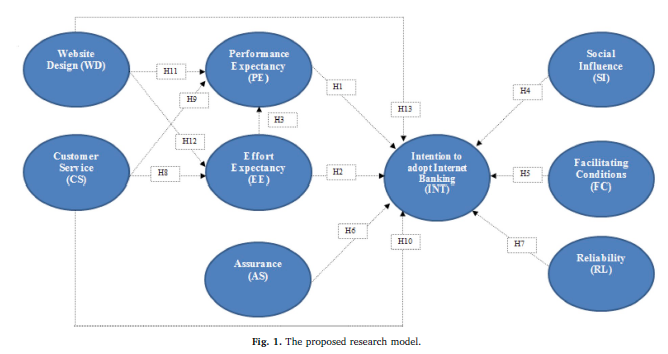
 

Rahi, S., Ghani, M., & Ngah, A. (2019). Integration of unified theory of acceptance and use of technology in internet banking adoption setting : Evidence from Pakistan. Technology in Society (58), 1-10.

Résumé :

The banking sector has evolved in information technology for their internal and external business operations. In effect, user acceptance of internet banking is considered as one of the most fundamental issue in banking sector.
In order to identify which factors affect user intention to adopt internet banking, this study develops an amalgamated model based on technology and social psychological literature. The research model was empirically tested using 398 responses from customers of commercial banks. Data was analyzed using structural equation modeling (SEM). The results of this study provided theoretical and empirical support for newly developed
integrated model. Importance performance matrix analysis (IPMA) revealed that assurance is the most influential factor among all others to determine user’s intention to adopt internet banking. These findings provide valuable insight to marketers and managers to understand customer behavior towards adoption of technology, especially in emerging e-payment domain. To the best of our knowledge, this is the first study that investigates internet banking adoption issues with integrated technology model (UTAUT & E-SQ) in South Asia.
Finally the study calls for researchers to use current integrated model in other e-commerce domains such as online shopping websites to establish the external validity of the model.


Conclusion :

The current study proposed an integrated model UTAUT & E-SQ to investigate user behaviors towards adoption of internet banking. In line with study objectives, the proposed integrated model has direct and positive impact on user intention. This study identified determinants of user beliefs in internet banking adoption context such as website design,
assurance customer service, reliability, performance expectancy, effort expectancy, social influence, and facilitating condition. The results of the structural equation modeling revealed that both website design and customer service have significant influence on performance
expectancy and effort expectancy. Previous studies have claimed that performance expectancy and effort expectancy are the most important determinants to accept internet banking. Therefore, a little has been discussed about the antecedents of performance expectancy and effort expectancy. This study has revealed that website design and customer service are the key factors that enhance users performance expectancy
and effort expectancy towards use of internet banking technology.

These findings demonstrated the success of the proposed integrated model in achieving the objectives of the current study. The findings emanating from current research suggested that there is the need for future research. First, this study integrates UTAUT model with e-service quality to understand user intention towards adoption of internet banking. Therefore, several beneficial areas remain to be explored in other online technology acceptance to investigate customer behavior in online shopping. Second, this study has used intention to adopt as dependent variable to measure the acceptance of internet banking, consistent with prior research Chaouali et al. [51]; Morosan and DeFranco [45]. Therefore, future research may be conducted with actual usage of internet banking instead of intention to adopt. Furthermore, prospect exists for future studies to examine how the newly integrated (UTAUT+E-SQ) model affect the relationship of the constructs put across in this study in other cultural settings. Thus, applying this model to other Asian countries might be interesting.

Bibliographie :

[1] H. Hoehle, E. Scornavacca, S. Huff, Three decades of research on consumer adoption
and utilization of electronic banking channels: a literature analysis, Decis.
Support Syst. 54 (1) (2012) 122–132.
[2] S. Rahi, M.A. Ghani, A structural equation modeling (SEM-AMOS) for investigating
brand loyalty and customer’s intention towards adoption of internet banking, Paper
Presented at the Economic and Social Development (Book of Proceedings), 29th
International Scientific Conference on Economic and Social, 2018.
[3] A.A. Alalwan, A.M. Baabdullah, N.P. Rana, K. Tamilmani, Y.K. Dwivedi, Examining
adoption of mobile internet in Saudi Arabia: extending TAM with perceived enjoyment,
innovativeness and trust, Technol. Soc. 55 (2018) 100–110.
[4] M. Xue, L.M. Hitt, P.-y. Chen, Determinants and outcomes of internet banking
adoption, Manag. Sci. 57 (2) (2011) 291–307.
[5] M. Wang, S. Cho, T. Denton, The impact of personalization and compatibility with
past experience on e-banking usage, Int. J. Bank Mark. 35 (1) (2017).
[6] C. Martins, T. Oliveira, A. Popovič, Understanding the Internet banking adoption: a
unified theory of acceptance and use of technology and perceived risk application,
Int. J. Inf. Manag. 34 (1) (2014) 1–13.
[7] S. Rahi, M.A. Ghani, Customer’s perception of public relation in E-commerce and its
impact on E-loyalty with brand image and switching cost, J. Internet Bank.
Commer. 21 (3) (2016).
[8] M.A. Ghani, S. Rahi, N.M. Yasin, F.M. Alnaser, Adoption of internet banking: extending
the role of technology acceptance model (TAM) with E-customer service
and customer satisfaction, World Appl. Sci. J. 35 (9) (2017) 1918–1929.
[9] S. Rahi, M.A. Ghani, Investigating the role of E-service quality and brand image in
internet banking acceptance context with structural equation modeling (SEM-PLS),
Paper Presented at the Economic and Social Development (Book of Proceedings),
30th International Scientific Conference on Economic and Social, 2018.
[10] R. Samar, M.Y. Norjaya, M.A. Feras, Measuring the role of website design, assurance,
customer service and brand image towards customer loyalty and intention to
adopt interent banking, J. Internet Bank. Commer. 22 (S8) (2017).
[11] S. Samar, M. Ghani, F. Alnaser, Predicting customer’s intentions to use internet
banking: the role of technology acceptance model (TAM) in e-banking, Manag. Sci.
Lett. 7 (11) (2017) 513–524.
[12] K. Al-Qeisi, C. Dennis, E. Alamanos, C. Jayawardhena, Website design quality and
usage behavior: unified theory of acceptance and use of technology, J. Bus. Res. 67
(11) (2014) 2282–2290.
[13] C.-M. Chiu, E.T. Wang, Understanding Web-based learning continuance intention:
the role of subjective task value, Inf. Manag. 45 (3) (2008) 194–201.
[14] J.T. Marchewka, C. Liu, K. Kostiwa, An application of the UTAUT model for understanding
student perceptions using course management software, Commun.
IIMA 7 (2) (2007) 93.
[15] T. Oliveira, M. Thomas, G. Baptista, F. Campos, Mobile payment: understanding the
determinants of customer adoption and intention to recommend the technology,
Comput. Hum. Behav. 61 (2016) 404–414.
[16] F.D. Davis, R.P. Bagozzi, P.R. Warshaw, Extrinsic and intrinsic motivation to use
computers in the workplace1, J. Appl. Soc. Psychol. 22 (14) (1992) 1111–1132.
[17] S. Taylor, P. Todd, Assessing IT usage: the role of prior experience, MIS Q. (1995)
561–570.
[18] R.L. Thompson, C.A. Higgins, J.M. Howell, Personal computing: toward a conceptual
model of utilization, MIS Q. (1991) 125–143.
[19] G.C. Moore, I. Benbasat, Integrating Diffusion of Innovations and Theory of
Reasoned Action Models to Predict Utilization of Information Technology by End-
Users Diffusion and Adoption of Information Technology, Springer, 1996, pp. 132–146.
[20] D.R. Compeau, C.A. Higgins, Computer self-efficacy: development of a measure and
initial test, MIS Q. (1995) 189–211.
[21] V. Venkatesh, M.G. Morris, G.B. Davis, F.D. Davis, User acceptance of information
technology: toward a unified view, MIS Q. (2003) 425–478.
[22] S. Rahi, M. Ghani, F. Alnaser, A. Ngah, Investigating the role of unified theory of
acceptance and use of technology (UTAUT) in internet banking adoption context,
Manag. Sci. Lett. 8 (3) (2018) 173–186.
[23] S. Rahi, M.A. Ghani, A.H. Ngah, A structural equation model for evaluating user’s
intention to adopt internet banking and intention to recommend technology,
Accounting 4 (4) (2018) 129–170, https://doi.org/10.5267/j.ac.2018.3.002.
[24] A. Alalwan, Y. Dwivedi, M. Williams, Examining factors affecting customer intention
and adoption of Internet banking in Jordan, Paper Presented at the Proceedings
of United Kingdom Academy of Information Systems UKAIS Conference, 2014.
[25] T. Zhou, Y. Lu, B. Wang, Integrating TTF and UTAUT to explain mobile banking
user adoption, Comput. Hum. Behav. 26 (4) (2010) 760–767.
[26] A. Parasuraman, V.A. Zeithaml, A. Malhotra, ES-QUAL a multiple-item scale for
assessing electronic service quality, J. Serv. Res. 7 (3) (2005) 213–233.
[27] M. Blut, E-service quality: development of a hierarchical model, J. Retail. 92 (4)
(2016) 500–517.
[28] E. Cristobal, C. Flavián, M. Guinalíu, Perceived e-service quality (PeSQ)
Measurement validation and effects on consumer satisfaction and web site loyalty,
Manag. Serv. Qual.: Int. J. 17 (3) (2007) 317–340.
[29] C.-T.B. Ho, W.-C. Lin, Measuring the service quality of internet banking: scale development
and validation, Eur. Bus. Rev. 22 (1) (2010) 5–24.
[30] S. Rahi, M. Ghani, F. Muhamad, Inspecting the role of intention to trust and online
purchase in developing countries, J. Socialomics 6 (1) (2017), https://doi.org/10.
41.72/2167-0358.1000191.
[31] S. Rahi, M.A. Ghani, F.M. Alnaser, The influence of E-customer services and perceived
value on brand loyalty of banks and internet banking adoption: a structural
equation model (SEM), J. Internet Bank. Commer. 22 (1) (2017) 1–18.
[32] M. Wolfinbarger, M.C. Gilly, eTailQ: dimensionalizing, measuring and predicting
etail quality, J. Retail. 79 (3) (2003) 183–198.
[33] B.B. Holloway, S.E. Beatty, Satisfiers and dissatisfiers in the online environment: a
critical incident assessment, J. Serv. Res. 10 (4) (2008) 347–364.
[34] A.M. Aladwani, P.C. Palvia, Developing and validating an instrument for measuring
user-perceived web quality, Inf. Manag. 39 (6) (2002) 467–476.
[35] S.J. Barnes, R.T. Vidgen, An integrative approach to the assessment of e-commerce
quality, J. Electron. Commer. Res. 3 (3) (2002) 114–127.
[36] E.T. Loiacono, R.T. Watson, D.L. Goodhue, WebQual: a measure of website quality,
Market. Theor. Appl. 13 (3) (2002) 432–438.
[37] Z. Yang, X. Fang, Online service quality dimensions and their relationships with
satisfaction: a content analysis of customer reviews of securities brokerage services,
Int. J. Serv. Ind. Manag. 15 (3) (2004) 302–326.
[38] H.H. Bauer, T. Falk, M. Hammerschmidt, eTransQual: a transaction process-based
approach for capturing service quality in online shopping, J. Bus. Res. 59 (7) (2006)
866–875.
[39] F. Alnaser, M. Ghani, S. Rahi, Service quality in Islamic banks: the role of PAKSERV
model, customer satisfaction and customer loyalty, Accounting 4 (2) (2018) 63–72.
[40] C. Liu, K.P. Arnett, Exploring the factors associated with Web site success in the
context of electronic commerce, Inf. Manag. 38 (1) (2000) 23–33.
[41] M. Long, C. McMellon, Exploring the determinants of retail service quality on the
Internet, J. Serv. Mark. 18 (1) (2004) 78–90.
[42] F. Alnaser, M. Ghani, S. Rahi, The impact of SERVQUAL model and subjective
norms on customer’s satisfaction and customer loyalty in islamic banks: a cultural
context, Int. J. Econ. Manag. Sci. 6 (5) (2017) 455.
[43] Y.-C. Shen, C.-Y. Huang, C.-H. Chu, C.-T. Hsu, A benefit–cost perspective of the
consumer adoption of the mobile banking system, Behav. Inf. Technol. 29 (5)
(2010) 497–511.
[44] J.D. Jackson, Y.Y. Mun, J.S. Park, An empirical test of three mediation models for
the relationship between personal innovativeness and user acceptance of technology,
Inf. Manag. 50 (4) (2013) 154–161.
[45] C. Morosan, A. DeFranco, It’s about time: revisiting UTAUT2 to examine consumers’
intentions to use NFC mobile payments in hotels, Int. J. Hosp. Manag. 53 (2016)
17–29.
[46] E. AbuShanab, J.M. Pearson, A.J. Setterstrom, Internet banking and customers’
acceptance in Jordan: the unified model’s perspective, Commun. Assoc. Inf. Syst. 26
(1) (2010) 23.
[47] Y.S. Foon, B.C.Y. Fah, Internet banking adoption in Kuala Lumpur: an application of
UTAUT model, Int. J. Bus. Manag. 6 (4) (2011) 161–167.
[48] F. Shahzad, G. Xiu, M. Shahbaz, Organizational culture and innovation performance
in Pakistan’s software industry, Technol. Soc. 51 (2017) 66–73.
[49] C.L. Miltgen, A. Popovič, T. Oliveira, Determinants of end-user acceptance of biometrics:
integrating the “Big 3” of technology acceptance with privacy context,
Decis. Support Syst. 56 (2013) 103–114.
[50] M. Riffai, K. Grant, D. Edgar, Big TAM in Oman: exploring the promise of on-line
banking, its adoption by customers and the challenges of banking in Oman, Int. J.
Inf. Manag. 32 (3) (2012) 239–250.
[51] W. Chaouali, I.B. Yahia, N. Souiden, The interplay of counter-conformity motivation,
social influence, and trust in customers’ intention to adopt Internet banking
services: the case of an emerging country, J. Retail. Consum. Serv. 28 (2016)
209–218.
[52] G.C. Moore, I. Benbasat, Development of an instrument to measure the perceptions
of adopting an information technology innovation, Inf. Syst. Res. 2 (3) (1991)
192–222.
[53] F. Alnaser, M. Ghani, S. Rahi, M. Mansour, H. Abed, Determinants of customer
loyalty: the role of service quality, customer satisfaction and bank image of islamic
banks in Palestine, Int. J. Econ. Manag. Sci. 6 (461) (2017) 2.
[54] M. Groß, Mobile shopping loyalty: the salient moderating role of normative and
functional compatibility beliefs, Technol. Soc. 55 (2018) 146–159.
[55] S.-J. Hong, J.Y. Thong, J.-Y. Moon, K.-Y. Tam, Understanding the behavior of
mobile data services consumers, Inf. Syst. Front. 10 (4) (2008) 431–445.
[56] F.M.I. Alnaser, M.A. Ghani, S. Rahi, M. Mansour, H. Abed, The influence of services
marketing Mix (7 Ps.) and subjective norms on customer’s satisfaction in islamic
banks of Palestine, Eur. J. Bus. Manag. 9 (27) (2017).
[57] V.A. Zeithaml, Service excellence in electronic channels, Manag. Serv. Qual.: Int. J.
12 (3) (2002) 135–139.
[58] S.I. Swaid, R.T. Wigand, Key dimensions of e-commerce service quality and its relationships
to satisfaction and loyalty, BLED 2007 Proceedings, 29 2007.
[59] S.-M. Kuoppamäki, Digital participation in service environments among senior electricity consumers in Finland, Technol. Soc. 55 (2018) 111–118.
[60] G.J. Udo, K.K. Bagchi, P.J. Kirs, An assessment of customers’e-service quality perception,
satisfaction and intention, Int. J. Inf. Manag. 30 (6) (2010) 481–492.
[61] H. Li, C. Kuo, M.G. Rusell, The impact of perceived channel utilities, shopping orientations,
and demographics on the consumer’s online buying behavior, J.
Computer-Mediated Commun. 5 (2) (1999).
[62] V. Swaminathan, E. Lepkowska-White, B.P. Rao, Browsers or buyers in cyberspace?
An investigation of factors influencing electronic exchange, J. Computer-Mediated
Commun. 5 (2) (1999) 0-0.
[63] M. Wolfinbarger, M.C. Gilly, Shopping online for freedom, control, and fun, Calif.
Manag. Rev. 43 (2) (2001) 34–55.
[64] J. Hulland, H. Baumgartner, K.M. Smith, Marketing survey research best practices:
evidence and recommendations from a review of JAMS articles, J. Acad. Mark. Sci.
(2017) 1–17.
[65] S. Rahi, Research design and methods: a systematic review of research paradigms,
sampling issues and instruments development, Int. J. Econ. Manag. Sci. 6 (2)
(2017) 1–5.
[66] J. Rowley, Designing and using research questionnaires, Manag. Res. Rev. 37 (3)
(2014) 308–330.
[67] P.M. Podsakoff, S.B. MacKenzie, J.-Y. Lee, N.P. Podsakoff, Common method biases
in behavioral research: a critical review of the literature and recommended remedies,
J. Appl. Psychol. 88 (5) (2003) 879.
[68] P.M. Podsakoff, W.H. Bommer, N.P. Podsakoff, S.B. MacKenzie, Relationships between
leader reward and punishment behavior and subordinate attitudes, perceptions,
and behaviors: a meta-analytic review of existing and new research, Organ.
Behav. Hum. Decis. Process. 99 (2) (2006) 113–142.
[69] C.M. Ringle, S. Wende, J.-M. Becker, SmartPLS 3, Boenningstedt: SmartPLS GmbH,
2015.
[70] J.F. Hair, W.C. Black, B.J. Babin, R.E. Anderson, R.L. Tatham, Multivariate Data
Analysis 7, (2010).
[71] C. Fornell, D.F. Larcker, Structural equation models with unobservable variables
and measurement error: algebra and statistics, J. Mark. Res. (1981) 382–388.
[72] W.W. Chin, Commentary: Issues and Opinion on Structural Equation Modeling,
JSTOR, 1998.
[73] J. Henseler, C.M. Ringle, R.R. Sinkovics, The Use of Partial Least Squares Path
Modeling in International Marketing New challenges to International Marketing,
Emerald Group Publishing Limited, 2009, pp. 277–319.
[74] J.F. Hair Jr., G.T.M. Hult, C. Ringle, M. Sarstedt, A Primer on Partial Least Squares
Structural Equation Modeling (PLS-SEM), Sage Publications, 2016.
[75] J. Henseler, C.M. Ringle, M. Sarstedt, A new criterion for assessing discriminant
validity in variance-based structural equation modeling, Acad. Mark. Sci. J. 43 (1)
(2015) 115.
[76] R. Kline, Principles and Practice of Structural Equation Modeling, third ed., Guilford
Press, New York, 2011.
[77] A.H. Gold, A.H.S. Arvind Malhotra, Knowledge management: an organizational
capabilities perspective, J. Manag. Inf. Syst. 18 (1) (2001) 185–214.
[78] N. Kock, G. Lynn, Lateral Collinearity and Misleading Results in Variance-Based
SEM: an Illustration and Recommendations, (2012).
[79] F. Hair Jr., M. Sarstedt, L. Hopkins, V.G. Kuppelwieser, Partial least squares
structural equation modeling (PLS-SEM) an emerging tool in business research, Eur.
Bus. Rev. 26 (2) (2014) 106–121.
[80] J. Cohen, Statistical Power Analysis for the Behavioural Sciences, Lawrence
Earlbaum Associates, Hillside. NJ, 1988.
[81] S. Rahi, M. Abd. Ghani, Does gamified elements influence on user’s intention to
adopt and intention to recommend internet banking? Int. J. Inf. Learn. Technol.
(2018), https://doi.org/10.1108/IJILT-05-2018-0045 0(0), null.
[82] S. Rahi, Moderating role of brand image with relation to internet banking and
customer loyalty: a case of branchless banking, J. Internet Bank. Commer. 20 (3)
(2015) 1.
[83] H.H. Bauer, M. Hammerschmidt, T. Falk, Measuring the quality of e-banking portals,
Int. J. Bank Mark. 23 (2) (2005) 153–175.
[84] S. Rahi, Impact of customer value, public relations perception and brand image on
customer loyalty in services sector of Pakistan, Arabian J. Bus. Manag. Rev. S 2
(2016) 2.
[85] A.G. Mazuri, R. Samar, M.Y. Norjaya, M.A. Feras, Adoption of internet banking:
extending the role of technology acceptance model (TAM) with E-customer service
and customer satisfaction, World Appl. Sci. J. 35 (9) (2017).
[87] R. Samar, A.G. Mazuri, Internet banking, customer perceived value and loyalty: the
role of switching costs, J. Account. Mark. 5 (4) (2016).
[88] R. Samar, A.G. Mazuri, Does gamified elements influence on user’s intention to
adopt internet banking with integration of UTAUT and General Self-Confidence?
Int. J. Bus. Excell. (2019), https://doi.org/10.1504/IJBEX.2019.10016706 0(0).
[89] R. Samar, A.G. Mazuri, Integration of DeLone & McLean and Self-Determination
Theory in internet banking continuance intention context, Int. J. Account. Inf.
Manag. 27 (3) (2019).

Jibril, A., Kwarteng, M., Chovancova, M., & Denayoh, R. (2019). Customer’s constraints towards online banking transaction : a literature review. Journal of Sustainable development (9), 29-43.

Résumé :

The internet and its accompanying technologies regarding the e-bank
industry’s products and services have been diversified in relations to customers’ needs
and desires. In spite of improved quality of service delivery on banker-customer
transactions facilitated by the increasing levels of adoption and use of new
technologies, important variables that inhibit customers in their quest to engage in
successful online banking transactions have been silent in the context of some
emerging economies. Against this backdrop, the focus of the study was aimed at
reviewing the antecedents and investigating the barriers of internet banking adoption
and acceptance from an emerging economy perspective. Document Analysis (DA) as a
research technique for executing the general aim of the study was employed. The study
presents and highlights the leading constraints of online banking transaction adoption,
notably; Infrastructural constraint, Behavioral Influence, Social Influence, Operating
(Transaction) Cost, Perceived Credibility, Performance Expectancy, Effort Expectancy,
and Perceived Knowledge were discovered as online banking customers’ constraints.
In theory, the study adds up to broaden the scope of internet marketing in banking
from the perspectives of consumer behaviour in online banking transactions. The
practical knowledge will help practitioners and industry players in the banking
fraternity to strategize and repose confidence in customers in their quest to engage in
online banking transactions.

Mots-clés : customer’s risk, online banking transaction, technology adoption, emerging economies

Adoption and acceptance model of Internet Banking from the Literature

Methodology : the researchers employ document analysis (DA) as the research technique.

Conceptual Framework :

Conclusion :

The study was aimed at reviewing the antecedence and barriers of internet
banking adoption and acceptance from an emerging economy’s perspective. Document
Analysis (DA) as a research technique for executing the general aim of the study was
employed. The study presents and highlights the antecedence of online banking
transaction adoption specifically infrastructural constraint, behavioral influence, social
influence, operating(transaction) cost, perceived credibility, Performance Expectancy
(PE) and perceived knowledge were discovered as online banking customers’
constraints. In theory, the study adds up to broaden the scope of internet marketing
(banking) given the interplay of consumer behavior in the online banking transaction.
The practical knowledge will help practitioners and industry players in the banking
fraternity to strategize and repose confidence in customers in their quest to engage in
online banking transactions.

Bibliographie :

Ahmad, D. T., & Hariri, M. (2012). User Acceptance of Biometrics in E-banking to improve
Security. Business Management Dynamics, 2(1), 1.
• Aliyu, A. A., Rosmain, T., & Takala, J. (2014). Online banking and customer service delivery in Malaysia: data screening and preliminary findings. Procedia-Social and Behavioral Sciences, 129, 562–570.
• Bandura, A. (1989). Human agency in social cognitive theory. American Psychologist, 44(9), 1175.
• Bandura, A. (2001). Social cognitive theory: An agentic perspective. Annual Review of
Psychology, 52(1), 1–26.
• BUZZ GHANA. Top 10 Banks in Ghana. By Chuka Obiorah https://buzzghana.com/top-10-
biggest-banks-ghana/[online] Retrieved on: 07/03/2019
• Dauda, S. Y., & Lee, J. (2015). Technology adoption: A conjoint analysis of consumers ׳
preference on future online banking services. Information Systems, 53, 1–15.
• Davis, F. D. (1993). User acceptance of information technology: system characteristics, user perceptions and behavioral impacts. International journal of man-machine studies, 38(3),
475-487.
• Davis, F. D., & Venkatesh, V. (1996). A critical assessment of potential measurement biases in the technology acceptance model: three experiments. International journal of humancomputer studies, 45(1), 19-45.
• Ernst & Young. (2011). The digitisation of everything. Retrieved from
http://www.ey.com/Publication/vwLUAssets/The_digitisation_of_everything_-
How_organisations_must_adapt_to_changing_consumer_behaviour/$FILE/EY_Digitisation_of
everything.pdf
• Fishbein, M., & Ajzen, I. (1975). Intention and Behavior: An introduction to theory and
research.
• Fishbein, M., Jaccard, J., Davidson, A. R., Ajzen, I., & Loken, B. (1980). Predicting and
understanding family planning behaviors. In Understanding attitudes and predicting social
behavior. Prentice Hall.
• Fusilier, M., & Durlabhji, S. (2005). An exploration of student internet use in India: the
technology acceptance model and the theory of planned behaviour. Campus-Wide Information Systems, 22(4), 233–246.
• Hamid, M. R. A., Amin, H., Lada, S., & Ahmad, N. (2007). A comparative analysis of Internet banking in Malaysia and Thailand. Journal of Internet Business, (4).
• Hanafizadeh, P., Keating, B. W., & Khedmatgozar, H. R. (2014). A systematic review of Internet banking adoption. Telematics and Informatics, 31(3), 492–510.
• Igbaria, M., Parasuraman, S., & Baroudi, J. J. (1996). A motivational model of microcomputer usage. Journal of Management Information Systems, 13(1), 127–143.
• Im, I., Hong, S., & Kang, M. S. (2011). An international comparison of technology adoption:
Testing the UTAUT model. Information & Management, 48(1), 1–8.
• Kesharwani, A., & Singh Bisht, S. (2012). The impact of trust and perceived risk on internet
banking adoption in India: An extension of technology acceptance model. International
Journal of Bank Marketing, 30(4), 303–322.
• Legris, P., Ingham, J., & Collerette, P. (2003). Why do people use information technology? A critical review of the technology acceptance model. Information & Management, 40(3), 191–
204.
• Liska, A. E. (1984). A critical examination of the causal structure of the Fishbein/Ajzen
attitude-behavior model. Social Psychology Quarterly, 61–74.
• López-Nicolás, C., Molina-Castillo, F. J., & Bouwman, H. (2008). An assessment of advanced mobile services acceptance: Contributions from TAM and diffusion theory models.
Information & Management, 45(6), 359–364.
• Martins, C., Oliveira, T., & Popovič, A. (2014). Understanding the Internet banking adoption: A unified theory of acceptance and use of technology and perceived risk application.
International Journal of Information Management, 34(1), 1–13.
• Mathieson, K. (1991). Predicting user intentions: comparing the technology acceptance model with the theory of planned behavior. Information Systems Research, 2(3), 173–191.
JOURNAL OF SUSTAINABLE DEVELOPMENT, VOL. 9, ISSUE 23 (2019), 29-43
UDC: 336.71:004.738.5]:366.1
43
• Miltgen, C. L., Popovič, A., & Oliveira, T. (2013). Determinants of end-user acceptance of
biometrics: Integrating the “Big 3” of technology acceptance with privacy context. Decision
Support Systems, 56, 103–114.
• Norman, P., & Smith, L. (1995). The theory of planned behaviour and exercise: An
investigation into the role of prior behaviour, behavioural intentions and attitude variability.
European Journal of Social Psychology, 25(4), 403–415.
• Norton, J. A., & Bass, F. M. (1987). A diffusion theory model of adoption and substitution for successive generations of high-technology products. Management Science, 33(9), 1069–1086.
• Saleem, A., & Higuchi, K. (2014). Globalization and ICT innovation policy: Absorption capacity in developing countries. 16th International Conference on Advanced Communication
Technology, 409–417. IEEE.
• Sarver, V. T. (1983). Ajzen and Fishbein’s” theory of reasoned action”: A critical assessment.
• Sathye, M. (1999). Adoption of Internet banking by Australian consumers: an empirical
investigation. International Journal of Bank Marketing, 17(7), 324–334.
• Shankar, V., & Meyer, J. (2009). The internet and international marketing. In The SAGE
Handbook of International Marketing. https://doi.org/10.4135/9780857021007.n23
• Shankar, V., Smith, A. K., & Rangaswamy, A. (2003). Customer satisfaction and loyalty in online and offline environments. International Journal of Research in Marketing, 20(2), 153–175.
• Sin Tan, K., Choy Chong, S., Lin, B., & Cyril Eze, U. (2009). Internet-based ICT adoption:
evidence from Malaysian SMEs. Industrial Management & Data Systems, 109(2), 224–244.
• Sin Tan, K., Choy Chong, S., Lin, B., & Cyril Eze, U. (2010). Internet-based ICT adoption among SMEs: Demographic versus benefits, barriers, and adoption intention. Journal of Enterprise
Information Management, 23(1), 27–55.
• Sohail, M. S., & Shanmugham, B. (2003). E-banking and customer preferences in Malaysia: An empirical investigation. Information Sciences, 150(3–4), 207–217.
• Stafford, T. F., Stafford, M. R., & Schkade, L. L. (2004). Determining uses and gratifications for the Internet. Decision Sciences, 35(2), 259–288.
• Tan, K. S., & Eze, U. C. (2008). An empirical study of internet-based ICT adoption among
Malaysian SMEs. Communications of the IBIMA, 1(1), 1–12.
• Thambiah, S., Eze, U. C., Tan, K. S., Nathan, R. J., & Lai, K. P. (2010). Conceptual framework for the adoption of Islamic retail banking services in Malaysia. Journal of Electronic Banking
Systems, 2010(1), 1–10.
• Venkatesh, V., & Davis, F. D. (2000). A theoretical extension of the technology acceptance
model: Four longitudinal field studies. Management science, 46(2), 186-204.
• Venkatesh, V., & Zhang, X. (2010). Unified theory of acceptance and use of technology: US vs. China. Journal of Global Information Technology Management, 13(1), 5–27.
• Venkatesh, V., Morris, M. G., Davis, G. B., & Davis, F. D. (2003). User acceptance of information technology: Toward a unified view. MIS Quarterly, 425–478.
• Williams, M. D., Rana, N. P., & Dwivedi, Y. K. (2015). The unified theory of acceptance and use of technology (UTAUT): a literature review. Journal of Enterprise Information Management,
28(3), 443-488.
• Williams, R. L., & Cothrel, J. (2000). Four smart ways to run online communities. MIT Sloan Management Review, 41(4), 81.
• Yiu, C. S., Grant, K., & Edgar, D. (2007). Factors affecting the adoption of Internet Banking in Hong Kong—implications for the banking sector. International Journal of Information
Management, 27(5), 336–351.
• Yu, C.-S. (2012). Factors affecting individuals to adopt mobile banking: Empirical evidence
from the UTAUT model. Journal of Electronic Commerce Research, 13(2), 104.
• Zhu, D. H., & Chang, Y. P. (2014). Investigating consumer attitude and intention toward free trials of technology-based services. Computers in Human Behavior, 30, 328–334.