Wu, M., Jayawardhena, C., & Hamilton, R. (2014). A comprehensive examination of internet banking user behavious : evidence from customers yet to adopt, currently using and stopped using. Journal of Marketing Management (30), 1006-1038.

Résumé :

Despite the surge in interest in research on customers’ adoption of
internet banking (IB), how discontinued users can be brought back to IB has not
received much attention. To respond to this question and to provide a
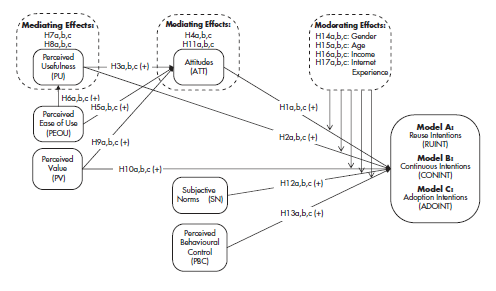
comprehensive understanding of IB customer behaviour, we develop a
conceptual model grounded on the extended technology acceptance model, and
empirically validate it using a sample of 614 IB customers (including those yet to
adopt, current users and discontinued users) from China. Perceived value is the
most important driver for explaining all categories of customers’ IB-related
behaviours. Banks that implement measures that aim to increase the perceived
usefulness of IB and enhance the value of IB are likely to be rewarded with
increasing IB adoption amongst its customer base.

Mots-clés : Internet banking behavious, deiscontinued users, technology acceptance model

Model conceptuel :
Méthodologie de recherche :

Data, using questionnaires, was collected for the three different categories of IB users
from urban Chinese bank customers who are also users of the Internet.

Data was analysed using the Partial Least Squares (PLS) approach for structural
equation modelling.

Bibliographie :

Abu-Shanab, E. (2013). Income divide: A determinant of technology acceptance. International
Arab Journal of e-Technology, 3, 121–127. Retrieved from http://www.iajet.org/iajet_files/vol.3/
no.2/Income%20Divide_%20a%20Determinant%20of%20Technology%20Acceptance.pdf
Abushanab, E., & Pearson, J. M. (2007). Internet banking in Jordan: The unified theory of
acceptance and use of technology (UTAUT) perspective. Journal of Systems and Information
Technology, 9, 78–97. doi:10.1108/13287260710817700
Ajzen, I. (1985). From intentions to actions: A theory of planned behavior. In J. Kuhl & J.
Beckmann (Eds.), Action control: From cognition to behavior (pp. 11–35). Berlin: Springer-
Verlag.
Ajzen, I. (1988). Attitudes, personality, and behavior. Milton Keynes: Open University Press.
Alsajjan, B., & Dennis, C. (2010). Internet banking acceptance model: Cross-market
examination. Journal of Business Research, 63, 957–963. doi:10.1016/j.jbusres.2008.12.014
Al-Smadi, M. O. (2012). Factors affecting adoption of electronic banking: An analysis of the
perspectives of banks’ customers. International Journal of Business and Social Science, 3,
294–309. Retrieved from http://connection.ebscohost.com/c/articles/87607373/factorsaffecting-
adoption-electronic-banking-analysis-perspectives-banks-customers
Al-Somali, S. A., Gholami, R., & Clegg, B. (2009). An investigation into the acceptance of
online banking in Saudi Arabia. Technovation, 29, 130–141. doi:10.1016/j.
technovation.2008.07.004
Wu et al. A comprehensive examination of internet banking user behaviour 1029
Analysys International. (2010). The centralization of China online banking market is increased,
ICBC and CBC occupy 59% in Q1, 2010. Retrieved from http://english.analysys.com.cn/
article.php?aid=90903
Baumgartner, H., & Homburg, C. (1996). Applications of structural equation modeling in
marketing and consumer research: A review. International Journal of Research in Marketing,
13, 139–161. doi:10.1016/0167-8116(95)00038-0
Benbasat, I., & Barki, H. (2007). Quo Vadis, TAM? Journal of the Association for Information
Systems, 8, 211–218. Retrieved from http://aisel.aisnet.org/jais/vol8/iss4/16
Çelik, H. (2008). What determines Turkish customers’ acceptance of internet banking?
International Journal of Bank Marketing, 26, 353–370. doi:10.1108/02652320810894406
Chan, R. Y., & Lau, L. (1998). A test of the Fishbein-Ajzen behavioral intentions model under
Chinese cultural settings: Are there any differences between PRC and Hong Kong
consumers? Journal of Marketing Practice: Applied Marketing Science, 4, 85–101.
doi:10.1108/EUM0000000004490
Chan, S., & Lu, M. (2004). Understanding internet banking adoption and use behavior: A
Hong Kong perspective. Journal of Global Information Management, 12, 21–43.
doi:10.4018/jgim.2004070102
Chang, H. H., & Wang, H. (2011). The moderating effect of customer perceived value on
online shopping behaviour. Online Information Review, 35(3), 333–359. doi:10.1108/
14684521111151414
Chau, V. S., & Ngai, L. W. L. C. (2010). The youth market for internet banking services:
Perceptions, attitude and behaviour. Journal of Services Marketing, 24(1), 42–60.
doi:10.1108/08876041011017880
Cheng, T. C. E., Lam, D. Y. C., & Yeung, A. C. L. (2006). Adoption of internet banking: An
empirical study in Hong Kong. Decision Support Systems, 42, 1558–1572. doi:10.1016/j.
dss.2006.01.002
Chin, W. W. (1998). The partial least squares approach to structural equation modeling. In A.
M. George (Eds.), Modern methods for business research (pp. 295–336). Mahwah, NJ:
Lawrence Erlbaum Associates.
Chin, W. W. (2010). How to write up and report PLS analyses. In V. E. Vinzi, W. W. Chin, J.
Henseler, & H. Wand (Eds.), Handbook of partial least square: Concepts, methods and
applications (pp. 655–689). Berlin: Springer.
China Financial Certification Authority [CFCA]. (2013). 2013 Report on electronic banking in
China. Beijing: Author.
China Internet Network Information Centre [CNNIC]. (2013). Statistical report on internet
development in China. Retrieved from http://www1.cnnic.cn/IDR/ReportDownloads/
201302/P020130221391269963814.pdf
Chong, A. Y., Ooi, K., Lin, B., & Tan, B. (2010). Online banking adoption: An empirical
analysis. International Journal of Bank Marketing, 28, 267–287. doi:10.1108/
02652321011054963
Cronin Jr., J. J., Brady, M. K., Brand, R. R., Hightower Jr., R., & Shemwell, D. J. (1997). A
cross-sectional test of the effect and conceptualization of service value. Journal of Services
Marketing, 11, 375–391. doi:10.1108/08876049710187482
Davies, H., Leung, T. K., Luk, S. T. K., & Wong, Y. (1995). The benefits of ‘Guanxi’: The value
of relationships in developing the Chinese market. Industrial Marketing Management, 24(3),
207–214. doi:10.1016/0019-8501(94)00079-C
Davis, F. D. (1989). Perceived usefulness, perceived ease of use, and user acceptance of
information technology. MIS Quarterly, 13, 319–340. doi:10.2307/249008
Davis, F. D. (1993). User acceptance of information technology: System characteristics, user
perceptions and behavioral impacts. International Journal of Man-Machine Studies, 38,
475–487. doi:10.1006/imms.1993.1022
1030 Journal of Marketing Management, Volume 30
Davis, F. D., Bagozzi, R. P., & Warshaw, P. R. (1989). User acceptance of computer technology:
A comparison of two theoretical models. Management Science, 35, 982–1003. doi:10.1287/
mnsc.35.8.982
Dean, D. H. (2008). Shopper age and the use of self-service technologies. Managing Service
Quality, 18, 225–238. doi:10.1108/09604520810871856
Deng, Z., Lu, Y., Wei, K. K., & Zhang, J. (2010). Understanding customer satisfaction and
loyalty: An empirical study of mobile instant messages in China. International Journal of
Information Management, 30, 289–300. doi:10.1016/j.ijinfomgt.2009.10.001
Dodds, W. B., Monroe, K. B., & Grewal, D. (1991). Effects of price, brand, and store
information on buyers’ product evaluations. Journal of Marketing Research, 28, 307–319.
doi:10.2307/3172866
Eggert, A., & Ulaga, W. (2002). Customer perceived value: A substitute for satisfaction in
business markets? Journal of Business & Industrial Marketing, 17, 107–118. doi:10.1108/
08858620210419754
Eriksson, K., Kerem, K., & Nilsson, D. (2005). Customer acceptance of internet banking in
Estonia. International Journal of Bank Marketing, 23, 200–216. doi:10.1108/
02652320510584412
Eriksson, K., Kerem, K., & Nilsson, D. (2008). The adoption of commercial innovations in
the former central and eastern European markets: The case of internet banking in Estonia.
International Journal of Bank Marketing, 26, 154–169. doi:10.1108/
02652320810864634
Eriksson, K., & Nilsson, D. (2007). Determinants of the continued use of self-service
technology: The case of internet banking. Technovation, 27, 159–167. doi:10.1016/j.
technovation.2006.11.001
Fishbein, M., & Ajzen, I. (1975). Belief, attitude, intention, and behavior: An introduction to
theory and research. Boston, MA: Addison-Wesley.
Flavián, C., Guinalíu, M., & Torres, E. (2006). How bricks-and-mortar attributes affect online
banking adoption. International Journal of Bank Marketing, 24, 406–423. doi:10.1108/
02652320610701735
Fornell, C., & Bookstein, F. L. (1982). Two structural equation models: LISREL and PLS
applied to consumer exit-voice theory. Journal of Marketing Research, 19, 440–452.
doi:10.2307/3151718
Froehle, C. M., & Roth, A. V. (2004). New measurement scales for evaluating perceptions of
the technology-mediated customer service experience. Journal of Operations Management,
22, 1–21. doi:10.1016/j.jom.2003.12.004
Gallarza, M. G., & Saura, I. G. (2006). Value dimensions, perceived value, satisfaction and
loyalty: An investigation of university students’ travel behaviour. Tourism Management, 27,
437–452. doi:10.1016/j.tourman.2004.12.002
Gefen, D. (2003). TAM or just plain habit: A look at experienced online shoppers. Journal of
Organizational and End User Computing, 15(3), 1–13. doi:10.4018/joeuc.2003070101
Geisser, S. (1974). A predictive approach to the random effect model. Biometrika, 61,
101–107. doi:10.1093/biomet/61.1.101
Gerrard, P., Cunningham, J. B., & Devlin, J. F. (2006). Why consumers are not using internet
banking: A qualitative study. Journal of Services Marketing, 20, 160–168. doi:10.1108/
08876040610665616
Henseler, J., Ringle, C. M., & Sinkovices, R. R. (2009). The use of partial least squares path
modeling in international marketing. Advances in International Marketing, 20, 277–319.
doi:10.1108/S1474-7979(2009)0000020014
Hernandez, J. M., & Mazzon, J. A. (2007). Adoption of internet banking: Proposition and
implementation of an integrated methodology approach. International Journal of Bank
Marketing, 25, 72–88. doi:10.1108/02652320710728410
Wu et al. A comprehensive examination of internet banking user behaviour 1031
Hitt, L. M., Xue, M., & Chen, P. (2007). The determinants and outcomes of internet banking
adoption. MSI Working Paper Series, (4), 99–122. Retrieved from http://www.msi.org/
reports/the-determinants-and-outcomes-of-internet-banking-adoption/
Hofstede, G. (2001). Culture’s consequences: Comparing values, behaviors, institutions, and
organizations across nations. Thousand Oaks, CA: Sage.
Hua, G. (2009). An experimental investigation of online banking adoption in China. Journal of
Internet Banking and Commerce, 14(1), 1–12. Retrieved from http://aisel.aisnet.org/
amcis2008/36/
iResearch. (2013). 2012–2013 Annual report on internet banking in China. Retrieved from
http://report.iresearch.cn/1987.html
Jackson, C. M., Chowand, S., & Leitch, R. A. (1997). Toward an understanding of the
behavioral intention to use an information system. Decision Sciences, 28, 357–389.
doi:10.1111/j.1540-5915.1997.tb01315.x
Karjaluoto, H., Mattila, M., & Pento, T. (2002). Factors underlying attitude formation towards
online banking in Finland. International Journal of Bank Marketing, 20, 261–272.
doi:10.1108/02652320210446724
Kim, H. W., Chan, H. C., & Gupta, S. (2007). Value-based adoption of mobile internet: An
empirical investigation. Decision Support Systems, 43, 111–126. doi:10.1016/j.
dss.2005.05.009
Koenig-Lewis, N., Palmer, A., & Moll, A. (2010). Predicting young consumers’ take up of
mobile banking services. International Journal of Bank Marketing, 28, 410–432.
doi:10.1108/02652321011064917
Kolodinsky, J. M., Hogarth, J. M., & Hilgert, M. A. (2004). The adoption of electronic
banking technologies by US consumers. International Journal of Bank Marketing, 22,
238–259. doi:10.1108/02652320410542536
Konus, U., Verhoef, P. C., & Neslin, S. A. (2008). Multichannel shopper segments and their
covariates. Journal of Retailing, 84(4), 398–413. doi:10.1016/j.jretai.2008.09.002
Laforet, S., & Li, X. (2005). Consumers’ attitudes towards online and mobile banking in
China. International Journal of Bank Marketing, 23, 362–380. doi:10.1108/
02652320510629250
Ledden, L., Kalafatis, S. P., & Samouel, P. (2007). The relationship between personal values and
perceived value of education. Journal of Business Research, 60, 965–974. doi:10.1016/j.
jbusres.2007.01.021
Lee, M. (2009). Factors influencing the adoption of internet banking: An integration of TAM
and TPB with perceived risk and perceived benefit. Electronic Commerce Research and
Applications, 8, 130–141. doi:10.1016/j.elerap.2008.11.006
Levy, J. A. (1988). Intersections of gender and aging. The Sociological Quarterly, 29, 479–486.
doi:10.1111/j.1533-8525.1988.tb01429.x
Lewis, B. R., & Soureli, M. (2006). The antecedents of consumer loyalty in retail banking.
Journal of Consumer Behaviour, 5, 15–31. doi:10.1002/cb.46
Li, D., Browne, G. J., & Chau, P. Y. K. (2006). An empirical investigation of web site use using
a commitment-based model. Decision Sciences, 37, 427–444. doi:10.1111/j.1540-
5414.2006.00133.x
Liang, H., Saraf, N., Hu, Q., & Xue, Y. (2007). Assimilation of enterprise systems: The effect
of institutional pressures and the mediating role of top management. MIS Quarterly, 31(1),
59–87. Retrieved from http://misq.org/assimilation-of-enterprise-systems-the-effect-ofinstitutional-
pressures-and-the-mediating-role-of-top-management.html
Lu, J., Yao, J. E., & Yu, C. (2005). Personal innovativeness, social influences and adoption of
wireless internet services via mobile technology. The Journal of Strategic Information
Systems, 14, 245–268. doi:10.1016/j.jsis.2005.07.003
1032 Journal of Marketing Management, Volume 30
Luarn, P., & Lin, H. (2005). Toward an understanding of the behavioral intention to use
mobile banking. Computers in Human Behavior, 21, 873–891. doi:10.1016/j.
chb.2004.03.003
Nilsson, D. (2007). A cross-cultural comparison of self-service technology use. European
Journal of Marketing, 41(3/4), 367–381. doi:10.1108/03090560710728381
Park, J., Yang, S., & Lehto, X. (2007). Adoption of mobile technologies for Chinese
consumers. Journal of Electronic Commerce Research, 8, 196–206. Retrieved from http://
www.csulb.edu/journals/jecr/issues/20073/Paper3.pdf
Parthasarathy, M., & Bhattacherjee, A. (1998). Understanding post-adoption behavior in the
context of online services. Information Systems Research, 9, 362–379. doi:10.1287/
isre.9.4.362
Peak, H. (1955). Attitude and motivation. In M. R. Jones (Ed.), Nebraska sympos on
motivation (pp. 149–188). Lincoln, NE: University of Nebraska Press.
Podsakoff, P. M., Mackenzie, S. B., Lee, R. H., & Podsakoff, R. (2003). Common method
biases in behavioral research: A critical review of the literature and recommended remedies.
Journal of Applied Psychology, 88, 879–903. doi:10.1037/0021-9010.88.5.879
Podsakoff, P. M., & Organ, D. W. (1986). Self-reports in organizational research: Problems and
prospects. Journal of Management, 12, 531–544. doi:10.1177/014920638601200408
Ringle, C. M., Wende, S., & Will, A. (2005). SmartPLS (2.0 beta). Retrieved from http://
smartpls.de
Riquelme, H. E., & Rios, R. E. (2010). The moderating effect of gender in the adoption of
mobile banking. International Journal of Bank Marketing, 28, 328–341. doi:10.1108/
02652321011064872
Rosenberg, M. J. (1956). Cognitive structure and attitudinal affect. The Journal of Abnormal
and Social Psychology, 53, 367–372. doi:10.1037/h0044579
Safeena, R., Date, H., Hundewale, N., & Kammani, A. (2013). Combination of TAM and TPB
in internet banking adoption. International Journal of Computer Theory and Engineering, 5,
146–150. doi:10.7763/IJCTE.2013.V5.665
Salisbury, W. D., Pearson, R. A., Pearson, A. W., & Miller, D. W. (2001). Perceived security and
world wide web purchase intention. Industrial Management & Data Systems, 101, 165-177 doi:10.1108/02635570110390071
Sawyer, A. G., Worthing, P. M., & Sendak, P. E. (1979). The role of laboratory experiments to
test marketing strategies. Journal of Marketing, 43(3), 60. doi:10.2307/1250147
Sheth, J. N., Newman, B. I., & Gross, B. L. (1991). Consumption values and market choices:
Theory and applications. Cincinnati, OH: South-Western Publishing.
Shih, Y., & Fang, K. (2004). The use of a decomposed theory of planned behavior to study
internet banking in Taiwan. Internet Research, 14, 213–223. doi:10.1108/
10662240410542643
Simon, F., & Usunier, J. (2007). Cognitive, demographic, and situational determinants of
service customer preference for personnel-in-contact over self-service technology.
International Journal of Research in Marketing, 24, 163–173. doi:10.1016/j.
ijresmar.2006.11.004
Sirdeshmukh, D., Singh, J., & Sabol, B. (2002). Consumer trust, value, and loyalty in relational
exchanges. Journal of Marketing, 66(1), 15–37. doi:10.1509/jmkg.66.1.15.18449
Spiller, J., Vlasic, A., & Yetton, P. (2007). Post-adoption behavior of users of internet service
providers. Information & Management, 44, 513–523. doi:10.1016/j.im.2007.01.003
Stone, M. (1974). Cross-validatory choice and assessment of statistical predictions. Journal of
the Royal Statistical Society, 36, 111–147. Retrieved from http://www.stat.washington.edu/
~ebfox/courses/stat527/s13/readings/Stone1974.pdf
Wu et al. A comprehensive examination of internet banking user behaviour 1033
Suh, B., & Han, I. (2002). Effect of trust on customer acceptance of internet banking.
Electronic Commerce Research and Applications, 1, 247–263. doi:10.1016/S1567-4223
(02)00017-0
Swanson, E. B. (1982). Measuring user attitudes in MIS research: A review. The International
Journal of Management Science, 10, 157–165. doi:10.1016/0305-0483(82)90050-0
Taylor, S., & Todd, P. (1995a). Assessing IT usage: The role of prior experience. MIS Quarterly,
19, 561–570. doi:10.2307/249633
Taylor, S., & Todd, P. (1995b). Decomposition and crossover effects in the theory of planned
behavior: A study of consumer adoption intentions. International Journal of Research in
Marketing, 12, 137–155. doi:10.1016/0167-8116(94)00019-k
Taylor, S., & Todd, P. (1995c). Understanding information technology usage: A test of
competing models. Information Systems Research, 6, 144–176. doi:10.1287/isre.6.2.144
Thaler, R. (1985). Mental accounting and consumer choice. Marketing Science, 4, 199–214.
doi:10.1287/mksc.4.3.199
Venkatesh, V., & Davis, F. D. (2000). A theoretical extension of the technology acceptance
model: Four longitudinal field studies. Management Science, 46, 186–204. doi:10.1287/
mnsc.46.2.186.11926
Vroom, V. H. (1964). Work and motivation. New York, NY: Wiley.
Wan, W. W. N., Luk, C. L., & Chow, C. W. C. (2005). Customers’ adoption of banking
channels in Hong Kong. The International Journal of Bank Marketing, 23, 255–272.
doi:10.1108/02652320510591711
Wang, H., & Yang, H. (2006). Do personality traits affect the acceptance of e-finance?
International Journal of Electronic Finance, 1, 200–221. doi:10.1504/IJEF.2006.010316
Wessels, L., & Drennan, J. (2010). An investigation of consumer acceptance of M-banking.
International Journal of Bank Marketing, 28, 547–568. doi:10.1108/02652321011085194
Yoon, H. S., & Steege, L. M. B. (2013). Development of a quantitative model of the impact of
customers’ personality and perceptions on internet banking use. Computers in Human
Behavior, 29, 1133–1141. doi:10.1016/j.chb.2012.10.005
Yousafzai, S., & Yani-de-Soriano, M. (2012). Understanding customer-specific factors
underpinning internet banking adoption. International Journal of Bank Marketing, 30(1),
60–81. doi:10.1108/02652321211195703
Zeithaml, V. A. (1988). Consumer perceptions of price, quality, and value: A means-end model
and synthesis of evidence. Journal of Marketing, 52(3), 2–22. doi:10.2307/1251446
Zhao, A. L., Hanmer-Lloyd, S., Ward, P., & Goode, M. M. H. (2008). Perceived risk and
Chinese consumers’ internet banking services adoption. International Journal of Bank
Marketing, 26, 505–525. doi:10.1108/02652320810913864
Zhao, A. L., Koenig-Lewis, N., Hanmer-Lloyd, S., & Ward, P. (2010). Adoption of internet
banking services in China: Is it all about trust? International Journal of Bank Marketing, 28,
7–26. doi:10.1108/02652321011013562
Zhu, J. J. H., & He, Z. (2002). Perceived characteristics, perceived needs, and perceived
popularity: Adoption and use of the internet in China. Communication Research, 29,
466–495. doi:10.1177/0093650202029004005
Illia, A., Ngniatedema, T., & Huang, Z. (2015). A conseptual model for mobile banking adoption. Journal of Management Information and Decision Sciences (18), 111-122.

Résumé :

Despite the steady growth of Internet banking and mobile banking, only half of adults in the U.S.
use online banking, with the other half still visiting physical branches for their banking services
(Fox, 2013). For years, studies are being conducted in the IS field using the Technology
Acceptance Model (TAM) in order to determine the key factors explaining the adoption of online
banking. But, due to the privacy concerns and the psychological barriers often associated with
conducting transactions in a virtual world, the TAM has proven to be a limited tool. In this study,
we revisited the IS literature on mobile banking adoption along with relevant theories from the
areas of marketing and psychology in order to develop a conceptual model that would have a
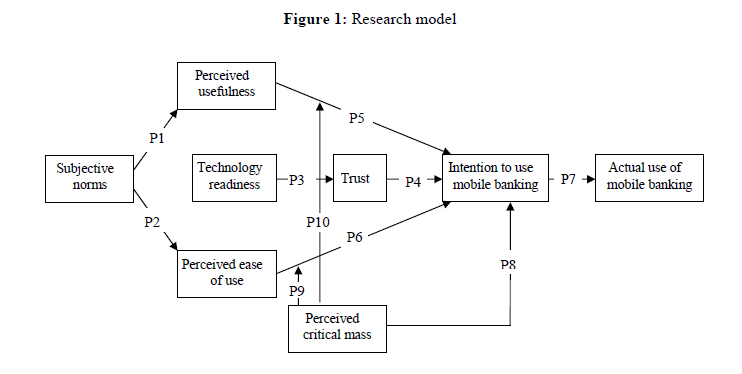
potentially greater explanation power. The proposed model emphasizes the role of subjective
norms, technological readiness, trust, and perceived critical mass of users. The model is
discussed along with the research propositions it implies. The theoretical and practical
implications of the study are also discussed.

Mots-clés : mobile banking, technology adoption, technology readiness, perceived critical mass

A noter : l’article présente le modèle conceptuel suivant mais ne présente pas de méthodologie de recherche.

Bibliographie :

Ajzen, I. (1991). The theory of planned behavior. Organizational behavior and human decision
processes, 50(2), 179-211.
Amin, H. (2007). Internet banking adoption among young intellectuals. Journal of Internet
Banking & Commerce, 12(3), 1-13.
Ayers, D. J., Menachemi, N., Ramamonjiarivelo, Z., Matthews, M., & Brooks, R. G. (2009).
Adoption of electronic medical records: The role of network effects. Journal of Product
& Brand Management, 18(2), 127–135. doi:10.1108/10610420910949022
Barki, H., & Hartwick, J. (1994). Measuring user participation, user involvement, and user
attitude. MIS Quarterly, 18(1), 59-82. doi:10.2307/249610
Chiou, J. -S., & Shen, C. -C. (2012). The antecedents of online financial service adoption: The
impact of physical banking services on Internet banking acceptance. Behaviour and
Information Technology, 31(9), 859-871. doi:10.1080/0144929X.2010.549509
Cho, H. (2011). Theoretical intersections among social influences, beliefs, and intentions in the
context of 3G mobile services in Singapore: Decomposing perceived critical mass and
subjective norms. Journal of Communication, 61(2), 283-306.
Davis, F. D. (1989). Perceived usefulness, perceived ease of use, and user acceptance of
information technology. MIS quarterly, 13(3), 319-340.
Doney, P. M., & Cannon , J. P. (1997). An examination of the nature of trust in buyer-seller
relationships. Journal of Marketing, 61(2), 35-51.
Elliott, K. M., Meng, J., & Hall, M. C. (2008). Technology readiness and the likelihood to use
self-service technology: Chinese vs. American consumers. Marketing Management
Journal, 18(2), 20-31.
Fishbein, M., & Ajzen, I. (1975). Belief, attitude, intention and behavior: An introduction to
theory and research. Reading, Mass. : Addison-Wesley Pub. Co.
Fox, S. (2013, August 7). 51% of U.S. Adults Bank Online. Retrieved from Pew Research Center:
http://www.pewinternet.org/2013/08/07/51-of-u-s-adults-bank-online/
Grabner-Kraeuter, S. (2002). The role of consumers’ trust in online-shopping. Journal of
Business Ethics, 39(1-2), 43-50.
Griskevicius, V., Goldstein, N. J., Mortensen, C. R., Cialdini, R. B., & Kenrick, D. T. (2006).
Going along versus going alone: When fundamental motives facilitate strategic (non)
conformity. Journal of personality and social psychology, 91(2), 281-294.
Homburg, C., Wieseke, J., & Kuehnl, C. (2010). Social influence on salespeople’s adoption of
sales technology: A multilevel analysis. Journal of the Academy of Marketing Science,
38(2), 159-168. doi:10.1007/s11747-009-0157-x
Karahanna, E., & Straub, D. W. (1999). The psychological origins of perceived usefulness and
ease-of-use. Information & Management, 35(4), 237-250.
Kesharwani, A., & Bisht, S. S. (2012). The impact of trust and perceived risk on internet banking
adoption in India: An extension of technology acceptance model. International Journal of
Bank Marketing, 30(4), 303–322. doi:10.1108/02652321211236923
Kraut, R., Patterson, M., Lundmark, V., Kiesler, S., Mukophadhyay, T., & Scherlis, W. (1998).
Internet paradox: A social technology that reduces social involvement and psychological
well-being? American Psychologist, 53(9), 1017–1031. doi:10.1037/0003-
066x.53.9.1017
Journal of Management Information and Decision Sciences Volume 18, Number 1, 2015
120
Legris, J. Ingham, P. Collerette (2003). Why do people use information technology? A critical
review of the technology acceptance model, Information & Management, 40, 191–204
Lou, H., Luo, W., & Strong, D. (2000). Perceived critical mass effect on groupware acceptance.
European Journal of Information Systems, 9(2), 91-103.
doi:10.1057/palgrave.ejis.3000358
Mayer, R. C., Davis, J. H., & Schoorman, F. D. (1995). An integrative model of organizational
trust. Academy of Management Review, 20(3), 709-734.
McKechnie, S., Winklhofer, H., & Ennew, C. (2006). Applying the technology acceptance.
International Journal of Retail & Distribution Management, 34(4), 388–410.
doi:10.1108/09590550610660297
Mustonen-Ollila, E., & Lyytinen, K. (2003). Why organizations adopt information system
process innovations: A longitudinal study using Diffusion of Innovation theory.
Information Systems Journal, 13(3), 275-297. doi:10.1046/j.1365-2575.2003.00141.x
Parasuraman, A. (2000). Technology Readiness Index (TRI): A multiple-item scale to measure
readiness to embrace new technologies. Journal of Service Research, 2(4), 307–320.
doi:10.1177/109467050024001
Roca, J. C., García, J. J., & de la Vega, J. J. (2009). The importance of perceived trust, security
and privacy in online trading systems. Information Management & Computer Security,
17(2), 96-113. doi:10.1108/09685220910963983
Rogers, E. M. (1995). Diffusion of innovations (4th ed.). New York: Free Press.
Schmitz, J., & Fulk, J. (1991). Organizational colleagues, media richness, and electronic mail: A
test of the social influence model of technology use. Communication Research, 18(4),
487–523. doi:10.1177/009365091018004003
Shen, Y. C., Huang, C. -Y., Chu, C. -H., & Hsu, C. -T. (2010). A benefit–cost perspective of the
consumer adoption of the mobile banking system. A benefit–cost perspective of the
consumer adoption of the mobile banking system, 29(5), 497–511.
doi:10.1080/01449290903490658
Singer, D. D., Baradwaj, B. G., Flaherty, S., & Rugemer, F. (2012). The frequency and intensity
of experience in online banking use. Journal of Internet Banking & Commerce, 17(1), 1-
22.
Sledgianowski, D., & Kulviwat, S. (2009). Using social network sites: The effects of playfulness,
critical mass and trust in a hedonic context. Journal of Computer Information Systems,
49(4), 74-83.
Strader, T. J., Ramaswami, S. N., & Houle, P. A. (2007). Perceived network externalities and
communication technology acceptance. European Journal of Information Systems, 16(1),
54–65. doi:10.1057/palgrave.ejis.3000657
Teo, T. (2010). A path analysis of pre-service teachers’ attitudes to computer use: Applying and
extending the technology acceptance model in an educational context. Interactive
Learning Environments, 18(1), 65-79. doi:10.1080/10494820802231327
Vatanasombut, B., Igbaria, M., Stylianou, A. C., & Rodgers, W. (2008). Information systems
continuance intention of web-based applications customers: The case of online banking.
Information & Management, 45(7), 419–428. doi:10.1016/j.im.2008.03.005
Venkatesh, V., & Davis, F. D. (2000). A theoretical extension of the technology acceptance
model: Four longitudinal field studies. Management science, 46(2), 186-204.
doi:10.1287/mnsc.46.2.186.11926
Journal of Management Information and Decision Sciences Volume 18, Number 1, 2015
121
Wang, S. W., Hsu, M. K., Pelton, L. E., & Xi, D. (2014). Virtually compatible or risky business?
Investigating consumers’ proclivity toward online banking services. Journal of Marketing
Channels, 21(1), 43–58. doi:10.1080/1046669x.2013.832466
Wang, Y. -S., Wang, Y. -M., Lin, H. -H., & Tang, T. -T. (2003). Determinants of user
acceptance of Internet banking: An empirical study. International Journal of Service
Industry Management, 14(5), 501–519. doi:10.1108/09564230310500192
Yu, C. (2012). Factors affecting individuals to adop mobile banking: empirical evidence from the
UTAUT model. Journal of Electronic Commerce Research, 3(2), 104-121.
Zhu, J. H., & He, Z. (2002). Perceived characteristics, perceived needs, and perceived popularity:
Adoption and use of the Internet in China. Communication Research, 29(4), 466–495.
doi:10.1177/0093650202029004005
Journal of Management Information and Decision Sciences Volume 18, Number 1, 2015
122

Helna, P., Noufal, K., & Fasna, P. (2017). A study on satisfaction of banking customers towards online services. International Journal of Research in Commerce & Management, (8), 77-79.

Résumé :

As everything turns to its online format the service sector was also forced to render their services through online. The prime service sector called banking sector had
no other way but to go with these waves. The very busy world have no time to keep their money safe or to keep look on through. So the banks run behind their
customers through internet to serve them. But the customers being king of the market, always need more from their service provider to serve them. The study
reveals the association of various dimensions of online service quality towards satisfaction of the online banking customers. A sample of thirty has taken for the
study. The sample was operationally defined as those who regularly use online banking services. Structured questionnaire was used to collect the primary data. The
satisfaction was measured in relation to the following dimensions of online service quality: Efficiency, Assurance, Privacy, Contact and aesthetic code. The results
reveals that the online banking customers are satisfied with the services rendered. An interaction through this online methods could help to improve the e-CRM
which would be the most innovative way to keep in touch with customers and thus maintaining them.

Mots-clés : customer relationship management (CRM), banking customers, online services

Méthodologie de recherche :

Echelle de Lickert en 5 points. Données collectées depuis dessources primaires avec des questionnaires structurés. Les interrogés sont tous clients de banques en ligne. LE questionnaire est basé sur le modèle E-SQ (mesure de la qualité de service).

Conclusion :

In the highly competitive market, the customers may move from one bank to the other. So the online banking service providers were very particular in their
customer satisfaction. The study figures out the satisfaction of online banking services with the help of modified E-SQ model which have clubbed the dimensions
of E- SERVQUAL developed by Parasuraman. All the five dimensions have a mean score of more than 3, which reveals the satisfaction of online banking customers.
The least scored dimension was ‘contact’, which measured whether there was availability of customer representatives and the ability to redress the transaction
problems. The service providers can make available a representative online. All other variables scored above the average and we can conclude that the online
banking services provided were satisfied. Still, the banks can update the latest technology in electronic banking services. This would ultimately help the banks to
build e CRM which can emerge as the best way to maintain relationship with the customers.

Bibliographie :

  1. Dr. Preeti Singh, (August 2013), An Exploratory study on internet banking usage in semi urban areas in India, International Journal of Scientific and Research
    Publications, Volume 3, Issue 8.
  1. Mohd Shoki Md Ariff, Leong Ooi Yun, Norhayati Zakuan (2012), Ahmad Jusoh, Examining the dimensions of Electronic Service Quality for Internet Banking
    Services, Procedia- Social Behavioural Sciences. Volume 65, 3 December.
  2. Pallab Sikdar, Munish Makkad, Internet Banking in India – A perspective on Benefits and Challenges involved. International Journal of Engineering, Business
    and Enterprise Applications.
  3. Simon Gyasi Nimako, Nana Kwame Gyamfi, Abdil Mumuni Moro Wandaogou (2013), Customer Satisfaction With Internet Banking Service Quality In The
    Ghanaian Banking Industry, International Journal Of Scientific & Technology Research Volume 2, Issue 7.

Social Networks and Restaurant Ratings.

Tiwari, Ashutosh; Richards, Timothy J. (2016), Social Networks and Restaurant Ratings, Agribusiness, Vol. 32 Issue 2, p153-174.  

Mots clés : Social networks ; Consumer preferences; Corporate ratings; Commercial and Institutional Building Construction; Full-Service Restaurants; Other Individual and Family Services; Restaurant reviews; Peer pressure

Dans cet article il est question de comprendre quel élément influence un étudiant dans le choix d’un restaurant en y étudiant l’impact d’un avis de l’entourage versus l’avis d’un anonyme sur les réseaux sociaux.

  • En premier lieu, nous analyserons quels éléments viennent influencer le choix d’un restaurant chez un groupe d’étudiants.
  • Nous soulignerons ensuite comment cette influence s’explique.

Développement :

Selon, Tiwari, Ashutosh; Richards, Timothy J., il y a 2 catégories d’interactions sur les réseaux sociaux, le réseau constitué de proches et de personnes que l’on connaît ainsi que les amis d’amis aux 3ème et 4ème degré, et le réseau composé d’inconnus, tel que les influenceurs par exemple. Les deux se distinguent et ont des avantages, le premier offrant une fiabilité plus importante du fait de connaître les personnes partageant leurs avis, l’autre donnant une plus grande variété de choix et la possibilité d’élargir le spectre d’adresse. Il a été comparé également les avis positifs et négatifs dans les 2 cas.

Il a été étudié et comparé les effets des 2 groupes et une donnée a été prouvée, c’est l’impact d’un avis négatif, qui est beaucoup plus impactant et significatif pour l’utilisateur, que l’avis positif à un effet positif dans le choix du restaurant mais un avis négatif pèsera davantage sur la balance. L’effet « viral » que prend l’information sur les réseaux sociaux joue grandement sur la réputation d’un restaurant, et peut l’impacter négativement. En effet, une note négative va beaucoup plus décider du retour du consommateur dans le restaurant qu’une note positive.

Mais il y a aspect qui est difficilement remplaçable, c’est l’effet popularité du restaurant et l’attraction de la foule autour du lieu qui joue un rôle plus important que le réseau virtuel.  

Conclusion :

Les réseaux sociaux peuvent influencer grandement les choix d’un utilisateur en fonction de nombreux mécanismes.

2 groupes ont été comparés, les proches et les avis d’anonymes, avec des variantes d’avis positifs comme négatifs.

Ce qui en a été conclu, c’est qu’un avis d’un proche à 3 fois plus d’impact qu’un avis d’une personne lambda, et que l’avis négatif aura un impact d’autant plus important qu’un commentaire élogieux. Cependant, lorsque le groupe de proches est trop peu nombreux, il a été observé qu’il est difficile d’exercer une réelle influence sur un réseau social à cause du nombre limité de personnes.

Dans le même esprit, une campagne marketing menée avec peu de personne mais très bien ciblée aura plus de chances de toucher son public qu’une campagne large publique comme ont à l’habitude de le voir.

Références bibliographiques

  • Berger, J., Meredith, M., & Wheeler, S. C. (2008). Contextual priming: Where people vote affects how they vote. Proceedings of the National Academy of Sciences, USA, 105, 8846–8849. Bhatnagar, A., & Ghose, S. (2004).
  •  Online information search termination patterns across product categories and consumer demographics. Journal of Retailing, 80, 221–228. Bramoull´e, Y., Djebbari, H., & Fortin, B. (2009). Identification of peer effects through social networks. Journal of Econometrics, 150, 41–55. Brock, W. A., & Durlauf, S. N. (2002). A multinomial-choice model of neighborhood effects. American Economic Review, 92, 298–303. Brock, W. A., & Durlauf, S. N. (2007).
  • Identification of binary choice models with social interactions. Journal of Econometrics, 140, 52–75. Buda, R., & Zhang, Y. (2000). Consumer product evaluation: The interactive effect of message framing, presentation order, and source credibility. Journal of Product and Brand Management, 9, 229–242. Buttle,F.A.(1998).
  • Wordofmouth:Understandingandmanagingreferralmarketing.JournalofStrategicMarketing, 6, 241–254. Cai, H., Chen, Y., & Fang, H. (2007).Observational learning: Evidence from a randomized natural field experiment. (No. w13516). National Bureau of Economic
  • Research. Cheung, C. M., & Lee, M. K. (2012). What drives consumers to spread electronic word of mouth in online consumeropinion platforms. Decision Support Systems, 53, 218–225. Chevalier, J., & D. Mayzlin. (2006).
  • The effect of word of mouth on sales: Online book reviews. Journal of Marketing Research, 43, 345–354. Dawes,J.G.(2008).Dodatacharacteristicschangeaccordingtothenumberofscalepointsused?Anexperimentusing 5 point, 7 point and 10 point scales. International Journal of Market Research, 51, 61–77. De Bruyn, A., & Lilien, G. L. (2008).

A multi-stage model of word-of-mouth influence through viral marketing. International Journal of Research in Marketing, 25, 151–163. Dierkes, T., Bichler, M., & Krishnan, R. (2011).

Networks of Desire: How Technology Increases Our Passion to Consume.

Kozinets Robert, Patterson Anthony et Ashman Rachel, (2017). Networks of Desire : How Technology Increases Our Passion to Consume.

 Journal of Consumer Research. Vol. 43 Issue 5, p659-682. 24p.

Mot clés : Research ; Consumer behavior ; Capitalism ; Internet & society ; Desire ; Technology Psychological aspects ; Psychology

Les auteurs démontrent ici comment le « foodporn » est devenu une véritable tendance poussée grâce à des réseaux tels que Instagram, Facebook ou encore Pinterest. Cette habitude désormais inscrite chez la majorité des personnes, et non plus seulement les plus jeunes, pousse les utilisateurs à consommer davantage en étant constamment confronté à la vue de nourriture sur les réseaux sociaux. Il est aussi étudié la réaction des personnes qui font face à des images de nourriture, ainsi que leur action après avoir vu ces dernières.

  • En premier lieu, nous analyserons comment ces images de nourritures forment un réseau de désir et quelle réaction cela engendre
  • Nous soulignerons ensuite en quelques lignes comment les restaurateurs s’adaptent à cette tendance

Développement :

Selon Kozinets Robert, Patterson Anthony et Ashman Rachel, la consommation de nourriture n’est pas un thème intéressant non seulement pour les chercheurs en consommation mais aussi pour les anthropologistes et autres terrains de recherche par exemple. La représentation de la nourriture est une notion assez ancienne, on remonte sa trace dès la période de la Renaissance. Cela reflète assez bien déjà les habitudes d’aujourd’hui, celles d’être constamment entouré d’images de plats ou aliments.   

Le désir est quant à lui profondément lié à la consommation, c’est ce qui fait que le consommateur va continuellement alimenter l’économie en voulant assouvir ses envies.

C’est ce qui s’observe également avec la nourriture, l’effet de voir constamment des photos d’aliments crée et alimente le désir de ceux qui sont derrière leurs écrans. En effet, la digitalisation connaît un nouveau niveau de désir et il y une adaptation aux écrans qui font évoluer les désirs et pulsions des utilisateurs.

Une étude réalisée en Australie révèle que la moitié des photos prises par les Australiens sont des photos de nourriture et le 3ème type de photo la plus commune sur les réseaux sociaux. Plus de 130 millions de photos ont été taguées avec le #food et 54 millions de photos sur Instagram portent la mention #foodporn. 90 nouvelles photos hashtaguées foodporn sont téléchargées sur le réseau toutes les minutes.

Ces partages alimentent le réseau du désir, avec 3 types de réseau différents comme le réseau le plus intime et fermé, à savoir le cercle familial et amical, où l’on partage ses photos de plats ou de préparations de plats à sa famille et ses amis sur différents réseaux sociaux. La seconde catégorie est le réseau public, où on partagera ses photos à une audience qui va au-delà du cercle intime fermé. Elle est composée d’inconnus qui ont aussi une appétence pour la nourriture sur les réseaux. Il peut s’agir de profils très variés, allant du gourmet plus orienté sur l’expérience et la qualité au profil plus intéressé par les fast-foods ou les pâtisseries. 

La 3ème catégorie est plus orientée pour les professionnels du secteur, avec des photos partagées sur les blogs, les chaînes Youtube ou les microblogs sur Instagram. Il peut s’agir de partage de recettes, de vidéos de préparations de plats ou de conseils donnés par des professionnels.

L’une des choses que l’on entend à plusieurs reprises que l’un des problèmes liés à la participation au réseau de partage de photos sur l’alimentation est qu’elle a tendance à devenir dévorante ou à créer une dépendance. Le site et les autres membres du réseau vous offrent des récompenses séduisantes d’attention et de statut. L’écran vous appelle constamment.

Cette obsession, les restaurateurs l’ont bien compris, ils ont alors adapté progressivement leurs plats pour les rendre les plus visuels et photographiable possible, ou en exacerbant le côté foodporn de leurs produits pour rendre leurs photos plus « sexy ». Pour encore une fois assouvir le désir de voir des images débordantes de gourmandises des consommateurs.

Avec le monde connecté actuel, ce désir est constamment alimenté avec la collection de data qui permet d’offrir au consommateur des images qui lui correspondent, de lui proposer encore plus d’images et donc de provoquer davantage cette pulsion de consommation.

Références bibliographiques :

  • Belk, Russell W. (1988), “Possessions and the Extended Self,” Journal of Consumer Research, 15 (2), 139–68.
  • (2013), “Extended Self in a Digital World,” Journal of Consumer Research, 40 (October), 477–500.
  • Belk, Russell W., Gu¨liz Ger, and Søren Askegaard (2000), “The Missing Streetcar Named Desire,” in The Why of Consumption: Contemporary Perspectives on Consumer Motives, Goals, and Desires, ed. S. “Ratti” Ratneshwar, David Glen Mick, and Cynthia Huffman, London: Routledge, 98–119.
  • (2003), “The Fire of Desire: A Multi-Sited Inquiry into Consumer Passion,” Journal of Consumer Research, 30 (December), 311–25.
  • Belk, Russell W., Melanie Wallendorf, and John F. Sherry Jr. (1989), “The Sacred and Profane in Consumer Behavior: Theodicy on the Odyssey,” Journal of Consumer Research, 16 (1), 1–38.
  • Bendiner, Kenneth (2004), Food in Painting: From the Renaissance to the Present, London: Reaktion Books.
  • Benjamin, Walter (1936/1968), “The Work of Art in the Age of Mechanical Reproduction,” in Illuminations: Essays and Reflections, ed. Hannah Arendt, trans. Harry Zohn, New York: Schocken, 219–53.
  • Berger, Arthur Asa (2010), The Objects of Affection: Semiotics and Consumer Culture, New York: Palgrave Macmillan.
  • Bettany, Shona (2007), “The Material Semiotics of Consumption or Where (and What) Are the Objects in Consumer Culture Theory?” in Consumer Culture Theory Research in Consumer Behavior, Volume 11, ed.
  • Russell W. Belk and John F. Sherry, Bingley, UK: Emerald Group Publishing Limited, 41–56.
  • Brown, Stephen, Robert V. Kozinets, and John F. Sherry Jr. (2003), “Teaching Old Brands New Tricks: Retro Branding and the Revival of Brand Meaning,” Journal of Marketing, 67 (3), 19–33.
  • Canniford, Robin and Domen Bajde (2015), Assembling Consumption: Researching Actors, Networks, and Markets, London: Routledge.
  • Cockburn, Alexander (1977), “Gastro-Porn,” The New York Review, December 8, http://www.nybooks.com/articles/ archives/1977/dec/08/gastro-porn/.
  • Cova, Bernard and Daniele Dalli (2009), “Working Consumers: The Next Step in Marketing Theory?” Marketing Theory, 9 (September), 315–39.
  • Dean, Jodi (2001), “Feminism in Technoculture,” The Review of Education/Pedagogy/Cultural Studies, 23 (1), 23–47.
  • Deleuze, Gilles and Felix Guattari (1983), Anti-Oedipus: Capitalism and Schizophrenia, Minneapolis: University of Minnesota Press.

Marketing through Instagram influencers: The impact of the number of followers and product divergence on brand attitude

Marijke De Veirman,Veroline Cauberghe &Liselot Hudders (2017), Marketing through Instagram influencers : The impact of the number of followers and product divergence on brand attitude, International Journal of Advertising, 798-828

Mot-clé : E-WOM, influencer marketingInstagram, social influence, social media marketing.

Marijke De Veirma, Veroline Cauberghe et Liselot Hudders démontrent comment le nombre de followers joue un rôle sur le choix de l’influenceur par une marque.

La notion de brand attitude est également explorée, expliquant qu’un influenceur avec de nombreux abonnés n’est pas forcément le choix le plus adapté pour une marque car cela affectera son unicité et donc l’image globale de la marque. Il est aussi décrypté la perception qu’ont les « followee » (personnes que l’influenceur suit) d’un influenceur.

  • En premier lieu, nous analyserons comment l’audience d’un influenceur peut altérer la perception qu’ont les followers de ce dernier.
  • Nous soulignerons ensuite en quelques lignes l’impact que peut avoir l’audience d’un influenceur dans le choix des marques et l’effet d’unicité que peut avoir le produit.

Développement :

Selon Marijke De Veirma, Veroline Cauberghe et Liselot Hudders, l’interaction entre un abonné et son influenceur est influencée en partie par le nombre d’abonnés que ce dernier compte.  

Plus il comptera d’abonnés plus il génèrera de la confiance et une estime supérieure du fait de son nombre important d’abonnés.

Toutefois, toujours selon Marijke De Veirma, Veroline Cauberghe et Liselot Hudders, « les abonnés ne voient pas systématiquement pas un influenceur comme un opinion leader ».

Le type de produit mis en avant peut jouer un rôle dans cette confiance du follower à l’influenceur mais cela reste un facteur important déterminant le type d’audience auquel il va s’adresser.

Un autre facteur peut inverser la tendance, si l’influenceur suit très peu de compte et a très peu d’abonnements, une relation négative peut s’installer entre le follower et le followee.

Il est observé que les femmes auront beaucoup plus tendance à réagir ainsi, celles-ci étant plus sensible au ratio followers/followee de l’influenceur.

Les auteures ont observé qu’un tweet positif d’une célébrité avec un nombre élevé d’abonnés génèrent plus d’achats et d’intérêt de l’audience qu’une célébrité avec un nombre d’abonnés moins important.

Les auteures ont émis 2 différentes hypothèses expliquant les raisons de ce comportement :

H3 : Les produits au design divergent évoquent des attitudes plus élevées à l’égard de la marque par rapport aux produits au design standard.

H4 : L’effet positif de la divergence des produits sur l’attitude à l’égard de la marque est atténué par la perception de l’unicité de la marque.

En effet, si le produit est posté par un influenceur ayant un nombre élevé d’adeptes, cela pourrait déclencher la théorie naïve de la popularité et des pensées selon lesquelles le produit est plutôt commun au lieu d’être unique. Dans ce cas, l’unicité du produit est remise en cause car beaucoup de personnes pourraient l’acheter également. Par conséquent, il est attendu à ce que la relation positive entre la divergence du produit et l’attitude envers la marque à travers la perception de l’unicité de la marque soit affaiblie lorsque le produit est affiché par un influenceur ayant un très grand nombre de followers.

Conclusion :

Il est observé ici que l’audience de l’influenceur joue un rôle non négligeable dans la perception, la crédibilité et le degré d’affection de l’adepte à l’influenceur. Plus un influenceur comptera des abonnées plus il construira une audience qui lui accorde une crédibilité supérieure qu’un influenceur ayant un plus faible nombre d’abonnés.

Il a été montré aussi que le followee aura une perception différente d’un produit en fonction de la personne qui le mettra en avant. 

Le repérage marketing des influenceurs dans les réseaux sociaux.

Vernette, Eric, Tlssier-Desbordes, Elisabeth (2012), Le repérage marketing des influenceurs dans les réseaux sociaux, Decisions Marketing, Issue 67

Mot-clé : Klout Score, marketing influencer, Instagram, social influence, social media marketing, Pareto Law.

Vernette, Eric, Tlssier-Desbordes, Elisabeth démontrent comment la présence d’une personne sur les réseaux sociaux peut déterminer son statut social.

La notion de leader d’opinion est explorée, expliquant qu’une personne ayant une forte présence sur les réseaux sociaux, avec de nombreux abonnés, sera beaucoup plus avantagée par ses pairs et sa prise de parole prendra du sens pour ses followers.

L’indice Klout est également décrypté, en expliquant son impact sur la perception de la performance d’une personne sur les réseaux sociaux.

  • En premier lieu, nous analyserons comment l’opinion d’une personne est mesurée en fonction de sa présence sur les réseaux sociaux.
  • Nous soulignerons ensuite en quelques lignes l’impact que ce résultat peut avoir dans le repérage de ces derniers par les grandes marques.

Développement :

Selon Vernette, Eric, Tlssier-Desbordes, Elisabeth, l’indice Klout est une donnée qui permet aux marques de mesurer le taux d’influence, à travers 35 variables réparties en 3 catégories : l’audience engagée, qui définiet le nombre d’abonnés, « l’échos » du message, c’est-à-dire l’ampleur de la propagation du message peut avoir dans l’entourage du follower, et enfin l’amplitude, à savoir son audience totale une fois prise en compte la présence sur l’ensemble des réseaux sociaux.

Cet outil est contesté, car sa fiabilité a été remise en cause certaines fois, jusqu’à disparaître en 2018 car jugé trop volatile. Il est intéressant aussi de voir l’évolution de ces outils se concentrent aujourd’hui pour chaque réseau social plutôt que tous les réseaux sociaux. Chaque réseau nécessitant d’être pointu pour vraiment y être performant.

Toutefois, toujours selon Marijke De Veirma, Veroline Cauberghe et Liselot Hudders, « les abonnés ne voient pas systématiquement pas un influenceur comme un opinion leader ».

Il faudrait voir

Conclusion :

Il est observé ici que l’audience de l’influenceur joue un rôle non négligeable dans la perception, la crédibilité et le degré d’affection de l’adepte à l’influenceur. Plus un influenceur comptera des abonnées plus il construira une audience qui lui accorde une crédibilité supérieure qu’un influenceur ayant un plus faible nombre d’abonnés.

Il a été montré aussi que l’audience de l’influenceur dans le monde professionnel joue aujourd’hui un rôle clé et garantie à l’audience la valeur de ses opinions.

Enablers for end-user entrepreneurship: An investigation on Italian food bloggers.

Cuomo, Maria Teresa ; Tortora, Debora ; Festa, Giuseppe ; Giordano, Alex ; Metallo, Gerardino (2017) Enablers for end-user entrepreneurship : An investigation on Italian food bloggers. Psychology & Marketing. Vol. 34 Issue 12, p1109-1118.

Mot clés : Entrepreneurship ; Value creation ; Internet Publishing and Broadcasting and Web Search Portals ; Bloggers ; Virtual communities ; Blogs

Développement :

La nourriture est un sujet particulièrement populaire sur les blogs. D’un point de vue fonctionnel et culturel, l’alimentation a une place de choix dans la vie des gens ainsi que le partage de l’alimentation qui est au cœur de la culture de la plupart des populations dans le monde. Les livres de cuisine, les émissions de télévision et les sites web sur l’alimentation contribuent à façonner l’identité des gens.

Ainsi, écrire sur la nourriture ou faire partie d’une communauté de gastronomes donne aux gens un sentiment de place, d’appartenance et d’accomplissement dans un environnement confortable, authentique et stimulant (Mohsen, 2017). L’univers de la cuisine est une source de créativité extrêmement dynamique pour les blogueurs de nourriture et leurs communautés, qui peuvent ainsi interpréter le sujet de manière innovante. Les blogs et les réseaux sociaux représentent une plate-forme de marketing fructueux où les blogueurs alimentaires peuvent interagir avec leurs adeptes (Rousseau, 2012).

Cette étude vise à démontrer comment les interactions entre les blogueurs et leurs communautés peuvent conduire ces derniers vers l’entreprenariat accidentel et comment ils arrivent à monétiser ce qui n’était qu’au départ qu’une passion. 

Les auteurs ont émis 1 hypothèse expliquant les raisons de cette évolution :

  1. L’interaction entre les bloggeurs culinaire et leurs communautés affecte le désir de générer un revenu de cet échange, grâce à un cercle vertueux basé sur des interactions collectives de passion, d’expérience, de partage

Ils ont procédé à une analyse des commentaires des personnes les plus influentes dans le domaine gastronomique en Italie en catégorisant les commentaires émotionnels (passion), les commentaires fournissant des informations (partage), les commentaires recevant des informations (partage), et les commentaires ou observations (partage). Le sentiment a été divisé en commentaires positifs, négatifs et neutres (expérience). 

Les faits suggèrent que les interactions entre les blogueurs et leurs communautés (en termes de passion, d’expérience et de partage) encouragent les blogueurs à lancer le processus entrepreneurial.

Les études ont montré que les blogueurs alimentaires italiens génèrent près de 3 millions d’euros (en ne considérant que la publicité sur le web) grâce à plus de 15 millions d’interactions en ligne et 240 000 messages.

Cet échange vertueux entre la personne suivie et l’abonné génère une interaction émotionnelle que les acteurs traditionnels n’ont pas, provoquant ainsi une concurrence dans le milieu en amenant une nouvelle forme de communication ciblée pour chaque communauté.

On comprend aussi qu’une personne est motivée à suivre un compte car cela lui apporte une connaissance supplémentaire et leur permet d’intégrer une communauté.

Conclusion :

Avec le cercle virtuel fondé sur la passion, l’expérience et le partage et ancré dans la connaissance, l’innovation, le jugement et la prise de décision, la principale contribution théorique de cette étude est la catégorisation de trois principaux types d’utilisateurs, de blogueurs et d’entrepreneurs : amusants (basés sur le plaisir), fonctionnels (basés sur la pratique) et fervents (basés sur la croyance), c’est-à-dire susceptibles d’être motivés).

La valeur du sens de la communauté peut notamment être exprimée non seulement en termes d’information et de connaissance (actifs rationnels), mais aussi en termes d’implication et de confiance (actifs émotionnels). Si les blogueurs et les adeptes interagissent, travaillent et s’entraident, le partage de la passion et de l’expérience est susceptible d’être activé.

La principale contribution de cet article concerne le renforcement du processus entrepreneurial de l’utilisateur final en termes de motivation collective pour la création d’une nouvelle entreprise (dans ce cas, un blog) fondée sur la passion, l’expérience et le partage. Il s’agit d’une approche axée sur les aspects rationnels (c’est-à-dire les informations et les connaissances générées par les interactions sur le blog), mais il faut également tenir compte de la perspective émotionnelle (par exemple, l’implication et la confiance générées par les interactions sur le blog). Comme toute autre entreprise, ces entreprises dynamiques seront inévitablement confrontées aux défis du marché. Ainsi, la gestion et la gouvernance de l’entrepreneuriat (alimentaire) de blog devraient constituer le point de départ de futures recherches.

How the Coronavirus Will Change the Way We Buy Cars.

Auteur: Elliott Hannah pour Bloomberg magazine

Mots clés: Covid 19; Consumer behaviour, online purchase

A travers cet article de bloomberg , l’auteur se pose la question si la pajnhdémlie a modifié le processus d’achat classique d’une voiture et à ainsi augmenté le processus d’achat en ligne.
Pour ce faire l’auteur est aller à la rencontre de professionnels, des experts de sociétés de recherche, de concessionnaires automobiles et des experts de Bloomberg auto motive Intelligence.

Dans cet article une question nous intéresse particulièrement

Qu’en est-il des ventes en ligne ? Celles-ci vont-elles augmenter ?

Selon les experts , les ventes en ligne de voituresz ont augmenté en 2019 mais les ventes de voitures en ligne représentaient 10 à 15 % du marché automobile américain, selon le cabinet d’études Autopia. Cependant, l’achat d’une voiture en ligne ne sera pas le premier choix de la plupart des acheteurs de voitures, même après Covid-19.

D’aprés le concessionnaire M Tynan , Les concessionnaires sont susceptibles de mettre à jour et d’améliorer leurs sites web. Et ils répondront probablement plus rapidement aux demandes de renseignements envoyées par mail. Mais le prix moyen d’une voiture neuve est de 35 000 dollars, et de 21 000 dollars pour une voiture d’occasion. Il s’agit toujours d’un des plus gros montants dans une vie . Pour la plupart des gens, il est “nconcevable d’acheter quelque chose de cette valeur sans l’avoir vu au préalable,

Il explique aussi que le e-commerce va augmenter, mais il augmentait de toute façon”, dit-il, ajoutant que cela a aussi à voir avec l’obtention de la meilleure affaire possible, ce qui est moins probable via une transaction impersonnelle en ligne. (Les ventes en ligne représentaient moins de 10 % du total des ventes de voitures nationales il y a seulement trois ans). “Il se peut que nous fassions d’autres recherches en ligne d’abord, mais aucun concessionnaire ne vous donnera sa meilleure offre par e-mail. Je ne pense pas que cela se produira”.

Conclusion

Cet article nous prouve que malgré la pandémie et les mesures de distanciations sociales existantes, on observe une augmentation peu importante du commerce en ligne sur le marché automobile américain du à une l’urgence d’obtenir un véhicule sans pouvoir se rendre en concession. Le consommateur n’est visiblement pas prêt à obtenir un véhicule sans se rendre en concession et l’avoir vu et sans l’avoir négocié en face à face avec le vendeur.
Cependant les consommateurs peuvent tirer profit de cette situation en faisant plus de recherches en ligne et faire des achats croisés sur différentes concessions pour être pleinement informer des véhicules et des meilleurs offres pour ainsi être plus performant dans la phase de négociation avec le vendeur.

Buy a car online? Not me

Auteurs: Teahen Jr, John K

Teahen Jr, John K. (2008, 4 février). Buy a car online ? Not me. Automotive News, 1

Mots clés: Online shopping, automobile industry, internet, e commerce, automobile purchasing

Dans cet article, les auteurs présentent un certain point de vue sur l’achat d’une automobile sur Internet. Ils disent que lorsqu’il s’agit d’acheter une voiture, la méthode classique, c’est à dire se rendre en concession est plus agréable. Les auteurs affirment que lorsque le client veut acheter une voiture, il veut la sentir, s’asseoir dedans, la toucher, la tester, discuter de son achat avec une autre personne et tout cela est impossible à travers un ordianteur